


UNDERSTANDING GOOGLE ADS COST PER CLICK: WHAT YOU ACTUALLY PAY
Adwords cost per click is the amount you pay each time someone clicks on your ad in Google’s search or display network. Here’s what you need to know:
- Average CPC across industries: $5.26 on Search Network, under $1.00 on Display Network
- What you actually pay: Often less than your maximum bid, based on competitor Ad Rank and your Quality Score
- Formula: Actual CPC = (Ad Rank of advertiser below you ÷ Your Quality Score) + $0.01
- Range: From $0.11 for low-competition keywords to $137+ for highly competitive industries like legal services
- Monthly budgets: Most small to mid-sized businesses spend $1,000-$10,000
The confusion around Google Ads costs stems from a simple truth: there’s no fixed price. Your actual cost per click changes with every auction, influenced by your industry, keywords, Quality Score, and dozens of competitors bidding at the same time.
This dynamic pricing model means you’re not just competing with your wallet — you’re competing with the quality and relevance of your ads. A small business with a tight budget and high-quality ads can often outperform a larger competitor with deep pockets but poor ad relevance. The key is understanding how Google calculates your costs and knowing which levers to pull to lower them.
I’m Magee Clegg, founder of Cleartail Marketing, and I’ve managed millions in Google Ads spend for 90+ B2B clients since 2014, helping them understand and optimize their adwords cost per click to achieve returns like 5,000% ROI on campaigns. In this guide, I’ll break down exactly how CPC works, what you should expect to pay, and proven strategies to lower your costs without sacrificing results.
The Google Ads Auction: How Your Actual CPC is Calculated
At its core, Google Ads operates on a lightning-fast, real-time auction system. Every time someone types a search query into Google or visits a website on the Display Network, an auction takes place to determine which ads appear and in what order. This auction is also where your adwords cost per click is decided.
The ads aren’t just placed by who bids the highest. Google prioritizes user experience, so relevance and quality play a massive role. This is where the concept of “Ad Rank” comes in.
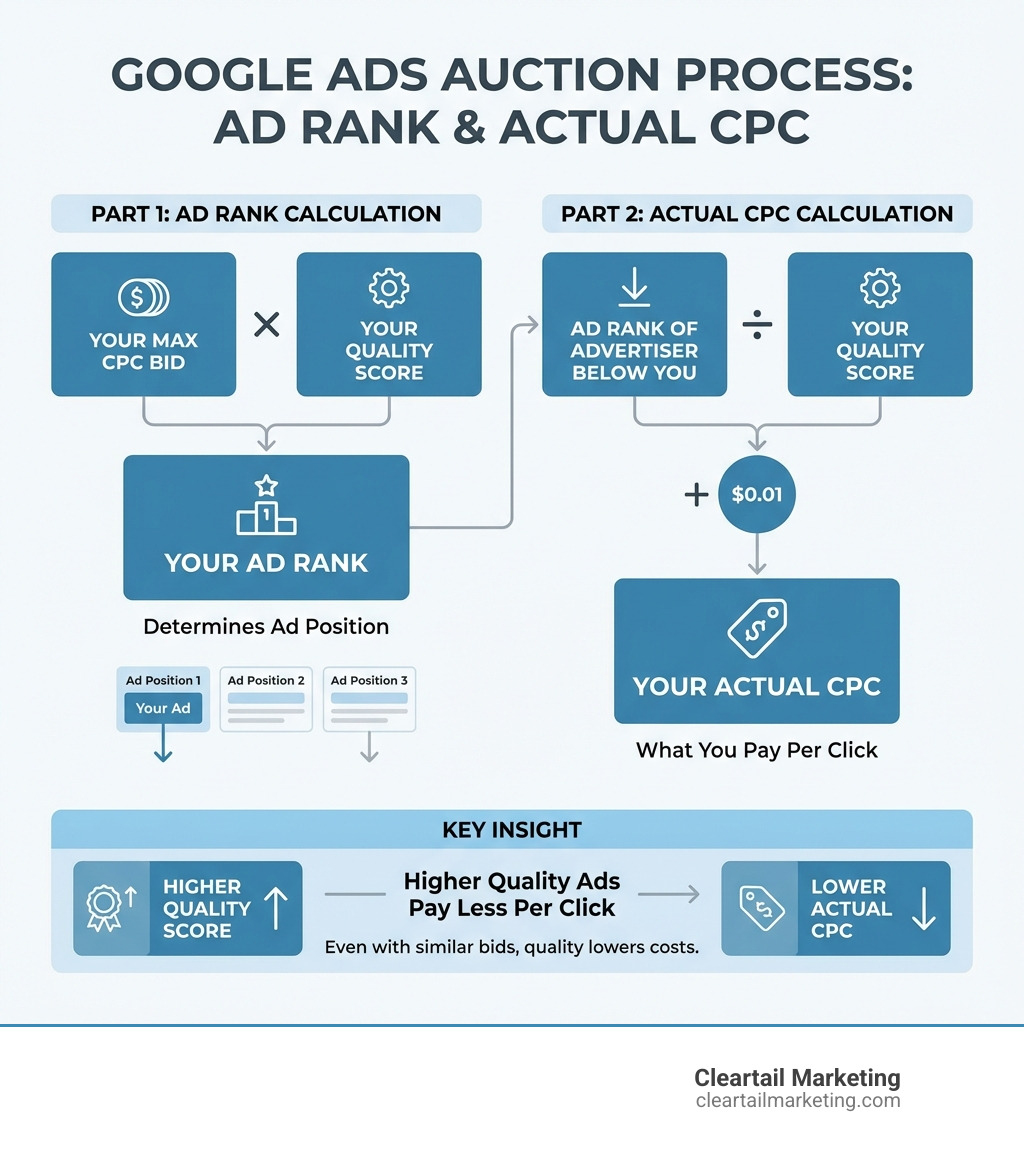
Ad Rank is Google’s primary metric for determining your ad’s position and whether it shows at all. It’s calculated using several factors:
- Max CPC Bid: This is the highest amount you’re willing to pay for a single click on your ad. Think of it as your opening bid in the auction.
- Quality Score: This is Google’s assessment of the quality and relevance of your ads, keywords, and landing page. It’s a score from 1 to 10.
- Ad Rank Thresholds: These are minimum quality thresholds that an ad must meet to appear in a particular position.
- Competitiveness of an auction: How many other advertisers are bidding for the same keywords and how their Ad Ranks stack up.
- Context of the person’s search: This includes factors like the user’s location, time of day, device, and other search signals.
- Expected impact of assets and other ad formats: The value Google anticipates from your ad extensions and other formats.
The simple way to think about Ad Rank is: Ad Rank = Max CPC Bid × Quality Score.
Now, here’s the kicker: You rarely pay your maximum bid. Your actual CPC is often less than your max. CPC. In the Google Ads auction, you only pay what’s minimally required to clear the Ad Rank thresholds and beat the Ad Rank of the competitor immediately below you. If there are no competitors immediately below, you pay the reserve price (the minimum amount to show your ad).
The formula for your actual CPC is:
Actual CPC = (Ad Rank of the ad below yours ÷ Your Quality Score) + $0.01
This means that if you have a high Quality Score, you can often pay less for a higher ad position than a competitor with a lower Quality Score, even if their maximum bid is higher than yours! This is a huge advantage for smart advertisers. For a deeper dive into this, Google explains it well in their official documentation: Actual cost-per-click (CPC): Definition.
The Role of Quality Score
We just touched on Quality Score, but it’s so important that it deserves its own spotlight. Your Quality Score is a number from 1 to 10 that Google assigns to each of your keywords. A higher score means your ad, keyword, and landing page are considered more relevant and useful to someone seeing your ad.
Quality Score is primarily influenced by three factors:
- Expected Click-Through Rate (CTR): This is Google’s prediction of how likely people are to click your ad when it’s shown for a particular keyword, based on your past performance and ad position.
- Ad Relevance: How closely your ad copy matches the intent behind the user’s search query. If someone searches for “red running shoes” and your ad is for “blue hiking boots,” your relevance will be low.
- Landing Page Experience: How relevant, transparent, and easy-to-steer your landing page is. A fast-loading, mobile-friendly page that clearly delivers on the promise of your ad will have a good landing page experience.
A high Quality Score is a superpower in Google Ads. It can lead to:
- Lower *adwords cost per click*: You pay less for each click.
- Higher ad positions: Your ads show up more prominently.
- More ad impressions: Your ads are shown to more people.
Essentially, Google rewards advertisers who provide a great user experience. It’s their way of saying, “Thank you for making our search results better!”
Max CPC vs. Actual CPC: What You Bid vs. What You Pay
Understanding the difference between your Maximum Bid (Max CPC) and your Actual CPC is crucial for managing your budget effectively.
- Maximum Bid (Max CPC): This is the ceiling you set. It’s the highest amount of money you tell Google you’re willing to pay for a single click on your ad. You set this at the keyword or ad group level.
- Actual CPC: This is the amount you actually pay for a click. As we discussed, it’s usually less than your Max CPC. It’s determined by the auction dynamics – specifically, just enough to outrank the next advertiser below you.
Think of it like this: You go to an auction for a vintage comic book. You decide you’re willing to pay up to $100 (your Max CPC). The bidding starts, and you win the auction for $60 (your Actual CPC) because no one else was willing to go higher than $59. You don’t pay your full $100 unless someone else bids $99.
There are a couple of situations where your Actual CPC might exceed your Max CPC:
- Improved CPC (eCPC): If you’ve enabled this bidding strategy, Google might automatically increase your bid in certain auctions if it believes a click is more likely to lead to a conversion.
- Bid Adjustments: You can set bid adjustments for devices, locations, or ad schedules. For example, if you set a +20% bid adjustment for mobile devices, your effective Max CPC for mobile clicks will be 20% higher than your base Max CPC.
This dynamic system gives you granular control over your spending while ensuring you only pay what’s necessary to maintain your ad position.
What Factors Influence Your Adwords Cost Per Click?
The price you pay per click isn’t just a random number; it’s a complex interplay of many factors. We’ve seen how the Google Ads auction and Quality Score play a role, but let’s zoom out to consider broader influences on your adwords cost per click.
Industry, Keywords, and Competition
This is perhaps the biggest external factor. Some industries are inherently more competitive, leading to higher CPCs. Why? Because the value of a customer in those industries is often much higher.
Consider these average CPCs by industry from 2025 data:
| Industry | Average CPC (2025) | Competitiveness |
|---|---|---|
| Attorneys & Legal Services | $8.58 | High |
| Dentists & Dental Services | $7.85 | High |
| Home & Home Improvement | $7.85 | High |
| Education & Instruction | $6.23 | High |
| Beauty & Personal Care | $5.70 | Moderate |
| Finance & Insurance | $3.46 | Moderate |
| Real Estate | $2.53 | Low |
| Arts & Entertainment | $1.60 | Low |
| Ecommerce/Retail | $0.82 | Low |
Source: Focus Digital Research Study, 2025 & Backlinko 2025 data
High-Competition Keywords: Keywords in high-value industries like legal, finance, and insurance command the highest CPCs. For instance, personal injury keywords can reach $137.55 per click, and some B2B software keywords can go even higher, justified by the potential lifetime value of a client. High-competition industries require 3.4x more investment per click than low-competition sectors.
Long-Tail Keywords: These are longer, more specific keyword phrases (e.g., “emergency plumber in downtown Austin” instead of “plumber”). They often have lower search volume but much higher commercial intent. Because they’re less competitive, their CPCs are typically lower, and their conversion rates can be significantly higher. For example, a keyword like “dog bite lawyer San Jose” might be expensive ($229 per click!), but it’s incredibly specific, meaning the user is very far along in their decision-making process.
Negative Keywords: These are terms you tell Google not to show your ads for. For example, if you sell new cars, you might add “used” or “rental” as negative keywords. Using negative keywords prevents your ads from appearing for irrelevant searches, saving you money on clicks that would never convert. It’s a simple yet powerful way to reduce wasted ad spend and improve your adwords cost per click.
Campaign Settings and Targeting
The way you configure your campaigns and targeting options also directly impacts your CPC.
- Search Network vs. Display Network: The Google Search Network (ads appearing on Google search results pages) generally has a higher CPC because users have strong commercial intent. The average CPC on the Search Network is $5.26. The Google Display Network (ads appearing on websites, apps, and YouTube) is typically much cheaper, averaging under $1.00 per click. However, Display Network clicks often have lower intent, making them better for brand awareness than immediate conversions.
- Geotargeting: This allows you to show your ads only to users in specific geographic locations (countries, states, cities, or even custom radius around a point). Targeting highly populated or affluent areas can increase CPC due to higher competition, while targeting less competitive areas might lower it. For instance, a “plumber near me” keyword costs $62.67 per click in Austin, Texas, but only $20.11 in Lincoln, Nebraska.
- Device Targeting: You can adjust bids for different devices (desktops, mobile phones, tablets). If mobile traffic converts exceptionally well for your business, you might bid higher on mobile. Conversely, if desktop traffic is less competitive for your offers, you might find lower CPCs there. By 2025, an estimated 73% of internet users will primarily access the web via mobile devices, so optimizing for mobile is critical.
- Ad Scheduling (Dayparting): This lets you choose specific days and times for your ads to run. If you know your customers only convert during business hours, you can pause your ads overnight to avoid wasted clicks, effectively lowering your overall adwords cost per click. A bakery closing at 7 p.m., for example, wouldn’t want to pay for clicks at 2 a.m.
Google Ads Cost Benchmarks: What’s a “Good” CPC?
Defining a “good” adwords cost per click isn’t about hitting a specific number; it’s about paying a price that delivers a positive return on investment (ROI) for your business. What’s good for a personal injury lawyer with a high client value might be terrible for an e-commerce store selling low-margin items.
However, understanding industry benchmarks and typical spending patterns can provide a valuable framework.
Understanding the Average Adwords Cost Per Click
Let’s look at the broader averages:
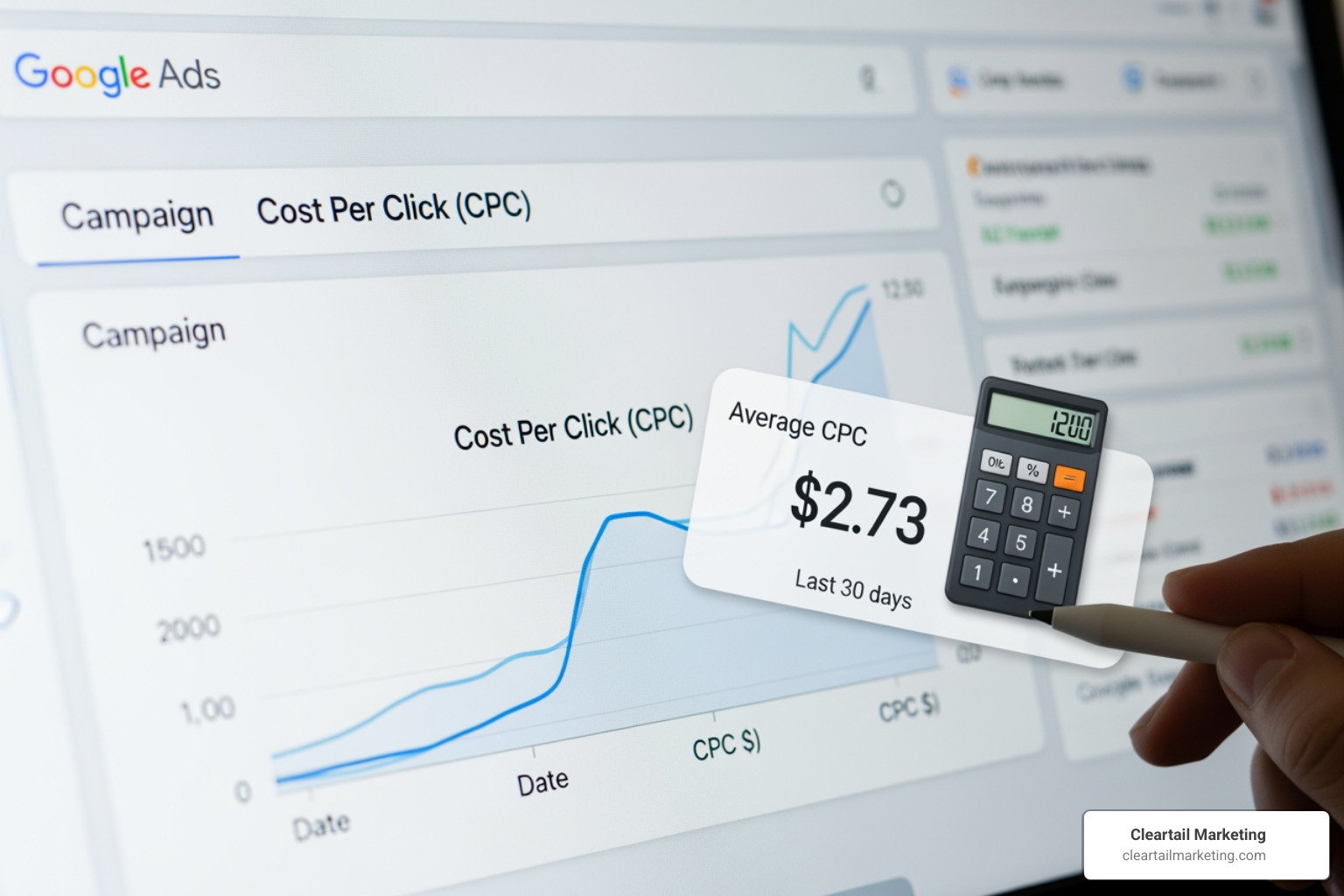
- Overall Average CPC in Google Ads (Search Network): The average CPC across industries on the Search Network is $5.26 (2025 data).
- Average CPC on the Google Display Network: Clicks tend to be significantly cheaper, averaging under $1.00.
- Most Expensive Keyword Categories: Industries with high customer lifetime value and intense competition consistently top the charts. In 2025, Attorneys & Legal Services ($8.58), Dentists & Dental Services ($7.85), and Home & Home Improvement ($7.85) are among the most expensive categories based on average CPC. However, individual keywords within these categories can be much higher, with legal services reaching $137.55 for personal injury keywords and insurance averaging $67.73.
These are averages. Your specific CPC will depend on your Quality Score, targeting, and the competitiveness of your chosen keywords.
Typical Budgets for Small & Mid-Sized Businesses
One of the first questions we hear from new clients is, “How much should I spend?” There’s no one-size-fits-all answer, but we can provide some typical ranges based on industry data:
- Starting Budgets: Most new Google Ads campaigns can cost around $20-$50 per day. This translates to an average starting budget of $1,000-$2,500 per month for small businesses (SMBs).
- Monthly Spend: Most businesses spend between $1,000-$10,000 per month on Google Ads. Mid-sized companies and agencies often spend between $7,000 and $30,000 per month.
- Spending Limits: Google Ads allows you to set an average daily budget for your campaigns. While Google may spend up to double your daily budget on any given day to capture high-value opportunities, it will never exceed your monthly spending limit (calculated as your average daily budget multiplied by the average number of days in a month, which is 30.4). This provides robust control over your overall spend. You can learn more about how Google Ads budgets work here: Learn more.
It’s crucial to allocate your budget wisely. For most businesses, we see a sweet spot of 6-25% of their total marketing budget going to PPC, with satisfied advertisers often allocating 15-35%.
Agency/Partner Fees: Beyond the direct ad spend, many businesses opt to work with a digital marketing agency like Cleartail Marketing. These fees typically range from 12%-30% of your ad spend or a flat monthly fee ($501-$3,000 per month for many SMBs). These fees cover expert campaign management, optimization, reporting, and strategy, which can often lead to a much better ROI than managing campaigns in-house.
How to Optimize and Reduce Your Google Ads Costs
The good news is that you’re not a passive participant in the Google Ads auction. You have significant control over your adwords cost per click through strategic optimization. Our goal at Cleartail Marketing is always to help our clients get the most clicks for their buck, without sacrificing quality or conversions.
Leveraging Data to Lower Costs
Data is your best friend in Google Ads. Without it, you’re flying blind.
- Conversion Tracking: This is non-negotiable. Conversion tracking tells you exactly what happens after someone clicks your ad – did they make a purchase, fill out a form, call your business? By measuring conversions, you can identify which ads, keywords, and campaigns are actually driving valuable business results. This allows us to focus your budget on what works and cut out what doesn’t.
- Performance Monitoring: Regularly review your campaign performance. Look at your CTR, conversion rates, and, of course, your CPC. Are certain keywords underperforming? Are there ad groups that are costing too much with too few conversions?
- Identifying Wasted Spend: This goes hand-in-hand with monitoring. High CPCs without corresponding conversions are a red flag. Irrelevant clicks (which negative keywords help prevent) are wasted spend. Tools like Google’s Performance Planner can help identify areas for improvement.
- Focusing on High-Performing Keywords: Once you know which keywords and ads are consistently driving conversions at a profitable CPC, we can allocate more budget to them. This ensures your money is always working as hard as possible.
Advanced Strategies to Lower Your Adwords Cost Per Click
We apply several proven strategies to help our clients lower their adwords cost per click and maximize their ROI:
- Improving Quality Score: As discussed, a higher Quality Score directly translates to lower CPCs and better ad positions. We focus on optimizing:
- Expected CTR: Crafting compelling ad copy, using relevant ad extensions, and ensuring strong keyword-ad copy alignment.
- Ad Relevance: Structuring ad groups tightly around specific themes and keywords, ensuring ad copy directly addresses user intent.
- Landing Page Experience: Optimizing landing pages for speed, mobile-friendliness, clear calls to action, and content that directly relates to the ad.
- Using Negative Keywords: We continuously refine negative keyword lists to filter out irrelevant searches. This proactive approach saves significant budget by preventing clicks from users who aren’t looking for what you offer.
- Focusing on Long-Tail Keywords: We strategically target long-tail keywords that demonstrate higher commercial intent. While they may have lower search volume, their lower competition often results in lower CPCs and higher conversion rates.
- Smart Bidding Strategies: Google Ads offers automated bidding strategies (like Target CPA, Maximize Conversions, Target ROAS) that leverage machine learning to optimize bids in real-time. When properly set up with robust conversion data, these strategies can significantly improve efficiency and lower your average CPC by bidding more aggressively on clicks that are more likely to convert, and less on those that aren’t. Google’s Performance Max campaigns, for example, represent the new frontier in automated optimization, relying on sufficient conversion data to train the AI effectively.
Frequently Asked Questions about Google Ads CPC
We often get a lot of questions about Google Ads costs, especially from businesses new to the platform. Here are some of the most common ones:
How can small businesses compete with larger advertisers on Google Ads?
It’s a common misconception that you need a huge budget to succeed in Google Ads. While larger businesses might have bigger budgets, small businesses can absolutely compete – and win – by focusing on quality and strategy.
Here’s how we help our small business clients level the playing field:
- Focus on Quality Score: This is your secret weapon. By having highly relevant ads, keywords, and landing pages, you can achieve a higher Ad Rank with a lower maximum bid, paying less per click than a competitor with a lower Quality Score, even if they bid higher.
- Niche Targeting: Instead of trying to be everything to everyone, focus on your specific niche. Target specific locations, demographics, or interests where your product or service shines.
- Long-Tail Keywords: These are often overlooked by larger advertisers chasing high-volume, broad keywords. Long-tail keywords offer lower competition, lower CPCs, and higher conversion rates because they indicate specific user intent.
- Ad Relevance: Craft ads that speak directly to the pain points and needs of your target audience. The more relevant your ad, the higher its expected CTR and Quality Score.
- Landing Page Experience: Ensure your landing pages are fast, mobile-friendly, and provide a seamless user experience that fulfills the promise of your ad.
By focusing on these areas, small businesses can achieve excellent results without needing to outspend their larger competitors.
What is the difference between a budget and a bid in Google Ads?
This is a fundamental distinction that often causes confusion for newcomers.
- Budget (Overall Spend Limit): Your budget is the total amount you’re willing to spend on a campaign over a specific period, typically set as an average daily budget. For example, if you set a daily budget of $50, Google aims to spend around $50 per day. While Google might spend up to twice your daily budget on any given day, it will never exceed your monthly spending limit (your average daily budget x 30.4 days). This sets the overall financial boundary for your campaign.
- Bid (Cost Per Action): Your bid is the maximum amount you’re willing to pay for a specific action, most commonly a click (your Max CPC). Bids are set at the keyword or ad group level and determine your competitiveness in the auction. Think of your budget as the total amount of money you brought to the casino, and your bid as how much you’re willing to wager on a single spin of the wheel.
How does conversion tracking help optimize CPC?
Conversion tracking is absolutely essential for optimizing your adwords cost per click and ensuring your campaigns are profitable. Here’s how it helps:
- Identifies valuable clicks: Without conversion tracking, you only know how many clicks you get. With it, you know which clicks lead to valuable actions (purchases, leads, sign-ups). This allows you to differentiate between cheap, irrelevant clicks and valuable, slightly more expensive clicks that generate revenue.
- Focuses budget on converting keywords: By seeing which keywords and ads drive conversions, we can reallocate your budget away from underperforming elements and towards those that are most effective, inherently improving your average CPC for profitable actions.
- Informs smart bidding: Automated bidding strategies rely heavily on conversion data to make intelligent, real-time adjustments to your bids. The more accurate and plentiful your conversion data, the better Google’s algorithms can optimize for conversions at the lowest possible cost.
- Measures ROI: Conversion tracking allows you to calculate your return on investment (ROI). Knowing that you’re earning $2 in revenue for every $1 spent on Google Ads (a common benchmark) helps you justify and scale your ad spend, even if individual CPCs seem high.
Master Your Google Ads Spend
Understanding your adwords cost per click is fundamental to running successful Google Ads campaigns. It’s not just about the number itself, but the intricate ecosystem of the Google Ads auction, Quality Score, and strategic optimization that truly determines your profitability.
Key Takeaways:
- CPC is dynamic: Your actual cost per click is rarely your maximum bid and fluctuates with every auction.
- Quality Score is crucial: A high Quality Score is your best friend, leading to lower CPCs and better ad positions.
- Optimization is key: Proactive account management, data-driven decisions, and continuous testing are essential to keep costs down and ROI high.
At Cleartail Marketing, we specialize in helping businesses like yours steer the complexities of Google Ads. Our proven strategies, built on years of experience managing millions in ad spend for clients across the United States and Canada, ensure that you’re not just paying for clicks, but paying for results. We focus on building strong client relationships and delivering measurable ROI, so your ad spend translates into real business growth.
To get a comprehensive breakdown of all the costs involved in a successful campaign, read our guide on how much Google Ads costs.
