



Why Your Small Business Reputation Matters More Than Ever
Reputation management for small business has become essential in today’s digital-first world. Your customers no longer just tell their neighbors about their experience—they tell the entire internet. With 90% of consumers checking reviews online before making a purchase, your digital reputation directly impacts your bottom line.
Here’s what effective reputation management includes:
- Monitoring online mentions across review sites, social media, and forums
- Responding professionally to both positive and negative feedback
- Encouraging satisfied customers to share their experiences online
- Creating positive content that ranks well in search results
- Measuring your reputation’s impact on sales and growth
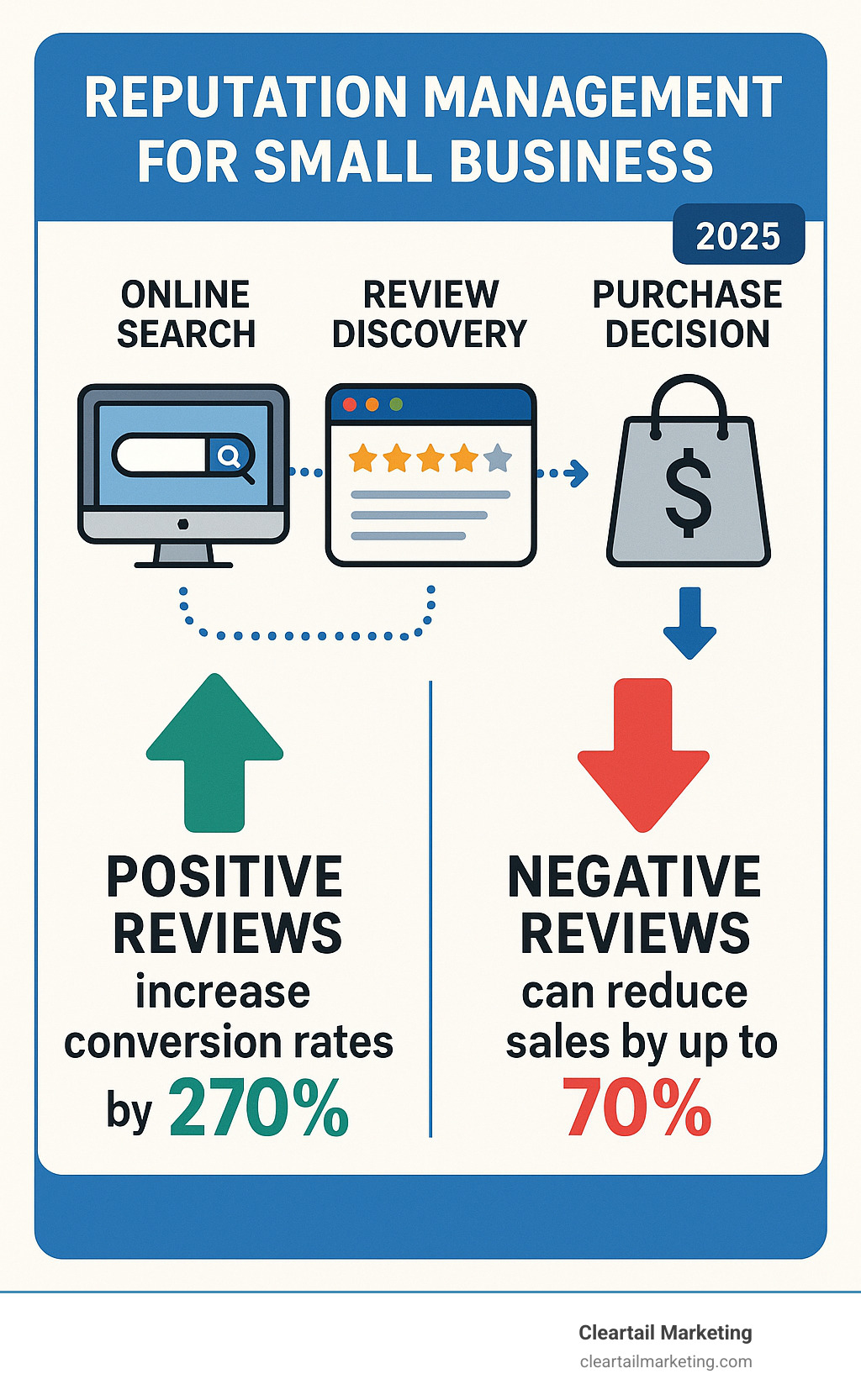
The stakes are higher for small businesses. Unlike large corporations that can weather negative publicity, a small business feels the impact immediately. Research shows that businesses with just one negative article ranking online risk losing up to 22% of prospective customers. With four or more negative articles, that number jumps to 70%.
But small businesses also have unique advantages. You can respond personally to customers, build genuine relationships, and turn negative experiences into positive outcomes more easily than large corporations. Your authentic voice can become your greatest reputation management asset.
I’m Magee Clegg, founder of Cleartail Marketing. We’ve helped over 90 clients build stronger online reputations, and I’ve seen how the right approach transforms a company’s growth.
Why Your Online Reputation is a Small Business Superpower
Your online reputation is the digital version of word-of-mouth, built from customer reviews, social media posts, and news articles. It’s your business’s digital fingerprint, telling a story about who you are.
For small businesses, a strong online reputation levels the playing field. You can build authentic customer relationships that larger competitors with big marketing budgets can’t fake.
Your digital reputation impacts every aspect of your business. It affects customer trust, pricing power, and even your ability to hire top talent. In fact, research shows that just one negative article ranking high in search results can cost you 22% of potential customers. Four or more negative articles? You could lose up to 70% of prospects.
But when you actively manage your online reputation, you create a competitive advantage. The beauty of reputation management for small business is your authenticity. A personal response from an owner to fix a problem becomes part of your brand story, and customers notice.
The Tangible Impact on Your Bottom Line
Consider the numbers: a one-star increase on Yelp can boost your revenue by up to 9%. That’s real money in your pocket.

For a business earning $500,000 annually, that’s an extra $45,000—often the difference between struggling and thriving.
The benefits extend beyond sales. A strong reputation builds higher customer loyalty, and loyal customers spend more and become your best marketing team by referring others.
Better talent acquisition is another hidden benefit. Top employees want to work for companies they can be proud of. A positive online presence helps you attract better candidates.
Even your business’s valuation is affected. Up to 25% of a company’s market value comes from its reputation, impacting investor confidence.
Investing in reputation management is an investment in your future growth. If you’re curious about the costs involved, you can learn more about how much reputation management costs for businesses like yours.
How Reviews Influence Local SEO and Visibility
Google treats your reviews as a ranking factor. When someone searches for local businesses, Google uses your reviews to decide where you appear in the results.
Google My Business reviews and review signals are consistently ranked as top factors in local search results. This means customer reviews directly impact whether new customers can find you.
The numbers are clear: businesses ranking highest in Google’s local results have more reviews. Plus, star ratings appear directly in search results, creating an immediate visual impact that influences clicks.
Think about your own search behavior—you likely skip businesses with low ratings. Your customers do the same.
Local Pack rankings—the top three businesses with map pins—heavily favor businesses with strong review profiles. Getting into that coveted spot can dramatically increase your visibility.
Your click-through rates also improve with better ratings. A business with 4.5 stars will get more clicks than one with 3.5 stars in the same search position.
Better yet, Google confirms that responding to reviews improves your local SEO. When you reply to feedback, you’re not just providing good service—you’re boosting your search rankings.
If you want to dominate your local market, combining reputation management with a solid local SEO strategy is essential. You can learn more about local SEO for small businesses and how these strategies work together.
A Practical Guide to Building and Improving Your Reputation
Building a strong online reputation requires a proactive approach. Think of reputation management for small business like tending a garden: it’s better to plant flowers proactively than to pull weeds reactively. The proactive route is far more effective and less stressful.
Proactive reputation management involves building positive content and encouraging reviews before problems arise. Reactive management is scrambling to fix damage after it’s done. Businesses that focus on prevention consistently outperform those that only react.
A complete strategy includes monitoring online conversations, review generation to encourage feedback, social media engagement to build community, content creation to tell your story, and SEO suppression to push down negative results.
This comprehensive approach creates a powerful online narrative that reflects the excellent service you provide. For a deeper dive into these strategies, check out our guide on how to manage your online reputation.
Where to Monitor Your Online Presence
You can’t manage what you don’t know about. Effective reputation management for small business starts with monitoring what’s being said about you online.

Review sites are your first priority. Beyond Google and Yelp, remember industry-specific platforms like Angi for contractors, Healthgrades for healthcare, or TripAdvisor for restaurants.
Social media platforms like Facebook, Instagram, X (formerly Twitter), and LinkedIn host real-time conversations about your brand.
Also monitor industry-specific forums, local community groups, blogs, and news sites, as mentions in these places can significantly impact your reputation.
To keep track of these mentions, use essential monitoring tools:
- Google Alerts: A free and simple way to get notified of new mentions of your business name or keywords.
- Mention: Offers real-time social media monitoring and more comprehensive coverage than basic alerts.
- Brand24: Provides deeper analysis with sentiment tracking to understand how people feel about your brand.
Key Strategies for Reputation Management for Small Business
Once you know where to look, it’s time to take action. Focus on a few key strategies to create lasting positive impressions.
Encouraging reviews is your most powerful tool. Surprisingly, 70% of customers will leave a review when asked, but most businesses never ask. Simply create a system to request reviews via email, at checkout, or with QR codes.
Providing exceptional service is the foundation. When you exceed expectations, positive reviews follow naturally, and every interaction becomes an opportunity to create an advocate.
Creating valuable content helps you control your narrative. Blog posts, videos, and social media content that showcase your expertise contribute to a positive online presence and can help with SEO.
Engaging with your community on social media and at local events builds goodwill that translates into positive online mentions.
Building positive press through local media or influencer collaborations adds to your overall reputation strength.
These strategies work best as part of a coordinated approach. For more detailed guidance, explore our insights on positive reputation management.
Mastering the Conversation: How to Respond to Online Feedback
Every piece of online feedback, positive or negative, is an opportunity to strengthen your reputation. When you respond, you’re not just talking to one customer; you’re speaking to every future customer watching.
That’s why responding to online feedback is crucial for reputation management for small business.
Timeliness matters. A quick, genuine, and professional response shows you’re engaged. Plus, Google confirms that businesses that respond to reviews improve their local SEO.
Every response is a chance to demonstrate your values and commitment to customer care. How you handle each moment can turn observers into customers.
For comprehensive strategies on handling all types of customer feedback, check out our guide on best practices for reputation management.
Responding to Positive Reviews: Amplify the Good
When you get a positive review, use it to build a stronger relationship and encourage others.
Thank them personally and reference a specific detail from their review. A generic “Thanks!” is not enough; a personal touch shows you’re listening.
Reinforce the positive. If they praise your staff, mention your team’s commitment to service. This tells future customers what to expect.
When customers mention specific team members, be sure to pass along the praise. This boosts morale and shows your staff cares.
Always invite them back with a simple, “We’d love to see you again soon!” to keep the relationship going.
Responding to Negative Reviews: Repair and Rebuild
How you handle criticism can be more powerful than a dozen positive reviews. A thoughtful response shows potential customers how you’ll treat them if something goes wrong.

Start by acknowledging their experience and apologizing. Research shows that 39% of customers who leave negative reviews simply want an apology—sometimes that’s all it takes.
Resist the urge to get defensive. An online argument looks unprofessional. Focus on understanding their perspective and finding a solution.
Move sensitive discussions offline. A simple, “I’d love to discuss this directly—please contact us privately so we can make this right,” keeps personal details private and shows you care.
Offer a genuine solution when appropriate, whether it’s a refund, a do-over, or a commitment to improve.
Every negative review response is a public demonstration of your customer service. Handle it well, and you can turn unhappy customers into loyal advocates.
For businesses dealing with serious reputation challenges, our business reputation repair services can help you steer complex situations.
Proactive Reputation Management for Small Business: From Prevention to Performance
Proactive reputation management for small business is like tending a garden: you cultivate good things regularly instead of just reacting to problems.
The best approach combines crisis prevention with performance improvement. This means having systems to catch issues early while continuously strengthening your positive online presence, allowing you to write your own story.
Crisis prevention starts with preparation. A clear communication plan ensures your team knows who responds to feedback and how to escalate serious issues.
Setting up monitoring alerts gives you an early warning system for new mentions online, allowing for a quick response that can de-escalate a potential crisis.
Employee training is crucial. Your team is your front line, and every interaction reflects on your business. When staff understand their impact on reputation, they become powerful advocates.
The goal is to create so much positive momentum that any occasional negative feedback is overshadowed. For guidance on handling serious challenges, check out our resource on business reputation crisis management.
Measuring Success: KPIs for Reputation Management for Small Business
You can’t improve what you don’t measure. For reputation management for small business, consistently track a few key performance indicators (KPIs).
- Overall star rating: The most visible metric. Aim for 4.5 stars or higher on key platforms like Google and Yelp, as this number directly influences clicks.
- Review quantity and velocity: The total number of reviews builds trust, while the speed at which new ones arrive (velocity) shows you’re relevant and active.
- Sentiment analysis: Track the percentage of positive, neutral, and negative mentions to gauge customer satisfaction and see how it changes over time.
- Response rate: Responding to a high percentage of reviews demonstrates engagement and professionalism.
- Search engine visibility: When someone searches your brand, you want the first page dominated by positive results. Track the rankings of your website, GMB profile, and positive press.
- Website traffic from review sites: Monitor this referral traffic to see if your strong reviews are converting browsers into customers.
Regularly checking these metrics helps you adjust your strategy and prove the value of your efforts. Reputation management is a marathon, not a sprint—consistent effort creates lasting results.
Frequently Asked Questions about Small Business Reputation
Managing your online reputation can feel overwhelming. Here are answers to common questions and myths we hear from small business owners.
What are the biggest myths about online reputation management?
- Myth: “It’s only for big companies.” Truth: Small businesses are more vulnerable to negative sentiment because they rely on local trust and lack large PR teams. A single bad review can have a much larger impact.
- Myth: “It’s too expensive.” Truth: Many foundational strategies are free. Setting up Google Alerts, responding to reviews, and asking for feedback cost only your time.
- Myth: “It’s too time-consuming.” Truth: With the right tools and processes, you can manage your reputation effectively in just a few hours a week.
- Myth: “You can just delete negative reviews.” Truth: Most platforms only remove reviews that violate their terms of service. Your energy is better spent generating positive reviews to outweigh the negative ones.
- Myth: “No news is good news.” Truth: Silence can hurt you. A lack of reviews and engagement can make your business seem less trustworthy compared to active competitors.
What’s the difference between reputation management and PR?
While related, these serve different purposes.
Reputation management is about monitoring and influencing user-generated content like reviews and social media comments. It’s largely about managing existing conversations.
Public Relations (PR) is about proactively creating and distributing your own message through press releases, media outreach, and generating positive news coverage.
Think of it this way: PR helps you tell your story, while reputation management helps you respond to how others tell your story.
Can I do reputation management myself?
Yes! Many owners successfully handle their own reputation management for small business. You can set up monitoring alerts, manage your Google Business Profile, request reviews, and respond to feedback yourself.
Your authentic voice is a powerful asset, and you know your business and customers best. This is the foundation of good reputation management.
However, it makes sense to hire a reputation management agency if you face a major crisis, a flood of negative content, or lack the time to manage it effectively. Agencies have advanced tools and proven systems for complex situations.
The key is to be honest about your capacity. Start with what you can handle, and seek help when your needs outgrow your resources.
Conclusion
Your online reputation is your most valuable business asset. It’s what potential customers see when they search for you online, comparing your reviews to your competitors’.
Reputation management for small business is about building a foundation for growth. A well-managed online presence attracts new customers, builds trust, and creates a powerful competitive edge.
You don’t need a huge budget to start. The most effective strategies are simple: ask for reviews, respond to all feedback, and deliver exceptional service.
At Cleartail Marketing, we’ve seen these consistent steps transform businesses. It doesn’t happen overnight, but committing to the process yields powerful results.
The key is to start today. Proactive reputation management builds the strength you need before a crisis hits, creating positive momentum for your business.
Every review response you write and every positive interaction you create is an investment in your business’s future. You’re not just managing your reputation—you’re shaping the story people tell about your brand.
Ready to take control of your online narrative? Take control of your online presence with expert reputation management services and start building the reputation your business deserves.
