



WHY EVERY BUSINESS NEEDS A SOCIAL MEDIA MARKETING PLAN
Social media marketing plans are structured documents that guide your social media efforts, changing random posting into strategic action. They are blueprints that outline your goals, target audience, content strategy, and key performance indicators (KPIs).
A social media marketing plan typically includes:
- Clear goals aligned with business objectives (e.g., brand awareness, lead generation).
- Target audience personas with demographics and interests.
- A content strategy with content pillars and posting schedules.
- Platform selection based on where your audience is active.
- Performance metrics to track success and ROI.
- Budget allocation for content creation, tools, and advertising.
Without a plan, you waste time on content that doesn’t resonate, your brand voice becomes inconsistent, and you can’t prove if your efforts are working. A plan saves time, maintains consistency, measures results, and contributes to business growth. Research shows that 80% of successful content marketers have a documented strategy.
Over 4.7 billion people use social platforms, but reaching them effectively requires strategy, not just presence.
As Magee Clegg, founder and CEO of Cleartail Marketing, I’ve helped 90+ B2B companies execute social media marketing plans that deliver measurable results, like increasing a client’s revenue by 278% in 12 months. Success comes from treating social media as a strategic business asset.
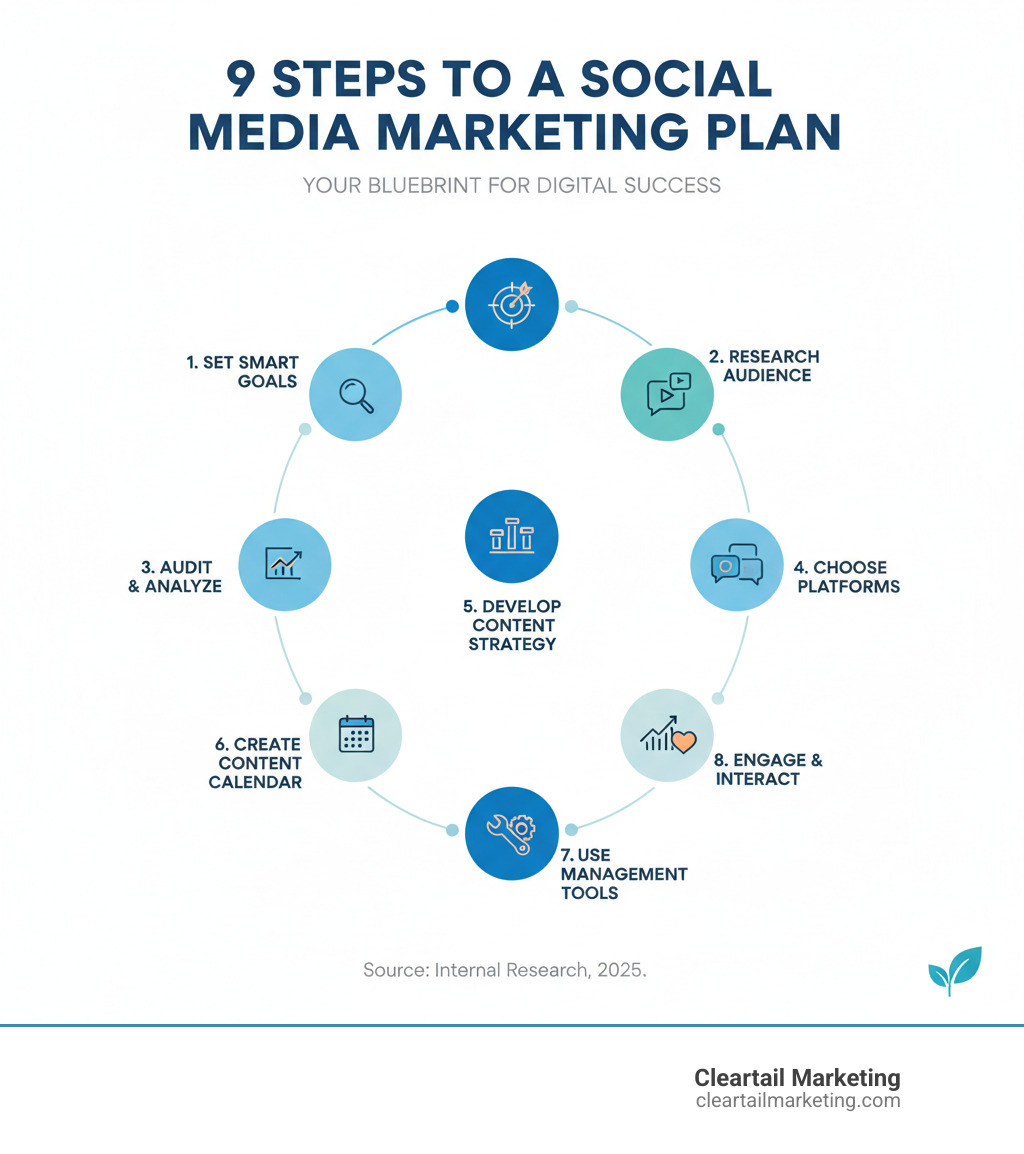
This guide will walk you through creating your own winning social media marketing plan to build customer connections and raise brand awareness. To make it easier, we’ve included a completely free social media strategy template to get you started!
Phase 1: Laying the Groundwork with Research and Goals
Before creating content, you need a strong foundation. This phase involves defining success, understanding your audience, and analyzing your competition.
Step 1: Defining Clear, Measurable Goals for Your Social Media Marketing Plans
Your social media marketing plans need clear goals tied to business objectives like sales, traffic, or lead generation—not vague wishes like “get more followers.”
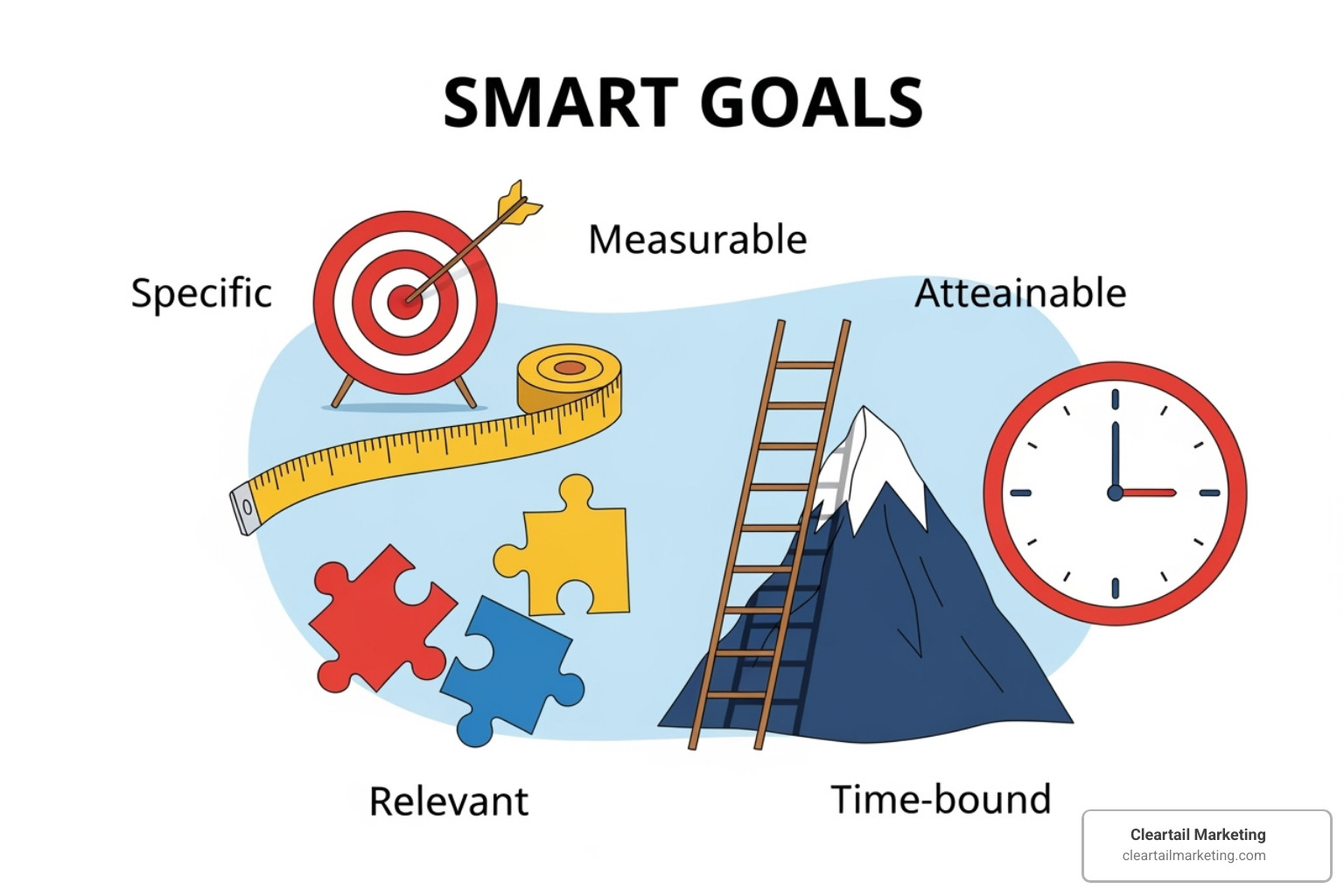
The SMART framework (Specific, Measurable, Attainable, Relevant, and Time-bound) transforms fuzzy ideas into actionable targets.
- Specific: Instead of “Grow our Instagram,” aim for “Gain 200 new Instagram followers per month.”
- Measurable: Focus on real Key Performance Indicators (KPIs) like conversion rates. While 69% of marketers prioritize KPIs for ROI, brand awareness is also important. Avoid vanity metrics like follower count alone.
- Attainable: Set realistic goals based on your resources.
- Relevant: Ensure goals align with broader business objectives. For example, if your company wants to increase sales, a relevant social goal is driving more traffic to product pages.
- Time-bound: Set clear deadlines, like “Increase website traffic by 10% in Q2.”
A solid goal looks like this: “Generate 50 qualified B2B leads through LinkedIn within the next quarter.” At Cleartail Marketing, we help clients define these precise objectives to ensure every action contributes to their bottom line.
Step 2: Identifying and Understanding Your Target Audience
After setting goals, identify who you’re talking to. Understanding your target audience requires digging into their demographics (age, location) and psychographics (interests, values, pain points). This allows you to create content that resonates.
- Develop buyer personas: Create semi-fictional profiles of your ideal customers. Include their goals, challenges, and how they spend time online. These personas help you visualize your audience. Grab our free buyer persona template to get started.
- Use social media analytics: Platforms provide valuable data on your followers’ demographics and behavior. For example, one company used Facebook Analytics to identify its key customer demographic, cutting ad costs by 40% through targeted ads.
- Practice social listening: Monitor conversations about your brand, competitors, and industry. One-third of brands in 2024 rely on social listening to understand audience sentiment and stay ahead of trends.
- Consider platform-specific behavior: Different platforms serve different purposes. With 46% of Gen Z preferring to search on social media over Google, your content must be findable and provide solutions.
A deep audience understanding helps you choose the right platforms and craft messages that feel like a genuine conversation.
Step 3: Conducting a Social Media Audit and Competitive Analysis
A social media audit is a health check for your current presence, while competitive analysis helps you understand the playing field.
Your social media audit reviews your current social media efforts. Identify which accounts are active, if profiles are optimized, and what content performs well. This process helps you identify what’s working so you can do more of it and what isn’t so you can fix or eliminate it. For a step-by-step walkthrough, read our complete social media audit guide.
Competitive analysis involves looking at what your competitors are doing on social media. Identify their platforms, content types, and engagement levels. This isn’t about copying them; it’s about finding opportunities to differentiate your brand and fill gaps they’re leaving open.
Social listening tools are valuable for tracking competitor mentions and industry trends. One-third of brands in 2024 rely on social listening for real-time intelligence.
A thorough audit and competitive analysis provide a complete picture of your current position and opportunities to stand out, making your next steps more strategic.
Phase 2: Building Your Content Strategy and Execution Framework
Now it’s time to turn research into action. This phase is about mapping out what you’ll share, where you’ll share it, and how you’ll maintain consistency.
Step 4: Choosing the Right Platforms and Optimizing Your Profiles
You don’t need to be on every platform. Focus on two or three channels where your target audience is most active. It’s better to excel on a few than to be mediocre on many.
Find where your audience hangs out. Match platform demographics to your audience research. For B2B, LinkedIn is key. For younger audiences, TikTok might be best. For visual brands, Instagram and Facebook are strong choices. While Facebook has 196 million monthly active users in Canada and the U.S., it may not be right for your specific business.
Once you’ve chosen your platforms, optimize your profiles for a strong first impression.
- Use consistent branding: Your profile picture, cover photo, and colors should be instantly recognizable across all channels.
- Complete your profile: Fill out every field, using keywords in your bio to improve searchability.
- Include a call-to-action link: Direct users to your website, a landing page, or a current campaign.
If you’re using Facebook, our guide on how to create a Facebook business page can help you get started correctly.
Step 5: Developing an Effective Content Strategy
Your content strategy defines what you’ll post and why it matters to your audience. It’s the heart of your social media marketing plans.
Start with content pillars, which are the main themes you’ll explore. For example, a B2B company like Cleartail Marketing might focus on SEO strategies, social media best practices, and client results. This keeps your content focused and simplifies planning.
Mix up your content archetypes:
- Educational: How-to guides, industry insights, or helpful tips.
- Entertaining: Content that makes people smile. A 2025 Social Media Trends survey found that 25% of respondents said most of their social content is entertainment-driven.
- Inspirational: Uplifting and motivating posts.
- Promotional: Showcases for your products or services.
Avoid being too promotional, as 34% of marketers find it a major turn-off for brands. Follow the 80/20 rule: 80% of your content should inform, educate, or entertain, while only 20% is directly promotional. This positions you as a trusted resource.
“Edutainment”—content that both educates and entertains—is becoming highly engaging. Give your audience both, and you’ll build a loyal following.
Step 6: Creating a Content Calendar for Consistency
A content calendar is your strategic roadmap for social media, preventing last-minute scrambling. It’s a detailed schedule of what, when, and where you’ll post, including captions, hashtags, and visuals.
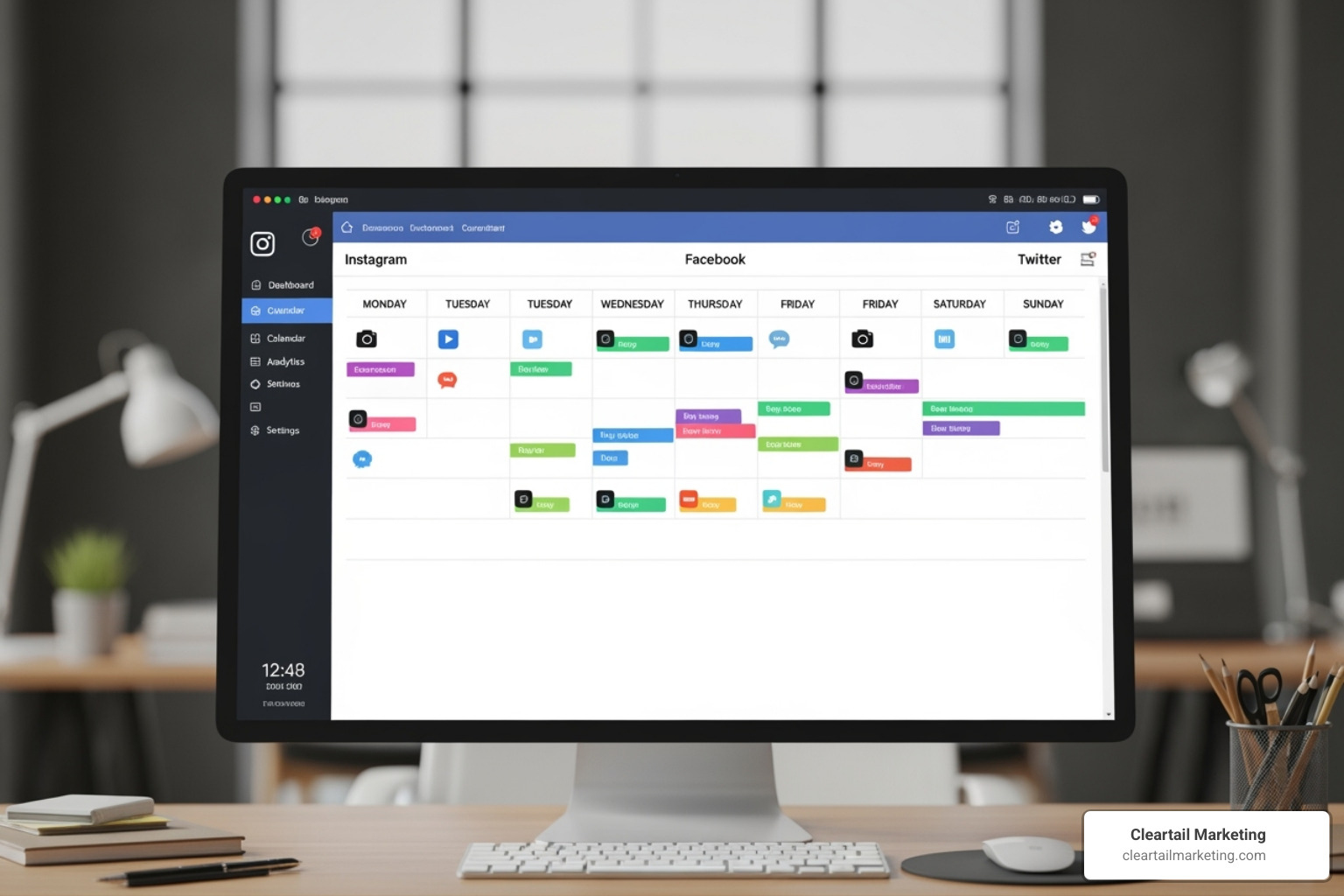
The benefits are significant:
- Consistency: A calendar ensures a regular presence, which helps you stay visible in algorithms and top-of-mind with your audience.
- Strategic Planning: Map out content around key dates, product launches, and holidays in advance.
- Time-Saving: Batching content creation and scheduling posts frees up hours each week.
A good calendar is also flexible, leaving room to jump on trending topics. The goal is structure with breathing room.
Posting frequency varies by platform. Cleartail Marketing experts recommend posting guidelines like 3-5 times per week for Instagram and TikTok, and 1-2 times per day for Facebook. However, these are starting points. The best schedule is one you can maintain consistently with quality content, custom to your audience.
Phase 3: Executing, Engaging, and Optimizing Your Social Media Marketing Plans
You’ve done the research and built your strategy. Now it’s time to bring your social media marketing plans to life by executing your content, engaging your audience, and using data to improve.
Step 7: Leveraging Social Media Management Solutions
Managing social media can be overwhelming. Social media management solutions bring order to the chaos by centralizing tasks like scheduling, analytics, and social listening.
These tools allow you to schedule posts from a single dashboard and gain clearer insights into content performance. Many now include AI-powered features; 61% of organizations rely on AI-powered insights for efficiency. AI can suggest optimal posting times, help generate captions, and analyze comment sentiment.
At Cleartail Marketing, we integrate these tools into your workflow, handling everything from scheduling to performance analysis. Our team ensures your social media marketing plans run smoothly so you can focus on your business. See how our Cleartail Marketing’s recommended tools and services can help.
Step 8: Fostering Community Engagement and Relationships
Social media is a two-way conversation. The brands that win are those that genuinely connect with their audience.
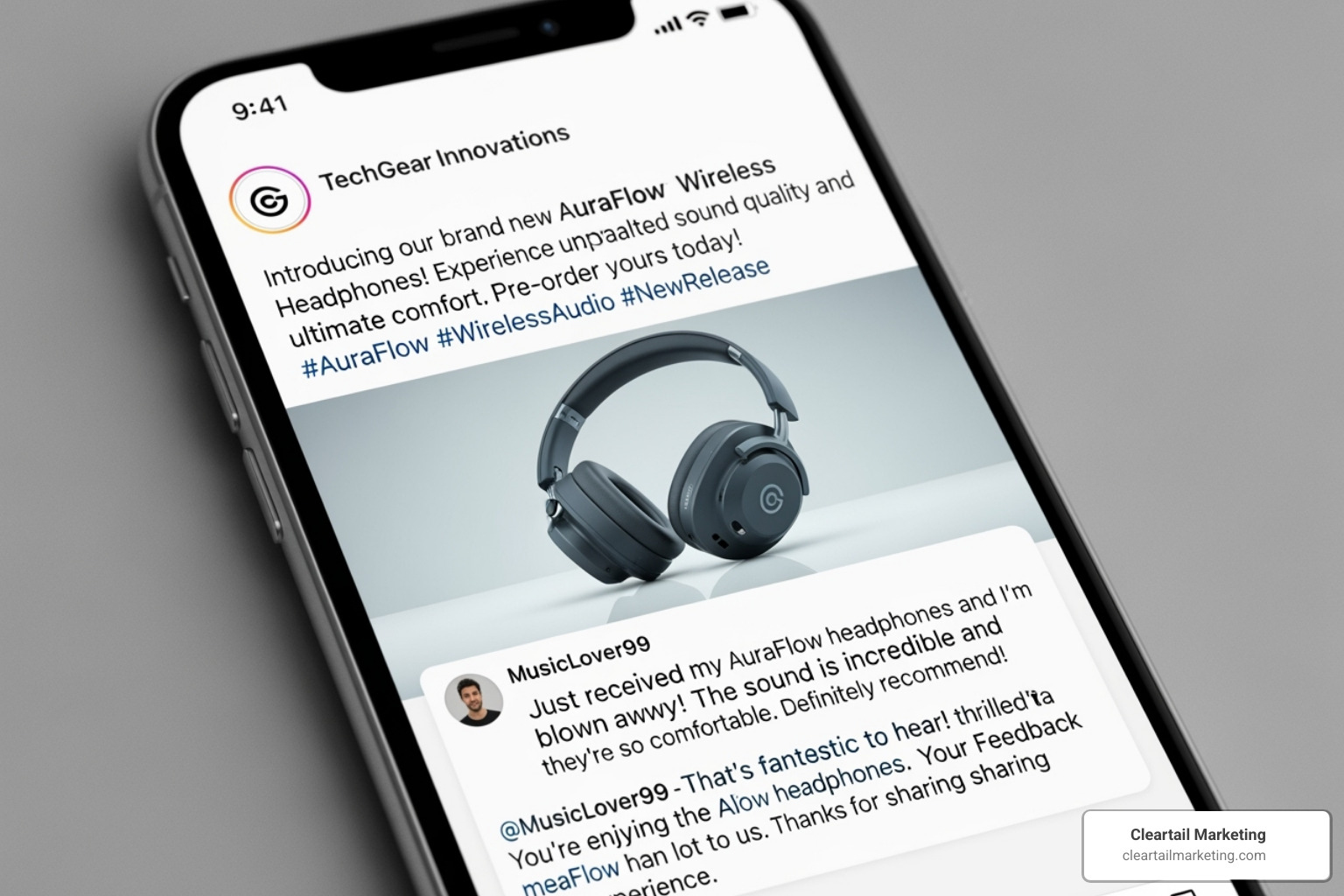
- Respond to comments and messages: This shows you value your audience and builds loyalty, as seen with brands like Bubble Skincare on TikTok.
- Start conversations: Ask questions, run polls, and host Q&As to make your content more interactive and engaging.
- Encourage user-generated content (UGC): When customers share their experiences, it provides authentic social proof. Reshare this content (with permission) to show appreciation and build community.
- Leverage influencer partnerships: Partner with influencers who align with your brand values. Even micro-influencers can be effective, as 49% of consumers make monthly purchases based on influencer posts.
- Promote employee advocacy: Your team members are your best brand ambassadors. Their posts can receive significantly higher engagement and reach than official brand content, humanizing your brand.
Step 9: Analyzing Performance and Optimizing Your Strategy
Your social media marketing plans are living documents that require continuous analysis and optimization to keep up with evolving trends, algorithms, and audience preferences.
Start by tracking the right KPIs defined in Step 1, such as engagement rate, reach, click-through rate, conversion rate, and ROI. We use comprehensive tools and UTM parameters to connect social media efforts directly to business results.
We constantly perform A/B testing on content formats, captions, and posting times to find what resonates with your audience. We also benchmark your performance against industry standards and competitors to identify areas for growth.
The social landscape moves fast, with new platforms like Threads and evolving features on Reels creating constant opportunities. We leverage technology, including the AI-powered insights that 61% of organizations rely on, to spot trends and stay ahead.
At Cleartail Marketing, our Analytics Services translate complex data into actionable insights. We tell you what the numbers mean and what to do next, ensuring your strategy continually improves to deliver maximum ROI.
Frequently Asked Questions about Social Media Marketing Plans
What are the key components of a social media marketing plan?
A comprehensive social media marketing plan includes several key components working together. It starts with clear, SMART goals tied to business objectives and detailed target audience personas. It should also feature a competitive analysis and social media audit to identify opportunities.
This research informs your content strategy, which includes content pillars and a balanced content mix (the 80/20 rule). A content calendar ensures consistency, while social media management tools streamline workflow. Finally, a plan needs a strategy for community engagement and a framework for analyzing performance to optimize based on data.
How can I integrate social media advertising into my plan?
Social media advertising amplifies your organic efforts, allowing you to reach specific audiences with precision.
Start by allocating a dedicated budget within your social media marketing plan. Use platform ad managers to target your defined audience personas. You can amplify top-performing organic content, run lead generation campaigns, or promote products directly. Ensure your ad goals align with your overall strategy.
Paid advertising helps you control your brand message and reach interested consumers. At Cleartail Marketing, we manage effective social media advertising campaigns to maximize your return on ad spend.
What are the benefits of incorporating ecommerce features into a social media strategy?
Incorporating e-commerce features into your social media marketing plan meets customers where they are, reducing friction in the buying process.
Platforms like Instagram Shopping, TikTok Shop, and Facebook Shop allow you to tag products and enable in-app purchasing. This shortens the customer journey and reduces the chance of drop-off.
With 81% of consumers using social media to shop around for their next purchase, these features turn your social presence into a direct sales channel. This enables seamless social selling, improves the customer experience, and provides valuable purchasing data.
How often should I update my social media marketing plan?
Your social media marketing plan should be a living document because the social media landscape changes rapidly.
Review your plan quarterly to analyze performance against your goals. Check your KPIs and see what content is resonating, then make adjustments as needed.
Conduct a full, in-depth revision annually or whenever there’s a major shift, such as a business pivot, a new platform emerging, or a significant algorithm change. Staying agile and adaptable is essential to keep your strategy effective.
Conclusion: Turn Your Plan into Action and Drive Results
Creating a comprehensive social media marketing plan is your roadmap to meaningful connections and measurable business growth. By following the steps outlined—from setting SMART goals and understanding your audience to creating a content strategy and optimizing based on data—you can transform social media into a strategic asset.
Your plan is a living document that must evolve. The key is continuous improvement and data-driven decisions to adapt to the ever-changing social media landscape.
This is where an experienced partner like Cleartail Marketing makes a difference. We help businesses in the United States and Canada develop social media marketing plans that deliver real results, like the 278% revenue increase we achieved for one client in 12 months. We become your strategic partner, handling the complexity of strategy, content creation, community management, and analytics so you can focus on your business.
With billions of users on social media, your customers are waiting. The question is whether you’re ready to be strategic and see real results.
Ready to turn your social media into a powerful growth engine? We’re here to help. Get a custom social media marketing plan that delivers results custom to your business. Let’s turn your plan into action.
