



Why Your Local Business Needs an Outstanding Website Design
Website design for local business is no longer optional—it’s how customers find and judge you. Your website is your digital storefront, and you have just 0.05 seconds to make a first impression. Visitors form an opinion about your business in the blink of an eye.
Here’s what you need to know about website design for local businesses:
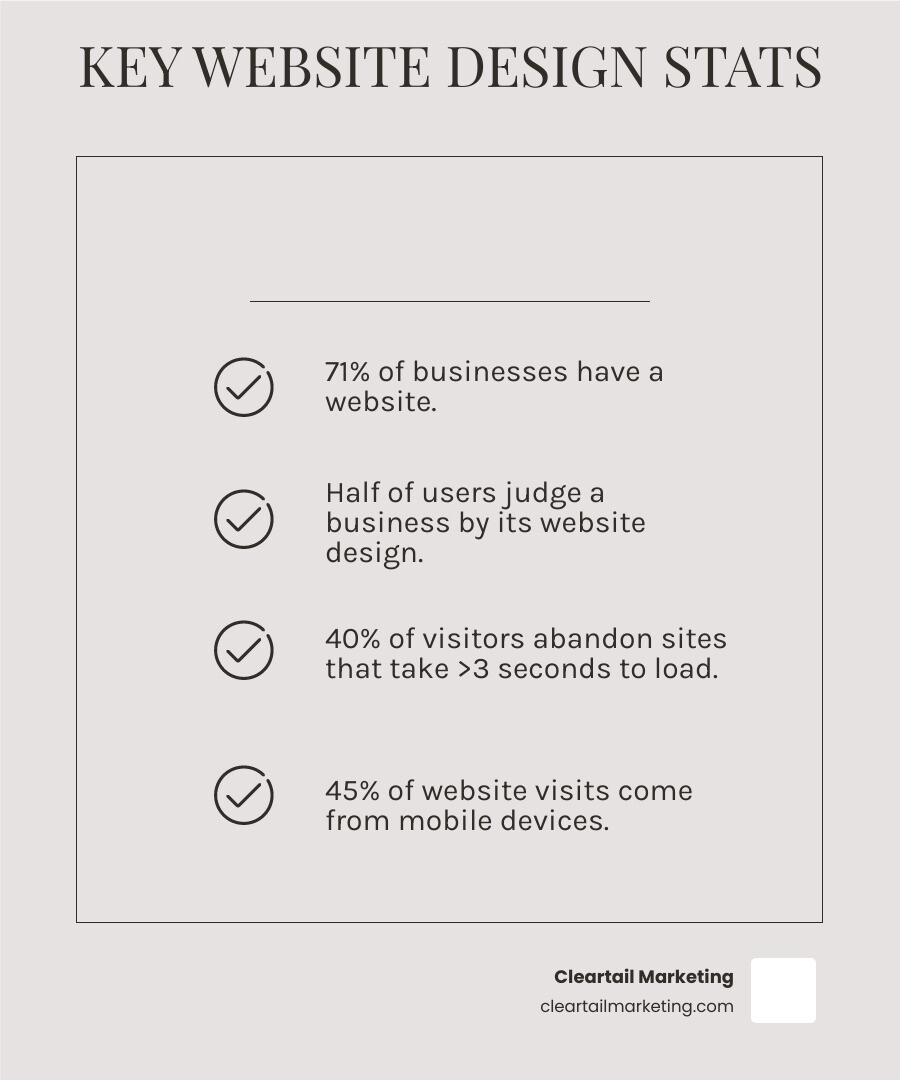
- 71% of businesses have a website, but nearly one in three still don’t—giving you a competitive advantage if you do it right
- Half of internet users judge your business based on your website design alone
- 40% of visitors abandon a website if it takes longer than three seconds to load
- 61% of people leave a site if they can’t find what they need within five seconds
- Mobile devices account for 45% of website visits in North America—your site must work perfectly on phones
A well-designed website builds credibility and trust, attracting local customers searching for your services. Without one, or with a poorly designed site, you’re losing business to competitors daily.
A great local business website needs clear navigation, fast loading speed, mobile-friendly design, quality photos, prominent calls-to-action, easy-to-find contact info, and customer testimonials. It should reflect your brand and guide visitors to act—whether that’s calling, booking, or buying.
I’m Magee Clegg, founder of Cleartail Marketing. Since 2014, we’ve helped over 90 B2B companies grow with effective digital marketing. We’ve seen how proper website design for local business transforms a company’s online presence and drives results, like generating thousands of reviews or increasing traffic by over 14,000%. This guide will show you inspiring examples and practical strategies to create a website that works for your business.
Essential Elements of an Effective Local Business Website
Think of your website as a 24/7 employee. Effective website design for local business isn’t just about looks; it’s about building a tool that attracts customers, answers questions, and drives conversions while you run your business.
The best local business websites make everything easy for the user. This is achieved by combining smart design with performance: clear navigation, great user experience, mobile-first thinking, fast loading, quality visuals, and clear next steps.
Let’s break down what makes these elements work.
Clear Homepage and Easy Navigation
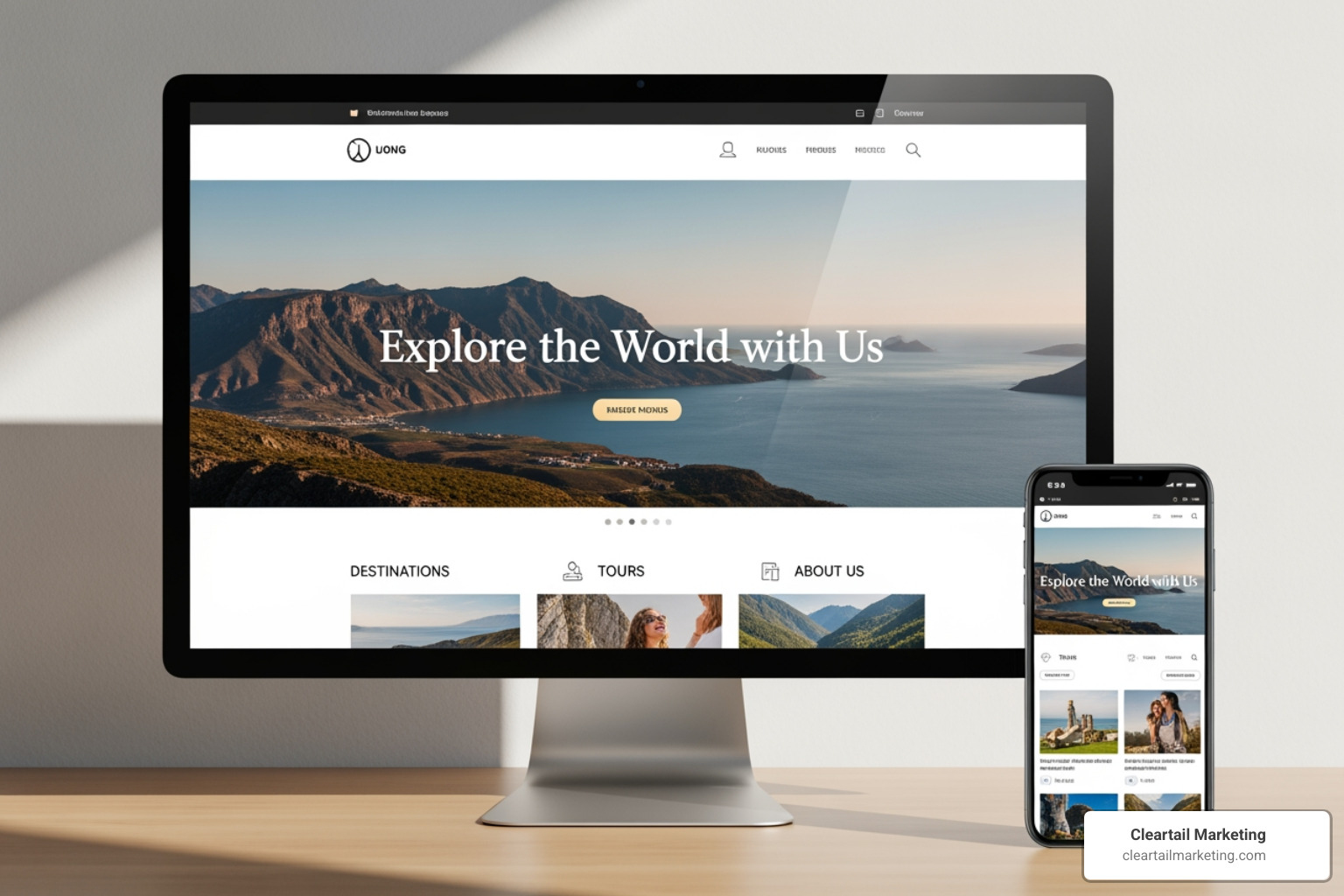
Your homepage must instantly tell visitors who you are and what you do. In the 0.05 seconds it takes to form an opinion, a strong welcome message and clear visual hierarchy confirm they’re in the right place.
Since 61% of people leave a site if they can’t find what they need in five seconds, intuitive navigation is critical. It should feel natural, not like a confusing map.
We organize sites around the user journey. For example, a plumber’s site navigation should follow a visitor’s natural flow: services, service area, reviews, then contact. For complex sites, we ‘silo’ content into distinct sections to keep related information together and easy to find. Your website is for your customers, so view it through their eyes.
Compelling Calls-to-Action (CTAs)
A website without clear Calls-to-Action (CTAs) is like a store with no staff or signage—frustrating. CTAs guide visitors to the next step with action-oriented language like “Call Now,” “Get a Quote,” or “Book an Appointment.”
CTA button design is crucial. They must stand out with contrasting colors and prominent placement. For example, a tree service needs a visible “Call Now” button for emergencies, while a salon might prioritize “Book Online” for convenience.
Place CTAs strategically where users pause to make decisions, such as after a service description or testimonial. The goal is to make it easy for them to convert.
Mobile-Friendly and Fast
With 45% of website visits in North America coming from mobile devices, your site must work perfectly on smartphones. If it doesn’t, you’re turning away nearly half your potential customers.
Google’s mobile-first indexing, announced in 2016, means your mobile site is primary for search rankings. The mobile experience is the main event.
Responsive design ensures your site adapts to any screen size. Buttons become finger-friendly, text stays readable, and photos resize perfectly.
Speed is another common hurdle. Since 40% of visitors abandon a site that takes longer than three seconds to load, slow speeds frustrate users and hurt search rankings. Every extra second of load time costs you customers.
You can use Google’s Mobile-Friendly Test Tool to check your site’s performance. A fast, mobile-friendly website is essential for meeting user expectations.
Inspiring Website Design Examples for Local Businesses
Let’s look at real-world examples of effective website design for local business. These sites show how different industries use design to attract customers, build trust, and drive conversions.
Service-Based Businesses (Trades, Salons, Consultants)
For service-based businesses, websites must immediately convey trust and professionalism, especially for urgent needs like a late-night plumber or a new hair stylist.
A local tree service company like Galan Tree Service uses a prominent “Call Now” button for urgent needs. The site builds trust with clear service offerings, quality images of their work, and testimonials, all within a professional design.
A boutique salon like Solo Salon uses a neat design and high-quality imagery to reflect its brand. An integrated online booking system offers 24/7 convenience. The calming colors and neat typography create a luxurious experience that reinforces their brand identity.
An accounting firm’s website must be reassuring. JWL Accountants achieves this with a clean layout, clear headlines, and professional photos to build credibility. They make a dry subject engaging, which is ideal for clients seeking financial help.
Food & Beverage (Restaurants, Cafes, Breweries)
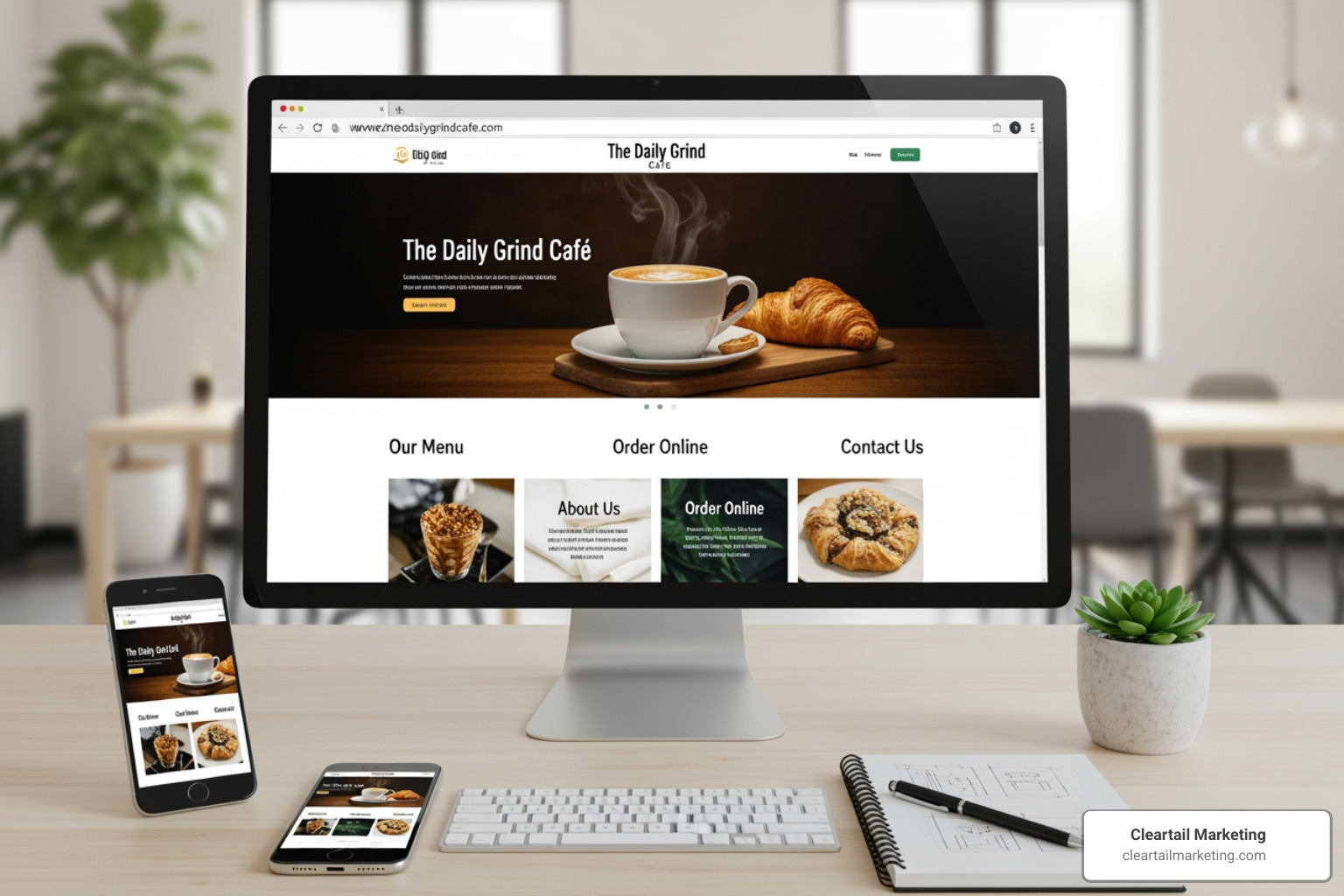
Food and beverage websites must make visitors hungry or thirsty and then provide an easy way to order or visit.
A modern eatery like Chez Felix Gourmet uses bold fonts and fun colors to create a vibrant feel. Simple navigation makes it easy to find menus and location info. Most importantly, the food photography must be mouth-watering.
Local breweries like Saw Mill Brewery can showcase their personality through brand-aligned design. Successful sites often integrate e-commerce for merch and beer, highlight taproom events, and tell their story to build a community feel.
A neighborhood restaurant like Loro Eats uses mouth-watering photos and a simple layout that prioritizes online ordering or reservations. The warm, inviting design encourages repeat business and makes it the obvious choice for dinner.
Retail & E-commerce
For retail, the website is a primary sales channel. The design must be visual, intuitive, and offer a seamless checkout to reduce cart abandonment.
Specialty foods retailers like Partake Foods succeed with mobile optimization, strong visuals, and a clear value proposition. A mobile-first approach with clickable calls to action is essential for capturing sales on the go.
Gift shops like Tattly use a playful design that matches their products. Easy-to-browse categories, high-quality photos, and a seamless checkout encourage purchases. The delightful experience is perfect for gift shopping.
Key Considerations for Your Website Design for Local Business
Effective website design for local business goes beyond aesthetics. Foundational technical and strategic choices, from domain registration to content management, determine your site’s success. For an overview, see A beginner’s guide to making a website.
Your domain name should be short, memorable, and related to your business, avoiding numbers and hyphens. After securing a domain, choose a hosting provider. Shared hosting is fine for simple sites, but growing businesses may need a VPS or dedicated hosting for more power.
Website security is non-negotiable. With small businesses frequently targeted by hackers, robust measures are essential. SSL certificates, secure payment pages, and clear privacy policies build customer trust by showing you take their safety seriously.
Plan for long-term content management. Your site needs regular updates to stay relevant. A Content Management System (CMS) allows you to make changes without code, keeping your site dynamic and engaging as your business evolves.
Choosing a Website Design Partner: Why Work with a Professional Agency
DIY website builders are tempting for their affordability and control. However, they often become time-consuming and lack the sophisticated design and SEO foundation needed to be competitive.
This is where partnering with a professional agency like Cleartail Marketing makes a real difference.
| Feature | DIY Website Builder (Going it Alone) | Professional Agency (e.g., Cleartail Marketing) |
|---|---|---|
| Design Quality | Limited templates, can look generic, requires design eye | Custom, unique design reflecting brand, visually stunning, professional |
| Customization | Restricted by platform features, less flexibility | Custom to specific business needs, scalable, advanced functionality |
| SEO Optimization | Basic tools, requires deep SEO knowledge, easy to miss key factors | Built from the ground up for SEO, local SEO expertise, ongoing optimization |
| Time & Effort | Significant time investment, steep learning curve | Hands-off for business owner, efficient process, quicker launch |
| Technical Support | Self-service, community forums, limited direct support | Dedicated support, maintenance, security monitoring, troubleshooting |
| Strategic Guidance | None, relies on owner’s marketing knowledge | Expert advice on marketing strategy, conversion optimization, market insights |
| Cost | Low monthly fees, hidden costs for advanced features | Higher initial investment, but often higher ROI and long-term value |
| Credibility | Can appear less professional if not expertly done | Improves legitimacy and trustworthiness, stands out from competitors |
A professionally designed website boosts your brand’s legitimacy. At Cleartail Marketing, we build custom, non-templated sites with SEO and conversion elements baked in. This reflects your unique brand and sets you apart from competitors using cookie-cutter solutions.
Our services include WordPress design, hosting, SEO, and ongoing support. You get a site that looks great and performs, driving leads while you focus on your business. We know a great website is an investment that pays dividends.
Local SEO: The Secret to Success for Website Design for Local Business
A beautiful website is useless if local customers can’t find it. Local SEO is essential, optimizing your online presence to attract nearby customers searching for your services.
Your Google Business Profile is the cornerstone of local SEO, often appearing before your website in search results. Optimizing it with accurate info and local keywords is crucial. We also ensure NAP (Name, Address, Phone Number) consistency across all online directories to avoid confusing search engines and customers.
On-page SEO means naturally weaving local keywords into your content. For example, a bakery might target “best sourdough in Portland.” We use tools like Ahrefs for keyword research. Local photos of landmarks or your storefront also signal your location to users and search engines.
Schema markup acts as a translator for search engines, helping Google understand your business details like address and hours. This improves your chances of appearing in local search results and rich snippets. Following Google’s business guidelines is key for local search success.
Ensuring Website Accessibility for All
Inclusive website design for local business ensures your site works for everyone, including people with disabilities. This is not only the right thing to do but also a legal requirement, as emphasized by the Americans with Disabilities Act web rule.
Accessible design includes providing alt text for images for screen readers, ensuring sufficient color contrast for low-vision users, and enabling keyboard-only navigation.
We adhere to the latest web content accessibility guidelines (WCAG) to meet established standards. This broadens your customer base, shows social responsibility, and helps avoid legal issues. Accessibility ensures your digital doors are open to everyone.
Frequently Asked Questions about Local Business Websites
Here are answers to common questions about website design for local business.
How much does a website for a local business cost?
The cost of a website varies widely, much like the cost of a car. It all depends on what you need.
DIY platforms like Wix (from $17/month), Squarespace (from $16/month), or Shopify (from $29/month) offer plans from roughly $10 to $50 monthly. WordPress.org is free software but requires paid hosting. While DIY seems affordable, costs can rise with advanced features.
When you hire a professional agency, the investment varies based on complexity. A simple, custom site might start in the low thousands, while more sophisticated sites can cost significantly more. Some agencies offer tiered packages for different needs, and comprehensive SEO services can be an additional monthly cost.
Remember ongoing costs: domain registration ($10-$20/year), hosting ($3+/month), and maintenance. Maintenance includes security, content updates, and performance monitoring, which may be bundled or charged separately.
A quality website is an investment that pays dividends through lead generation and increased credibility. It works for you 24/7, bringing in customers even while you sleep.
What are the most important pages for a local business website?
While every business is unique, several essential pages form the backbone of an effective local business website.
Your Homepage is your digital storefront. It must immediately communicate who you are, what you offer, and why it matters, using compelling visuals and clear CTAs.
The About Us page builds a connection by sharing your story, mission, and what makes you different. It helps build the know, like, and trust factor.
Your Services or Products pages should detail your offerings with dedicated pages. Use high-quality images and informative descriptions to showcase your work.
Make it easy for customers to reach you with a dedicated Contact page. Include your phone, email, address, map, hours, and a contact form. Make contact info prominent and mobile-friendly.
A Testimonials or Reviews page is crucial for building trust. According to BigCommerce, 92% of consumers read testimonials before purchasing, so feature written or video reviews.
Finally, a Blog or Resources section is optional but valuable for SEO. It demonstrates expertise, answers customer questions, and communicates your brand’s personality.
How can I measure my website’s success and ROI?
Measuring your website’s success and ROI is key to understanding what’s working. We build sites that deliver measurable results.
Track key metrics with tools like Google Analytics. Traffic data shows visitor volume, sources (search, social, etc.), and overall visibility trends.
Conversions are the most important metric. These are desired actions like form submissions, purchases, or calls. We set up conversion tracking to measure these valuable actions.
Your bounce rate (visitors who leave after one page) indicates engagement. A high rate may signal that visitors aren’t finding what they need.
Page views and click paths reveal popular pages and user journeys, helping identify roadblocks. Time on page is another indicator of engagement.
Regularly analyzing these metrics allows for strategic refinement, such as content optimization or A/B testing headlines and CTAs. This data-driven approach ensures your website design for local business continuously improves and delivers a strong ROI.
Conclusion
Your website is a 24/7 growth tool. It works around the clock to build credibility, answer questions, and convert visitors into customers.
This guide covered what makes website design for local business effective: fast first impressions, mobile-friendliness, and clear CTAs. We’ve seen inspiring examples from various industries that show how thoughtful design serves both the business and its customers.
Your website is your digital storefront and must reflect your professionalism. By prioritizing user experience, speed, mobile optimization, and local SEO, you create a site that doesn’t just look good—it performs.
At Cleartail Marketing, we help local businesses transform their online presence. We create custom, results-driven websites that establish credibility and visibility. We don’t use cookie-cutter templates; we build sites that tell your unique story and drive action.
Whether starting from scratch or upgrading, this investment will pay dividends. Your competitors are online, and your customers are searching. The question isn’t if you can afford a professional website—it’s if you can afford not to have one.
Ready to stop losing customers to competitors with better websites? Get a professional website that drives results and start turning your online presence into your hardest-working employee.
