



WHY UNDERSTANDING WEBSITE HOSTING COST MATTERS FOR YOUR BUSINESS
WEBSITE HOSTING COST IS A KEY EXPENSE WHEN BUILDING YOUR ONLINE PRESENCE, BUT PRICING CAN BE CONFUSING. WITH PLANS RANGING FROM A FEW DOLLARS TO HUNDREDS PER MONTH AND HIDDEN FEES, IT’S EASY TO GET CAUGHT OFF GUARD.
Quick Answer: What Does Website Hosting Actually Cost?
| Hosting Type | Monthly Cost Range | Best For |
|---|---|---|
| Shared Hosting | $2 – $20 | Small websites, blogs, beginners |
| VPS Hosting | $10 – $100 | Growing sites, e-commerce stores |
| Dedicated Hosting | $80 – $500+ | Large businesses, high-traffic sites |
| Cloud Hosting | $10 – $200+ | Sites with fluctuating traffic |
| WordPress Hosting | $3 – $25 | WordPress-specific optimization |
Most small businesses spend between $5 and $50 per month on hosting, but the base price isn’t the full story. Add-ons like domain names, SSL certificates, and email hosting increase your total cost. The right hosting type depends on your needs; a cheap shared plan won’t support a growing e-commerce store, while a powerful dedicated server is overkill for a simple blog.
Understanding renewal rates is critical. Low introductory prices often require long-term commitments and can triple or quadruple upon renewal. A plan advertised at $2.49/month might renew at $10/month or more.
I’m Magee Clegg, founder of Cleartail Marketing. Since 2014, I’ve helped over 90 B2B companies balance hosting performance and budget. This guide will clarify what you’re paying for, what to watch out for, and how to choose hosting that supports your business growth.
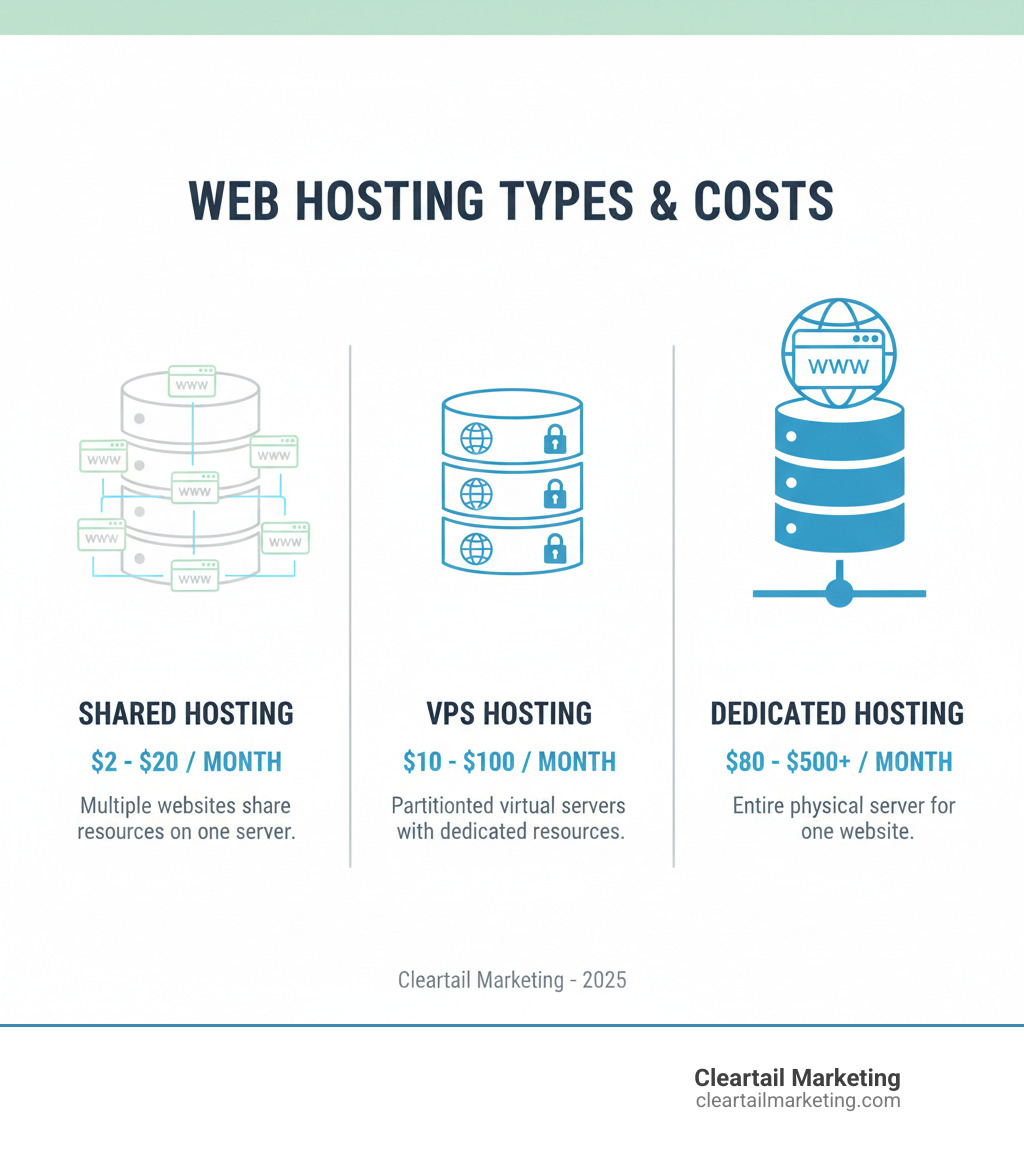
Understanding the Main Types of Web Hosting
Not all hosting is the same. The right type depends on your website’s size, traffic, and technical needs. At Cleartail Marketing, we help businesses in the US and Canada match their hosting to their actual requirements. To see what makes sense for you, you can Compare Hosting Plans.

Shared Hosting
Shared hosting is like an apartment building: multiple websites share one server’s resources. This makes it the most affordable option, ideal for personal blogs, small business sites, and websites with low traffic.
- Cost: $2 – $20 per month.
- Trade-off: Performance can be affected by other sites on the server, and you have less control. It’s a great value for beginners.
Virtual Private Server (VPS) Hosting
VPS hosting is a step up, like a condo. You still share a server, but a section is partitioned just for you with guaranteed resources. It’s perfect for growing websites, e-commerce stores, and businesses that have outgrown shared hosting. You get better performance and more control.
- Cost: $10 – $100 per month.
- Key Distinction: Managed VPS means the provider handles server maintenance, while self-managed requires you to do it, costing less but demanding technical skill. We recommend managed VPS for most businesses.
Dedicated Server Hosting
With dedicated hosting, you rent an entire physical server. All resources—CPU, RAM, and storage—are exclusively yours. This option is built for large businesses and high-traffic websites that require maximum performance, security, and control.
- Cost: $80 – $500+ per month.
- Requirement: Managing a dedicated server requires significant technical expertise, or you’ll need a more expensive managed plan.
Cloud Hosting
Instead of one server, cloud hosting uses a network of connected servers. If one fails, another takes over, making it incredibly reliable and scalable. It’s ideal for sites with fluctuating traffic, as resources can be adjusted on the fly.
- Cost: $10 – $200+ per month, often with pay-as-you-go models that can scale.
Specialized Hosting (WordPress & E-commerce)
Some platforms benefit from optimized hosting.
WordPress hosting is custom for sites built on WordPress, which powers over 43.4% of all websites. It offers speed and security optimizations, plus expert support. Costs typically range from $3 to $25 per month. For more details, see our guide on WordPress Hosting Cost.
E-commerce hosting provides features for online stores, like payment processing and inventory tools. For stores using WooCommerce, specialized plans are available. Costs generally range from $15 to $50+ per month, justified by the security needed for transactions. Learn more in our guide on the Cost of Hosting a Website on WordPress.
Key Factors That Influence Your Website Hosting Cost
Beyond the hosting type, your final website hosting cost is determined by the resources you need, your contract length, and the level of management you choose. Making decisions based on the advertised price alone can lead to surprises. Let’s break down the factors that determine your actual cost.

Server Resources & Performance
More powerful server components mean better performance but a higher price. Key resources include:
- CPU (Processing Power): The server’s brain. More power handles more visitors and complex tasks.
- RAM (Memory): The server’s short-term memory. More RAM allows it to manage more processes at once without slowing down, which is crucial for traffic spikes.
- Storage: SSD (Solid State Drive) storage is much faster than traditional HDD and is the standard for quality hosting. The amount you need depends on your site’s content (text vs. high-resolution media).
- Bandwidth: This is the amount of data your site can transfer to visitors. High-traffic or media-heavy sites need more. “Unmetered” plans usually have fair use policies.
- Uptime Guarantee: A 99.9% uptime guarantee is standard and reflects a provider’s investment in reliable infrastructure. The cost is worth it to avoid lost revenue from downtime.
Contract Length: Monthly vs. Annual
Your contract term can dramatically change your monthly cost. Hosting providers offer steep discounts for long-term commitments, but there’s a catch.
- Long-term contracts (1-4 years) offer the lowest monthly rates but require upfront payment. For example, a plan might be $3/month on a 3-year contract but $10/month if paid monthly.
- Monthly plans offer flexibility to cancel anytime but come at a premium price.
Crucially, always check the renewal rate. The low introductory price will jump significantly after the first term, revealing the true long-term cost.
Managed vs. Self-Managed Hosting
This choice comes down to convenience versus cost.
- Managed hosting means the provider handles server administration, including setup, security patches, updates, and backups. It costs more but saves you time and frees you from complex technical tasks. For most businesses, the extra cost is a worthwhile investment in reliability and peace of mind.
- Self-managed hosting puts you in control of all server administration. It’s cheaper upfront but requires technical expertise. If you lack the skills, you could face costly downtime or have to hire a specialist to fix issues.
Server Location
The physical location of your server impacts your website’s speed for your visitors.
- Proximity Matters: Data travels faster over shorter distances. If your audience is in the US and Canada, a server in North America will provide lower latency and faster page load times.
- Speed and SEO: Faster load times improve user experience and are a known Google ranking factor.
- Content Delivery Network (CDN): A CDN can solve the distance problem for a global audience. It’s a network of servers that delivers content from the location closest to the visitor. Many hosting plans include a basic CDN, with advanced options available as an add-on.
Beyond the Plan: Hidden & Additional Website Costs
The advertised website hosting cost is rarely your final bill. Several “extras” can significantly increase your budget, so it’s important to plan for them. For a full overview, see our Domain Hosting Price Comparison.

Domain Name Registration
Your domain name (e.g., yoursite.com) is your website’s address. It typically costs $10-$20 per year. Many hosts offer a free domain for the first year, but you’ll have to pay for renewals. Also consider domain privacy protection ($5-$15/year) to keep your personal information out of the public WHOIS database.
SSL Certificates
The padlock icon in a browser’s address bar signifies an SSL certificate, which encrypts data and builds trust. It’s essential for security and SEO, as Google prioritizes ranking sites with SSL certification. Fortunately, most hosts now include a free SSL certificate. Paid certificates ($8-$1,000/year) offer higher levels of identity verification but not stronger encryption.
Professional Email Hosting
A custom email address like [email protected] looks far more professional than a generic Gmail address. While basic hosting plans often include a few free accounts, you may need to upgrade for more mailboxes or features. Dedicated services like Google Workspace or Microsoft 365 cost $1-$15 per month per user.
The True Website Hosting Cost of Themes & Plugins
For platforms like WordPress, themes and plugins add design and functionality. While many are free, premium options offer better support and features.
- Premium Themes: $20 – $100+ one-time fee.
- Premium Plugins: $5 – $1,000+ per year, often as subscriptions.
Costs for e-commerce extensions, security tools, and performance plugins can add up to several hundred dollars annually on top of your hosting fee.
Backups, Security, and Migration
These services are your website’s insurance policy.
- Backups: Many hosts include automated backups, while others charge $2-$10 per month. Always have a backup plan.
- Security: Advanced security like malware scanning can cost $5-$50+ per month but is a vital investment. We recommend choosing Reliable Hosting Providers that prioritize security.
- Migration: Moving your site to a new host may be free or cost a one-time fee of $50-$200. Professional migration is worth it to avoid data loss.
Frequently Asked Questions about Website Hosting
Here are answers to some of the most common questions we hear at Cleartail Marketing from businesses in the US and Canada about website hosting cost.
Can I host a website for free?
Yes, but it’s not recommended for any serious business. Free hosting comes with significant drawbacks that undermine your credibility:
- Unprofessional Domain: You’ll be forced to use a subdomain (e.g., yoursite.wordpress.com) instead of a custom domain.
- Forced Ads: The provider will place ads on your site that you don’t control.
- Poor Performance: Limited storage and bandwidth lead to slow speeds and potential crashes.
- No Support: You’re on your own when things go wrong.
Free hosting is fine for a personal hobby, but it’s too risky for a business’s reputation.
What is a reasonable website hosting cost for a small business?
For most small businesses, a reasonable hosting cost is between $5 and $30 per month. This range typically covers high-quality shared hosting or managed WordPress hosting.
A plan in the $5-$10/month range is a great starting point. As your site grows, you may upgrade to a more robust plan ($10-$25/month) for better performance and security.
The key is to focus on reliability and support, not just the lowest price. A cheap but unreliable host will cost you more in lost business than you save. The right website hosting cost is an investment in a fast, secure, and accessible online presence.
What features should be included in a standard hosting plan?
When comparing plans, look for these essential features to be included, not offered as pricey add-ons:
- Sufficient SSD Storage & Bandwidth: Enough to handle your files and traffic without slowdowns.
- 99.9% Uptime Guarantee: This is the industry standard and is non-negotiable for a business site.
- 24/7 Customer Support: Access to help whenever you need it is crucial.
- User-Friendly Control Panel: A dashboard like cPanel for easy site management.
- 1-Click Installers: For easily setting up applications like WordPress.
- Free SSL Certificate: Essential for security, trust, and SEO. Google prioritizes ranking sites with SSL certification.
A quality plan includes these basics. If a provider charges extra for them, it’s a red flag. For help finding a provider that includes these, see our list of Reliable Hosting Providers.
Conclusion: Making a Smart Hosting Investment
Choosing a host isn’t about finding the cheapest plan; it’s about finding the best value. The right website hosting cost balances performance, reliability, and your budget. Match your hosting type to your website’s current needs—whether it’s a small blog or a growing e-commerce store—but always plan for future growth.
Remember to look beyond the low introductory price and factor in renewal rates and the cost of essential add-ons like domains, email, and plugins. The true cost of cheap hosting isn’t the low monthly bill, but the potential for lost revenue from downtime, slow speeds, and poor security. This is why we always emphasize reliability and support over rock-bottom pricing.
Your website should be an asset that grows with your business, not a liability that holds it back. Choose a provider that offers scalable solutions and makes it easy to upgrade. For a complete budget planner, explore our detailed guide on Website Hosting Costs.
At Cleartail Marketing, we help businesses in the US and Canada make smart digital investments. Our hosting solutions deliver dependable performance, and we offer a full suite of digital marketing services—from SEO and WordPress development to reputation management—to fuel your growth. Investing in quality hosting ensures your website makes a great first impression. Choose a partner who is as invested in your success as you are.
