



Why Bad Reviews Can Make or Break Your Business
Bad review removal is possible when reviews violate platform policies. Success requires understanding specific guidelines and following proper procedures. Here’s what you need to know:
Legitimate reasons for removal:
- Reviews containing hate speech, profanity, or threats
- Spam or fake reviews from non-customers
- Reviews posted by competitors or with conflicts of interest
- Content that violates platform-specific terms of service
- Reviews containing private or confidential information
When removal isn’t possible:
- Honest customer opinions, even if negative
- Reviews that comply with platform policies
- Feedback you simply disagree with
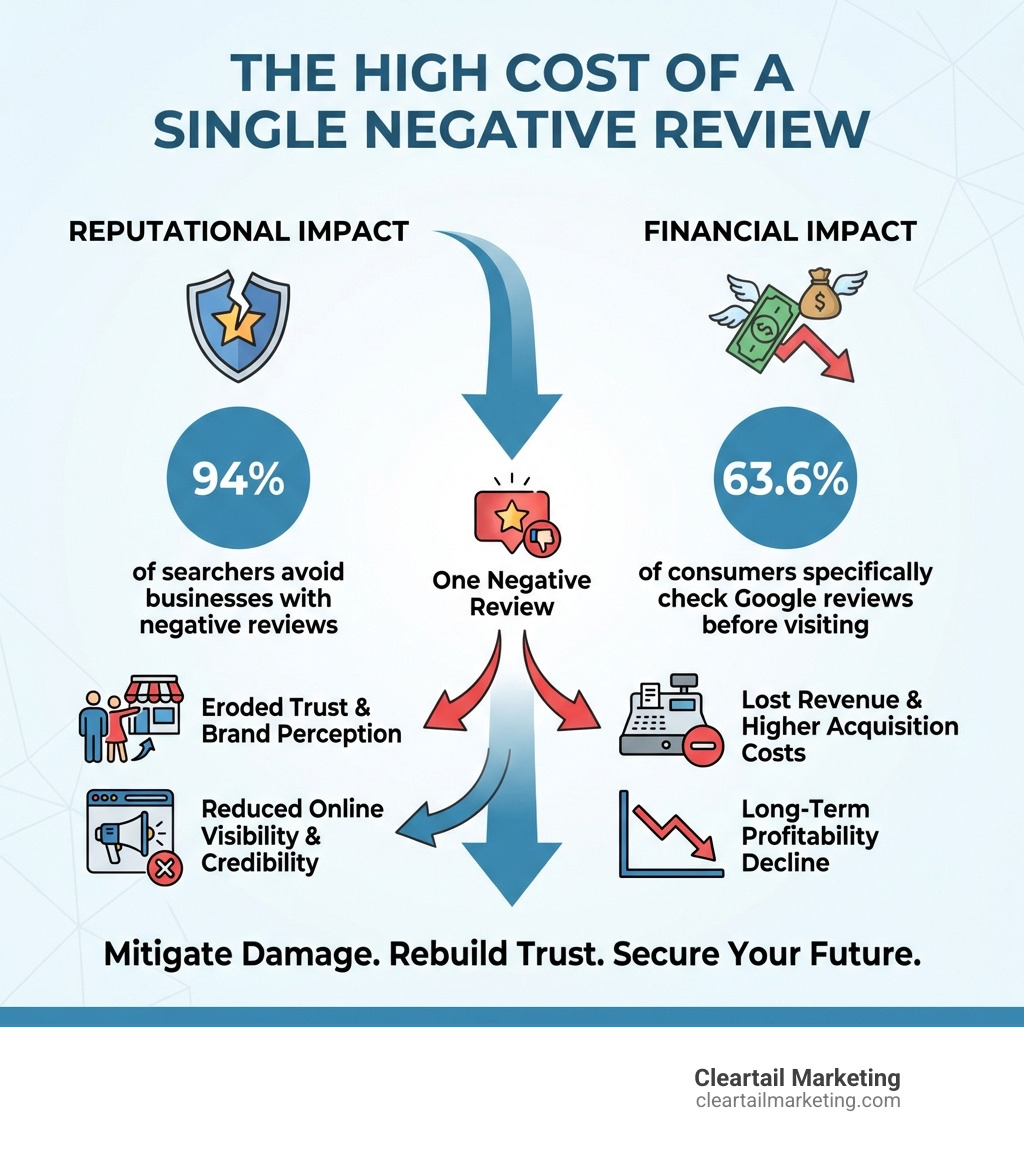
The stakes are high: 94% of searchers will avoid businesses with negative reviews, according to recent research. A single damaging review can cost you thousands, especially when 63.6% of consumers specifically check Google reviews before visiting a business.
It takes years to build a reputation but only seconds to destroy it. One automotive dealer’s rating plummeted from 4.6 to 1.7 overnight due to a fake review campaign by an ex-employee. The impact was immediate: phone calls dropped and showroom traffic vanished.
While you can’t remove every negative review, you can address illegitimate ones through proper channels and implement strategies to minimize damage and rebuild trust.
I’m Magee Clegg, founder of Cleartail Marketing. We’ve helped dozens of clients with bad review removal and reputation recovery, even generating 170 5-star reviews in two weeks for one business. Knowing which reviews can be removed and how to manage the rest is essential for protecting your brand.
Why Every Business Must Address Negative Reviews
Your online reputation is as crucial as your physical storefront. Negative reviews are potential crises that impact customer acquisition, brand perception, and revenue. Since 94% of searchers avoid businesses with negative reviews and 63.6% check Google reviews, managing your online presence is vital.
This isn’t just about avoiding a bad look; it’s about survival. Online reviews are the new word-of-mouth, heavily influencing consumer decisions. As we emphasize in our guide, Why is Online Reputation Management Important?, managing your online presence is foundational to Building Brand Trust and securing your future.
The Real Reasons Businesses Seek Review Removal
Businesses seek bad review removal for legitimate and often damaging reasons:
- Fake Reviews: Reviews from individuals who were never customers, often designed to harm a business. These can be from trolls or ruthless competitors.
- Competitor Sabotage: Rivals posting fabricated negative reviews to damage your standing.
- Disgruntled Ex-Employees: Former employees orchestrating campaigns of false negative reviews. One of our clients saw their rating plummet from 4.6 to 1.7 due to such an attack.
- Defamatory Content: Reviews containing untrue, libelous statements designed to harm your business’s reputation.
- Policy Violations: Content that breaks platform rules (e.g., hate speech, spam, private information, off-topic rants).
- Inaccurate Information: Reviews with significant factual errors about your services or products.
- Irrelevant Feedback: Feedback about a different business or something outside your control, like a third-party delivery service.
Navigating these challenges requires a clear strategy, as outlined in our Business Reputation Crisis Ultimate Guide. Our goal is to help businesses identify and address these unfair attacks.
Legitimate Bad Review Removal: Working Within Platform Policies
When facing unfair negative feedback, the first step is exploring legitimate bad review removal options on the platforms themselves. This DIY approach can be time-consuming but is a crucial starting point. Success depends on understanding and following each platform’s specific guidelines.
Platforms like Google, Yelp, and Etsy are generally unwilling to remove reviews simply because they’re negative. However, if a review violates their specific content policies, you have a strong case for removal.
The reporting process involves flagging the review and explaining the violation. Be patient and persistent; initial rejections are common, but with proper documentation, you can often succeed. As we share in our Small Business Review Management Tips, preparation and evidence are key.
Understanding What Qualifies for Removal
Knowing what constitutes a removable offense is half the battle. While each platform has its own rules, there’s significant overlap:
| Criteria | Google Reviews | Yelp Reviews | Etsy Reviews |
|---|---|---|---|
| Hate Speech | Prohibited | Prohibited (lewd, threatening commentary) | Prohibited (Anti-Discrimination Policy) |
| Spam | Prohibited (fake engagement, promotional) | Prohibited (solicitations) | Prohibited (advertising or spam) |
| Conflict of Interest | Prohibited (biased, compensated) | Prohibited (competitors, employees, incentives) | Prohibited (shilling, falsely inflate score) |
| Off-topic | Prohibited (personal opinions, political) | Prohibited (not personal consumer experience) | Prohibited (solely outside seller’s control) |
| Private Information | Prohibited (doxxing, personal data) | Prohibited (private info about employees/patrons) | Prohibited |
| Impersonation | Prohibited | N/A (covered by conflict of interest) | N/A |
| Threats/Extortion | Prohibited | Prohibited | Prohibited |
| Illegal Content | Prohibited | N/A | N/A |
| Misleading/False | Prohibited (fake engagement, misrepresentation) | N/A (focus on personal experience) | N/A (seller communication, item description) |
Google’s guide on Report inappropriate reviews on your Business Profile confirms that only policy-violating reviews are removable. Similarly, Yelp’s Yelp’s Content Guidelines target reviews from competitors or those not based on personal experience. Etsy is clear that it “cannot judge the accuracy of a buyer’s statement” unless it violates a listed policy. The key takeaway is to focus on demonstrable policy violations, not just opinions you dislike.
A Step-by-Step Guide to Reporting Illegitimate Reviews
Reporting an illegitimate review is a structured process that can lead to successful bad review removal.
-
For Google Business Profile:
- Go to your Google Business Profile, find the review, click the three dots, and select “Report review.” Choose the reason and submit. For appeals or multiple reports, use the Reviews Management Tool. You can also submit a one time appeal of a review if your initial flag is rejected. Have evidence like screenshots ready for appeals.
-
For Yelp for Business:
- Log in to your Yelp for Business account and go to the “Reviews” section. Find the review and click “Report review.” Select the violation and provide specific evidence, as Yelp states, “Mere suspicion usually isn’t enough for removal.”
-
For Etsy Sellers:
- From your Shop Manager, go to “Reviews,” find the review, and click “Report.” Add any relevant info. Etsy won’t remove reviews for opinions on quality unless a specific Etsy’s policies is violated.
-
For Facebook Business Suite:
- On your Facebook Page, go to the “Reviews” or “Recommendations” section. Click the “…” menu on the review and select “Report” or “Give feedback on this review.” Follow the prompts to select a reason.
Following Up and Appeals: Results aren’t instant. Review evaluation can take days or weeks. You can check the status of Google reports in the Reviews Management Tool. If a report is rejected, use the platform’s appeal process with your documented evidence. Effective Google My Business Reputation Management often requires persistence.
Professional Review Removal Services: The Pros and Cons
Sometimes, the DIY approach to bad review removal isn’t enough. Complex cases, unresponsive platforms, or a lack of time can make professional help necessary. This is where reputation management agencies like Cleartail Marketing come in.
When to Hire Experts:
- Complex Violations: When a violation is nuanced or skirts policy edges.
- Lack of Time/Resources: For busy owners who need to focus on their business.
- Persistent Issues: When facing a barrage of fake reviews or a stubborn review that platforms won’t remove.
- High Stakes: When a negative review is significantly impacting revenue or brand image.
When vetting a service, look for transparency, policy expertise, and realistic expectations. Many reputable agencies operate on a “pay-for-success” model, meaning you only pay if the review is removed. Companies like Removify and RemoveBadReviews.com advertise this model, but no legitimate service can guarantee 100% removal.
Choosing the right partner is vital, as highlighted in our guide to Expert Reputation Repair Agencies.
How Reputable Removal Companies Operate
Reputable bad review removal companies use specialized knowledge and persistent effort, not shady tactics. Here’s how trusted agencies operate:
- Policy Expertise: We possess an in-depth understanding of evolving platform guidelines to spot nuanced violations that a business owner might miss.
- Legal Knowledge: Some firms bring legal expertise to the table, framing removal requests based on defamation laws where applicable.
- Direct Platform Communication: Professionals often have established channels or a deeper understanding of how to effectively communicate with platform moderators.
- Case Building: This involves gathering evidence, documenting the violation, and presenting a compelling argument to the platform.
- Persistent Follow-Up: Reputable services don’t give up after an initial rejection. They appeal and re-submit requests, often refining their arguments.
- Legitimate Strategies: Ethical firms only use “white-hat” techniques based on genuine policy violations. We at Cleartail Marketing pride ourselves on this approach.
This systematic, expert-driven approach is what makes professional services effective, as detailed in How does online reputation management work?.
The Cost and ROI of Professional Bad Review Removal
The cost of professional bad review removal varies, but it should be viewed as an investment in your brand’s integrity and bottom line.
Service Pricing Models:
- Per-Review Cost: Many “pay-for-success” models charge a flat fee (from a few hundred to over a thousand dollars) for each successful removal.
- Monthly Retainers: Broader online reputation management (ORM) services often include removal efforts under a monthly retainer.
- Project-Based Fees: For larger reputation crises, a project-based fee might be negotiated.
For more details, see our guides on Reputation Management Price and Average Cost of Online Reputation Management.
Value vs. Cost (ROI):
View the cost as an investment, not an expense. Negative reviews cause lost revenue, so removing them offers a clear return. Calculate the ROI: if 94% of searchers avoid businesses with negative reviews, and a single negative review deters just a few customers, the lost revenue can easily exceed the cost of removal. A cleaner online profile boosts consumer confidence and makes your marketing more efficient. The cost of inaction can far outweigh the investment in professional bad review removal.
The Dangers of Deceptive Tactics and Legal Pitfalls
While the desire for bad review removal is intense, not all methods are ethical or legal. Engaging in deceptive “black-hat” tactics carries significant risks and can lead to severe consequences.

Legal Consequences and the Consumer Review Fairness Act (CRFA)
The legal landscape has evolved to protect consumers and penalize deceptive practices.
- Non-Disparagement Clauses: The Consumer Review Fairness Act (CRFA) of 2016 made it illegal for businesses to use contract clauses to threaten or penalize customers for leaving honest, critical reviews. The BBB warns this erodes trust and can lead to trouble with the FTC.
- FTC Warnings and Fines: The U.S. Federal Trade Commission (FTC) fines businesses for manipulating reviews, such as suppressing negative feedback or buying fake ones. Such actions lead to substantial penalties and reputational damage.
- Amazon’s Anti-Manipulation Policy: Platforms like Amazon aggressively enforce their own rules. Amazon’s Anti-Manipulation Policy for Customer Reviews can lead to suspension, removal of reviews, and forfeiture of payments for violators.
- ACCC Rules (Australia): Internationally, regulations like those from the Australian Competition and Consumer Commission (ACCC) make it illegal to create or arrange for fake reviews, with significant penalties for offenders.
Using deceptive tactics for bad review removal is a short-sighted strategy with severe risks. At Cleartail Marketing, we always advise clients to prioritize ethical and transparent reputation management.
When Removal Isn’t an Option: Responding and Rebuilding
Sometimes, a negative review doesn’t violate any platform policies. In these cases, bad review removal isn’t an option. However, this is an opportunity to demonstrate exceptional customer service, transparency, and a commitment to improvement.
Transparency and professionalism in your response can mitigate the impact of a negative review, as 97% of consumers read company responses to reviews. Your response is for every potential customer who reads it, not just the original reviewer. This is a critical component of how we Fix Bad Reviews for our clients.
How to Craft the Perfect Response to a Negative Review
Responding effectively requires a thoughtful approach. Here’s a blueprint:
- Acknowledge the Issue: Start by acknowledging their experience to show you’re listening.
- Apologize Sincerely (When Appropriate): If your business erred, a genuine apology is powerful.
- Take It Offline: Provide a direct contact (phone, email) to resolve the issue privately and prevent a public back-and-forth.
- Offer a Solution (If Possible): Briefly mention how you’ll address the problem to show your commitment.
- Don’t Be Defensive: Maintain a professional and respectful tone, even if you disagree.
- Highlight Positives (Subtly): Briefly reiterate your commitment to quality, but keep the focus on addressing the feedback.
Following these steps showcases your dedication to customer satisfaction. The BBB’s BBB Business Tip: How to handle negative reviews offers more insights.
Proactive Reputation Management: Your Best Defense
The best defense is a strong offense: proactive online reputation management. This means actively building a positive online presence and monitoring what’s being said about your brand.
- Review Generation Strategy: Actively encourage satisfied customers to leave reviews. Their recommendations are more powerful than advertising.
- Encouraging Positive Feedback: Make it easy for customers to leave reviews. A steady stream of positive feedback can naturally “bury” older negative ones, as many consumers consider recent reviews more relevant.
- Customer Feedback Loop: Establish systems to solicit feedback directly, allowing you to resolve issues privately before they become public complaints.
- Monitoring Tools: Use tools to track new reviews and mentions across platforms for swift responses.
- Burying Old Reviews: Generating new, positive reviews pushes older negative ones down, making them less visible and impactful.
Here are 4 simple ways to ask for more reviews:
- Verbal Requests: A polite in-person request can be very effective.
- On-Site Messaging: Use prompts on your website’s ‘thank you’ or product pages.
- Email Follow-ups: Send a polite email a few days after a purchase or service.
- Social Media Engagement: Invite customers on your social channels to share their experiences.
By focusing on these proactive measures, you can build a resilient reputation. Learn more in our guide How to Manage Your Online Reputation.
Frequently Asked Questions about Bad Review Removal
How long does it take to remove a Google review?
The timeline for bad review removal on Google varies. While some reviews may be removed in 24-48 hours, most take 1-4 weeks. Complex cases can extend to 60 days. Google typically provides an initial response to a removal request within 7 days.
Can I pay Google or Yelp to remove a bad review?
No. You cannot pay platforms like Google or Yelp to remove reviews. Legitimate bad review removal is based solely on a review violating their content policies, not on payment. Any service claiming otherwise is misrepresenting their process or using unethical methods.
Is it illegal to try and remove a bad review?
It is not illegal to request the removal of a review that violates a platform’s terms of service or the law (e.g., defamation). However, it is illegal or unethical to use deceptive tactics, suppress negative feedback in violation of the Consumer Review Fairness Act (CRFA), or buy fake reviews. These actions can lead to severe legal and reputational consequences.
Conclusion
Navigating online reviews, especially when faced with negative feedback, can feel like walking a tightrope. However, understanding the nuances of bad review removal is crucial for any business aiming to thrive in the digital age.
We’ve explored that legitimate removal is possible, but only when reviews violate specific platform policies, such as containing hate speech, being spam, or originating from a clear conflict of interest. For reviews that don’t meet these criteria, a thoughtful, professional response is your most powerful tool, changing potential damage into an opportunity to showcase excellent customer service.
Your best defense is a proactive approach to online reputation management. By consistently generating authentic positive reviews, establishing clear feedback channels, and promptly addressing concerns, you can minimize the impact of negative feedback and build a resilient, trustworthy brand.
At Cleartail Marketing, we specialize in helping businesses in the United States and Canada take control of their brand’s story. With our experience, proven results, and dedication to building strong client relationships, we equip you with the strategies and support needed to not just manage, but master your online presence. Don’t let unfair feedback define your business. Take control of your narrative and Clean Up Your Online Reputation today.
