


UNDERSTANDING WHAT YOU’LL ACTUALLY PAY FOR GOOGLE ADS
Google advertising cost varies widely, but here’s what most businesses actually spend:
| Cost Metric | Typical Range |
|---|---|
| Average Cost Per Click (CPC) | $1.99 – $4.01 (US), $1.66 (Canada) |
| Monthly Budget for Small Businesses | $1,000 – $10,000 |
| Recommended Starting Budget | $1,000 – $2,500/month |
| Daily Campaign Cost | $20 – $50 |
| Search Network Average CPC | $5.26 |
| Display Network Average CPC | Under $1.00 |
The clearest (and most frustrating) answer to “how much does Google Ads cost?” is: it depends. Your actual spend is determined by your industry, how competitive your keywords are, your Quality Score, and how well you manage your campaigns.
Unlike traditional advertising where you pay upfront for placement, Google Ads operates on a pay-per-click (PPC) model. You only pay when someone actually clicks your ad. This gives you control—but it also means costs can add up quickly if you’re not strategic.
The good news? You set your own budget limits. Whether you have $500 or $50,000 to spend, Google Ads can work for you. The key is understanding how Google determines your costs so you can maximize every dollar.
I’m Magee Clegg, founder and CEO of Cleartail Marketing, and I’ve helped 90+ B2B companies optimize their Google advertising cost strategies, including delivering a 5,000% ROI on one client’s AdWords campaign. Understanding the mechanics behind Google’s pricing is the first step to making your ad budget work harder.
HOW GOOGLE DETERMINES YOUR ADVERTISING COST
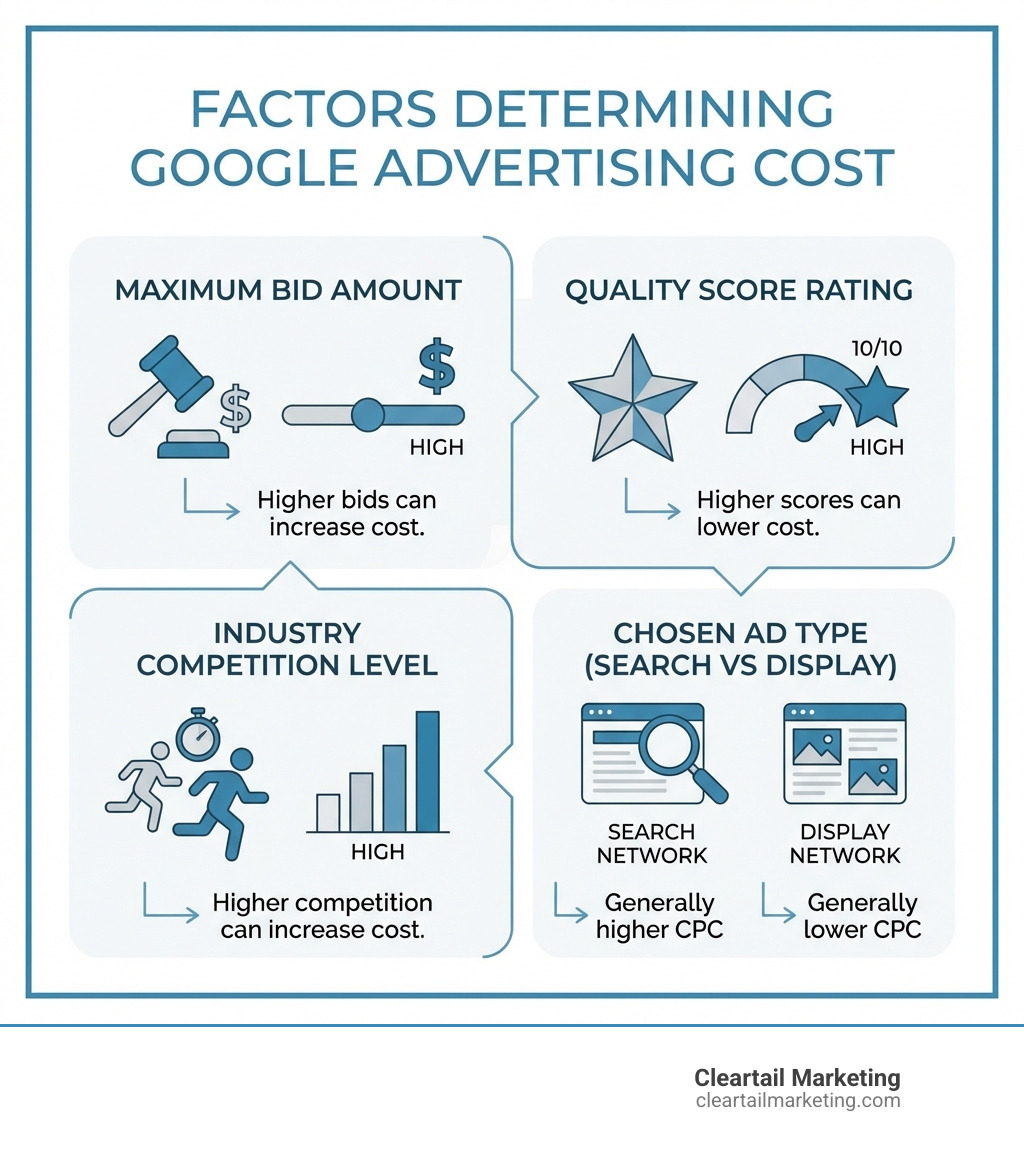
Understanding the core mechanics behind Google’s pricing model is essential for any advertiser. It’s not a fixed price list; it’s a dynamic, auction-based system where many factors come into play. We’re talking about a sophisticated process that evaluates and ranks ads for every single search query or display placement. This means that for virtually every ad impression, there’s a mini-auction happening in milliseconds.

THE GOOGLE ADS AUCTION IN ACTION
At the heart of Google Ads is a real-time auction. Every time a user types a query into Google or visits a website on the Google Display Network, an auction takes place to decide which ads will show and in what order. It’s a bit like a silent, lightning-fast bidding war.
So, how do we win this auction? It’s not just about who bids the highest. Google’s system is designed to reward relevance and quality. The key player here is Ad Rank.
Ad Rank Formula:
Ad Rank = Max. CPC Bid × Quality Score + (Impact of Ad Extensions and other ad formats)
- Max. CPC Bid: This is the maximum amount you’re willing to pay for a single click on your ad. It’s your top bid, but remember, you often pay less than this.
- Quality Score: This is Google’s estimate of the quality of your ads, keywords, and landing pages. It’s a score from 1 to 10. A higher Quality Score means your ads are more relevant and useful to users, and this can significantly lower your actual Cost Per Click.
- Impact of Ad Extensions and other ad formats: These are additional pieces of information that can be added to your ad, like phone numbers, site links, or location details. They can improve your ad’s visibility and performance, indirectly affecting Ad Rank.
The advertiser with the highest Ad Rank “wins” the auction and gets the top position. However, here’s where it gets really interesting: you don’t pay your maximum bid. Your actual CPC is determined by the Ad Rank of the advertiser directly below you, divided by your Quality Score, plus one cent. This means that by improving your Quality Score, you can pay less per click while still maintaining a high ad position. This is why focusing on ad quality is crucial for any Paid Search campaign.
DIFFERENT TYPES OF GOOGLE ADS
Google Ads isn’t a one-trick pony. It offers various ad types, each with its own purpose, reach, and cost dynamics. Understanding these differences helps us choose the right strategy for our clients.
- Google Search Ads: These are the text ads that appear above and below organic search results when users actively search for something on Google. They are highly effective for capturing demand because they target users with high commercial intent.
- Google Display Network Ads: These are visual ads (banners, images, rich media) that appear on a vast network of websites, apps, and YouTube videos. They are excellent for building brand awareness and reaching users earlier in their buying journey.
- Shopping Ads: For e-commerce businesses, these ads showcase product images, prices, and store names directly in search results, making them highly effective for driving product sales.
- Video Ads: These ads appear on YouTube and other video partner sites, great for engaging audiences with dynamic content and building brand recognition.
- App Ads: Designed to drive app installs and engagement across Google Search, Play, YouTube, and the Display Network.
Each of these ad types taps into different user behaviors and parts of the customer journey, influencing their cost and potential ROI.
KEY FACTORS THAT INFLUENCE YOUR GOOGLE ADVERTISING COST
Our Google advertising cost isn’t just a random number; it’s a dynamic outcome influenced by several key variables. Understanding these factors allows us to take control of our budget and optimize for better results.

THE CRUCIAL ROLE OF QUALITY SCORE
If there’s one concept to master in Google Ads for cost efficiency, it’s Quality Score. This metric, rated on a scale of 1 to 10, is Google’s way of telling us how relevant and useful our ads, keywords, and landing pages are to users. A higher Quality Score directly translates to lower costs and better ad positions. It’s a win-win!
Quality Score is primarily influenced by three factors:
- Expected Click-Through Rate (CTR): This is Google’s prediction of how likely users are to click our ad when it’s shown for a particular keyword. A higher expected CTR indicates that our ad is highly relevant and compelling.
- Ad Relevance: How closely our ad copy matches the intent behind a user’s search query. If someone searches for “red running shoes” and our ad is for “blue hiking boots,” our relevance will be low.
- Landing Page Experience: Once a user clicks our ad, what kind of experience do they have on our website? Google assesses factors like page load speed, mobile-friendliness, ease of navigation, and whether the content is relevant to the ad they clicked. A smooth, relevant landing page improves this score.
By focusing on these three areas, we can significantly improve our Quality Score. And when our Quality Score goes up, our CPC Meaning often goes down, allowing us to get more clicks for the same budget.
INDUSTRY AND KEYWORD COMPETITIVENESS
Just like in any market, supply and demand play a massive role in Google Ads pricing. The more advertisers vying for the same keywords, the higher the prices. This is why some industries naturally have a higher PPC Advertising Cost.
- High-competition industries: Sectors like legal services, finance, and insurance often see very high CPCs. For instance, Attorneys & Legal Services can have an average CPC of $8.58 in the US, and even higher for specific, highly valuable keywords. Dentists & Dental Services also command a higher average CPC, around $4.22. The reason? The potential customer value (lifetime value of a client) in these industries is extremely high, making advertisers willing to pay more per click.
- Low-competition industries: Other sectors, like Apparel & Fashion, tend to have lower CPCs, with averages around $0.54. While they might still bid for volume, the lower profit margins per transaction mean they can’t sustain extremely high click costs.
- Keyword Choice: The specific keywords we target also matter. Highly transactional keywords (e.g., “buy custom widgets online”) are generally more expensive than informational ones (e.g., “how custom widgets work”). Long-tail keywords (more specific, multi-word phrases) often have lower competition and thus lower CPCs than broad, generic keywords.
AD NETWORK: SEARCH VS. DISPLAY COSTS
Google Ads offers two primary networks where our ads can appear, and their cost structures differ significantly.
- Google Search Network: This is where text ads appear on Google search results pages, Google Shopping, and Google search partners. Users here are actively searching for something, indicating high intent. Because of this high intent, clicks on the Search Network tend to be more valuable and, consequently, more expensive. The average CPC for the Search Network is around $5.26.
- Google Display Network (GDN): This network consists of millions of websites, news sites, blogs, and Google sites like YouTube and Gmail. Ads here are typically visual (image, video) and are shown to users who are browsing content, not actively searching. The Display Network is excellent for building brand awareness, remarketing, and reaching a broad audience. Because the intent is generally lower (users aren’t actively looking to buy), clicks on the Display and Retargeting Network tend to be much cheaper, often averaging under $1 per click.
Choosing the right network depends on our marketing goals. If we want immediate conversions, the Search Network is usually preferred, despite higher costs. For brand building or nurturing leads, the Display Network offers a cost-effective way to stay top-of-mind.
WHAT TO EXPECT: AVERAGE GOOGLE ADS COSTS & BUDGETS
While the “it depends” answer is technically true, we know you’re looking for more concrete figures. Industry benchmarks and typical spending ranges can provide a solid starting point for our clients to plan their Google advertising cost effectively.
AVERAGE COST PER CLICK (CPC) BENCHMARKS
The average cost per click (CPC) is the most common metric for Google Ads. It tells us how much we’re paying for each click on our ads. These averages vary significantly by geography and industry.
- United States: Businesses in the US typically pay between $1.99 and $4.01 per click.
- Canada: In Canada, Google Ads costs are generally lower, with an average CPC of $1.66 in 2024, or around $1.23 in some reports.
- Highly Competitive Keywords: Some niche keywords, especially in high-value industries like legal or insurance, can skyrocket to $100+ per click. In extreme cases, we’ve even seen some personal injury lawyer keywords reach $500 per click!
To give you a clearer picture, here’s a table comparing average CPCs across various industries in the US and Canada:
| Industry | Average CPC (US) | Average CPC (Canada) |
|---|---|---|
| Attorneys & Legal Services | $8.58 | $4.05 |
| Dentists & Dental Services | $7.85 | $4.22 |
| Home & Home Improvement | $6.96 | N/A |
| Insurance | N/A | $6.10 |
| Marketing & Advertising | N/A | $3.12 |
| Apparel & Fashion | $0.54 | N/A |
| Restaurants & Food | N/A | $0.56 |
Note: Some figures are from 2024/2025, and exact numbers can fluctuate over time and depend on the specific data set.
TYPICAL MONTHLY GOOGLE ADVERTISING COST FOR SMALL BUSINESSES
For many small and mid-sized businesses (SMBs), one of the first questions is, “How much should we budget per month?” The good news is that Google Ads is highly scalable, allowing us to start small and scale up as we see results.
- Common Monthly Budget Range: For most small and mid-size businesses, monthly ad budgets typically range between $1,000 and $10,000. This translates to an annual spend of $12,000 to $120,000.
- Recommended Starting Budget: If you’re just dipping your toes in, a good starting budget to cover Google Ads costs for SMBs is usually $1,000-$2,500 per month. This allows enough spend to gather meaningful data and make optimizations.
- Daily Budget Examples: To put this into daily terms, most new Google Ads campaigns can cost around $20-$50 per day. This daily flexibility is a huge advantage, as we can adjust it based on performance and market conditions.
Our goal at Cleartail Marketing is always to help our clients determine the optimal Google Ads Management Pricing that aligns with their business goals and delivers a strong return on investment.
MAXIMIZING YOUR ROI: IS GOOGLE ADS WORTH IT?
This is the million-dollar question, isn’t it? After all this talk about costs, we need to know: are Google Ads actually worth the investment? Our answer, based on years of experience and countless successful campaigns for our clients, is a resounding yes—when done right.
Google itself estimates an impressive 8:1 return for its Ads users, meaning businesses make $8 for every $1 they spend. Another statistic suggests that, across industries, businesses generally earn $2 in revenue for every $1 spent on Google Ads. This indicates a strong return on investment (ROI), often exceeding 100% or even 200% for well-managed campaigns.
Why is Google Ads such a powerful investment?
- Immediate Visibility: Unlike SEO, which can take months to yield results, Google Ads provides immediate visibility for your business. Your ads can appear at the top of search results almost instantly.
- Targeted Reach: We can precisely target our audience based on keywords, demographics, location, interests, and even past interactions with our business. This ensures our budget is spent reaching those most likely to convert.
- Scalability: Google Ads campaigns are highly scalable. We can start with a modest budget, and as we see positive results, we can easily increase our spend to capture more opportunities.
- Measurable Results: Every click, impression, and conversion is tracked, providing a wealth of data. This allows us to measure campaign performance accurately and make data-driven decisions to optimize our Marketing Campaign ROI.
- Flexibility and Control: We have full control over our daily budgets, bids, ad copy, and targeting. We can pause campaigns, shift budgets, and adapt strategies in real-time, which is a significant advantage over traditional advertising.
The bottom line: Google Ads is a fast, trackable, and scalable way to reach potential customers who are actively searching for what you offer. It puts your business directly in front of buyers ready to convert.
HOW TO OPTIMIZE YOUR SPEND AND IMPROVE ROI
Achieving a positive ROI with Google Ads isn’t about setting it and forgetting it. It requires continuous optimization and strategic management. Here are key strategies we employ to help our clients maximize their ad spend and boost their returns:
- Thorough Keyword Research: This is foundational. We identify specific, relevant keywords that our target audience uses, including long-tail keywords which often have lower competition and higher intent. Equally important is building a strong negative keyword list to prevent our ads from showing for irrelevant searches, saving valuable budget.
- Compelling Ad Copy: Our ad copy needs to be clear, concise, and engaging, directly addressing user intent and highlighting our unique selling propositions. Well-crafted ads lead to higher click-through rates and better Quality Scores.
- Landing Page Optimization: The user’s experience after clicking our ad is critical. We ensure our landing pages are fast-loading, mobile-friendly, highly relevant to the ad copy, and designed with clear calls to action to drive conversions.
- Conversion Tracking: We set up robust conversion tracking to accurately measure valuable actions, such as purchases, lead form submissions, or phone calls. This data is invaluable for understanding which campaigns, keywords, and ads are truly driving business results.
- Continuous Testing: Google Ads is an iterative process. We constantly test different ad variations, keyword match types, bidding strategies, and targeting options. This A/B testing allows us to identify what works best and continuously refine campaigns for optimal performance.
- Work with Experts: Managing Google Ads effectively requires time, expertise, and a deep understanding of the platform’s intricacies. For many businesses, partnering with a professional Paid Search Advertising Agency like Cleartail Marketing can provide expert management and insights, leading to significantly better results and a higher ROI. We handle the complexities so you can focus on your business.
FREQUENTLY ASKED QUESTIONS ABOUT GOOGLE ADS COSTS
We often get a lot of questions about Google advertising cost. Here are some of the most common ones we encounter:
HOW DOES BUDGETING WORK IN GOOGLE ADS?
Google Ads offers a flexible budgeting system designed to give you control over your spending. You set an average daily budget for each campaign. This is the amount you’re comfortable spending each day, on average, for that campaign.
Google then uses this daily budget to calculate your monthly spending limit, which is the absolute most you’ll pay in a given month. This monthly limit is typically your average daily budget multiplied by the average number of days in a month (approximately 30.4 days).
While your actual daily spend might fluctuate, sometimes exceeding your average daily budget by up to two times (this is called “overdelivery” and Google does it to help capture opportunities on high-traffic days), you will never be charged more than your monthly spending limit. Google tracks this carefully, and if overdelivery causes your monthly spend to exceed your limit, you’ll receive a credit. This ensures predictable maximum expenses. You can monitor your billing and cost data through your Google Ads account’s billing summary.
ARE GOOGLE ADS BETTER THAN SEO?
This is a classic question, and the simple answer is: Google Ads and Search Engine Optimization (SEO) are not mutually exclusive; they are complementary strategies that work best together.
- Google Ads (PPC): Provides immediate visibility and traffic. You pay for clicks, and your ads appear instantly at the top of search results. It’s excellent for generating leads quickly, promoting specific offers, or testing new markets.
- SEO: Focuses on improving your website’s organic ranking in search results over time. It builds long-term, sustainable authority and traffic without direct per-click costs. However, it can take months or even years to see significant results.
Many businesses find that a balanced approach, combining the immediate impact of Google Ads with the long-term benefits of SEO, yields the best overall results. For example, PPC can drive traffic while your SEO efforts mature, or it can be used to dominate search results for high-value keywords.
DO I NEED AN AGENCY FOR GOOGLE ADS?
While it’s entirely possible to manage Google Ads campaigns yourself, the question is often whether it’s the most effective use of your time and resources.
- DIY Management: Can be cost-effective if you have the time, expertise, and dedication to learn the platform, keep up with algorithm changes, and continuously optimize. However, a poorly managed campaign can quickly drain your budget without delivering results.
- Agency Management: Partnering with a professional Paid Search Advertising Agency offers several advantages. Agencies bring specialized expertise, advanced tools, and a wealth of experience across various industries. We can save you significant time and money by applying best practices in campaign setup, keyword research, ad copy creation, bidding strategies, and ongoing optimization. Our goal is to maximize your ROI, often achieving results that are difficult for an in-house team to match without dedicated focus.
For businesses that want to ensure their Google advertising cost is being spent effectively and efficiently, an agency can be an invaluable partner.
CONCLUSION: TAKING CONTROL OF YOUR AD SPEND
Understanding how much Google Ads will cost is less about finding a single, fixed number and more about learning the dynamic factors you can control. The world of Google Ads is an ever-changing market, where costs and performance are driven by competition, ad quality, and strategic management.
By focusing on improving your Quality Score, implementing smart bidding strategies, and committing to continuous optimization, businesses of any size can transform Google Ads into a highly profitable part of their marketing strategy. Smart advertisers win by scoring higher, not just by spending more.
At Cleartail Marketing, we pride ourselves on helping businesses steer these complexities, ensuring every dollar spent on Google Ads works harder for you. We understand the nuances of the auction system, the importance of Quality Score, and the strategies that drive real results.
Ready to get a clear estimate and a custom strategy for your business? Learn more about how much Google AdWords should cost for your specific needs. We’re here to help you open up the full potential of your Google advertising cost investment.
