


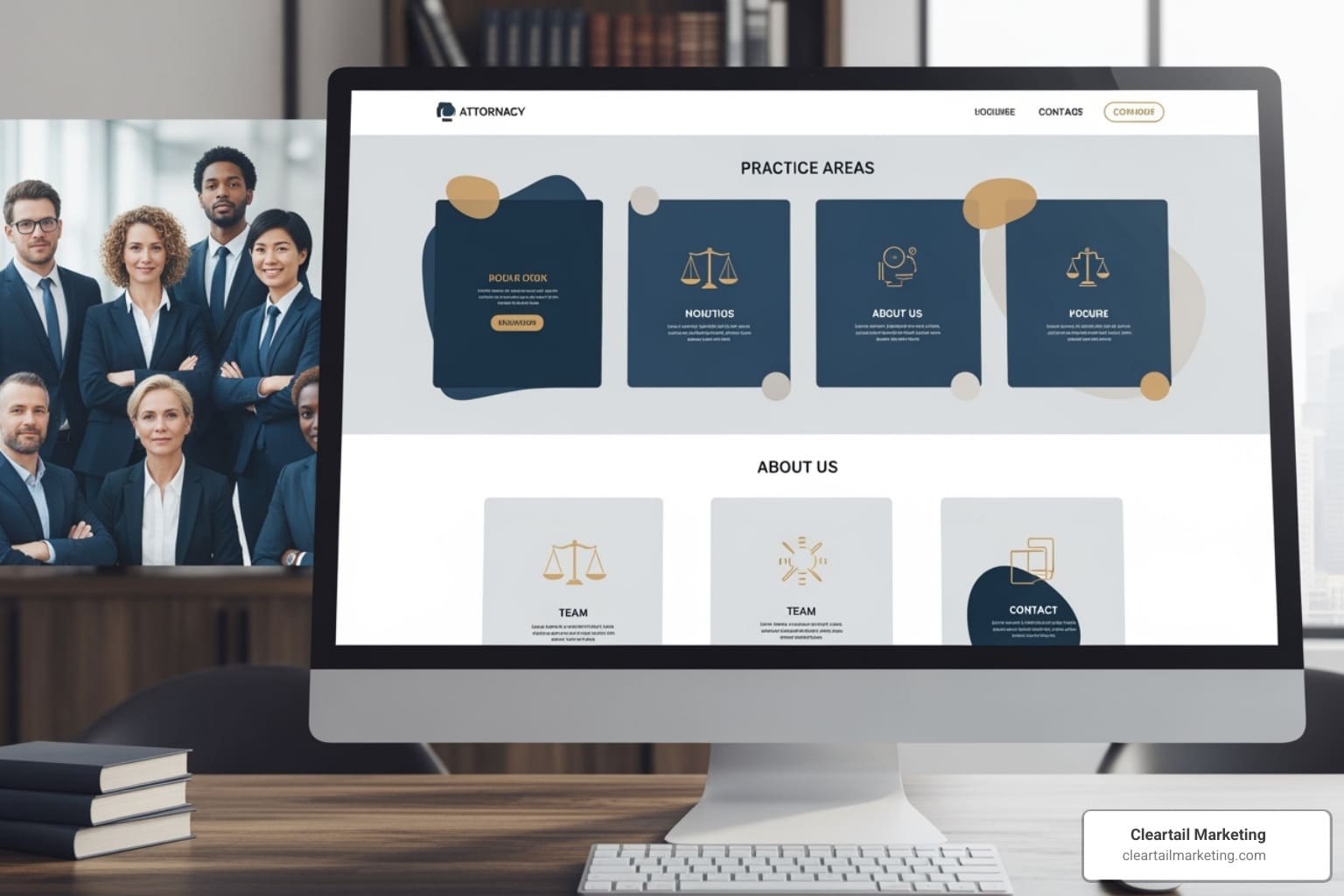
Why Your Law Firm’s First Click Matters More Than You Think
Attorney landing page design is critical for converting expensive legal ad clicks into clients. An effective attorney landing page has:
- A single focused goal (e.g., schedule consultation, submit form, or call)
- A problem-focused headline that addresses a client’s pain point
- Trust signals like testimonials, case results, and attorney photos
- A mobile-first design that loads in under 3 seconds
- No distracting navigation menus or sidebar links
- Client-centered copy that focuses on “you,” not “we”
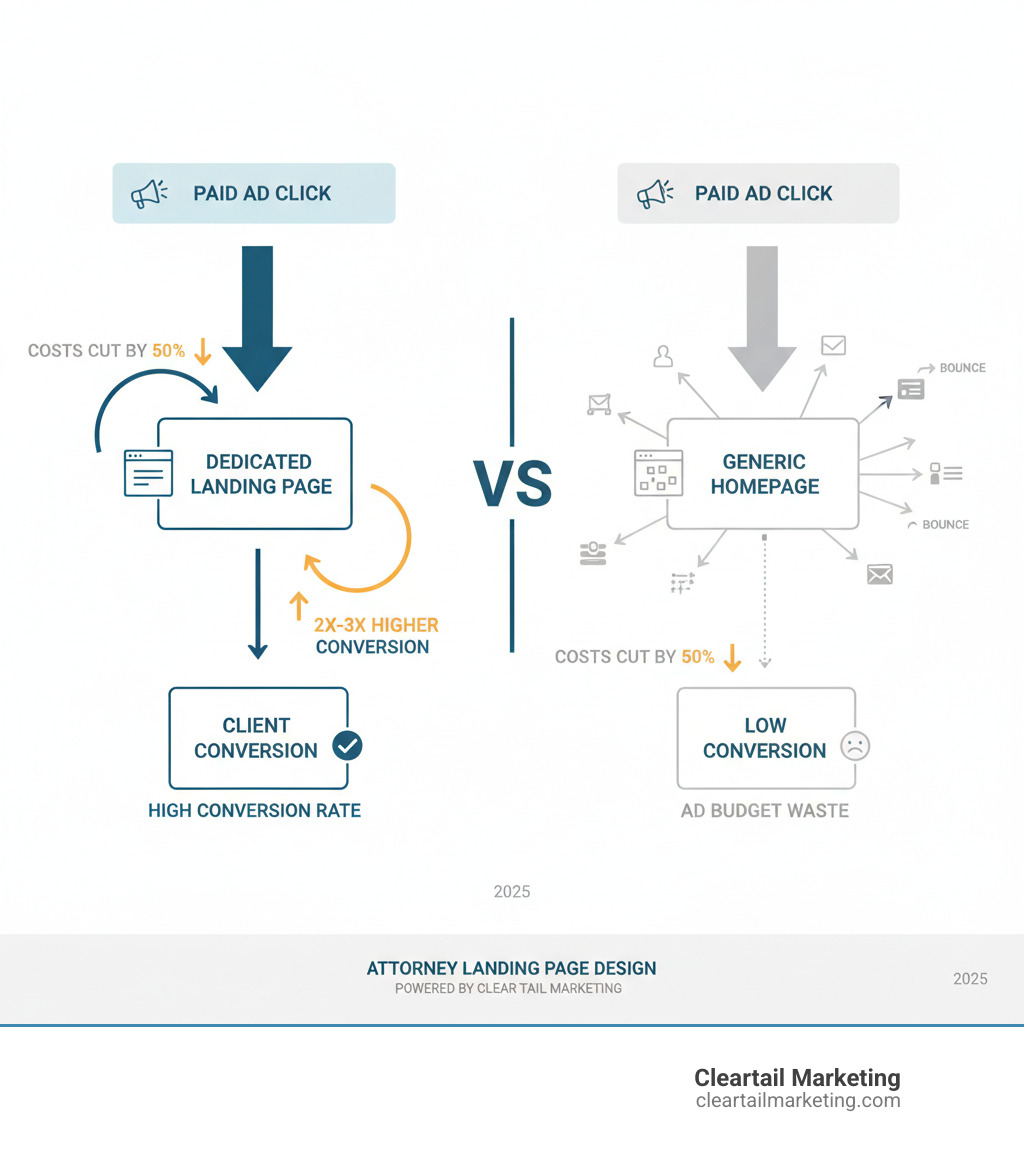
When paid traffic lands on a homepage full of menus and links, visitors get confused and leave within seconds. Your ad budget evaporates. Legal PPC campaigns cost between $6 and $50 per click, which is not money you can afford to waste.
Replacing a homepage with a focused landing page can double or triple conversion rates and cut acquisition costs by as much as 50 percent. The difference is eliminating distractions and matching your message to the ad that brought the visitor there.
A dedicated landing page speaks to one concern, mirrors the promise in your ad, and guides visitors toward a single action without the noise of a full website.
I’m Magee Clegg, founder of Cleartail Marketing. Since 2014, we’ve helped over 90 clients grow with cost-effective digital strategies, including attorney landing page design that converts paid traffic into signed cases. Our approach uses conversion-focused design and strategic testing to maximize your marketing spend.
Simple guide to Attorney landing page design terms:
Homepage vs. Landing Page: Why Your Website Kills Conversions
Your law firm’s homepage might be beautiful, but it’s probably costing you clients.
Imagine someone searches for a “car accident lawyer” after a collision. They click your ad seeking immediate help but land on your homepage, which is filled with links for other services, your blog, and awards. They’re overwhelmed.
They freeze. They hesitate. They leave. That $50 click just disappeared.
This is “choice paralysis.” When visitors face too many options, they often choose none. Your homepage is designed for broad appeal, but someone in crisis needs a clear path, not a buffet of options.
A dedicated attorney landing page design removes these distractions. It matches the ad’s message precisely. If the ad is for car accidents, the landing page is only about car accidents—no menus or unrelated links.
This focused approach, called “message matching,” is why firms using dedicated landing pages see conversion rates double or even triple. Many have cut client acquisition costs by as much as 50 percent.
The difference is stark: a homepage tries to be everything to everyone, while a landing page exists for one visitor with one problem, guiding them toward one action.
| Attribute | Law Firm Homepage | Dedicated Landing Page |
|---|---|---|
| Primary Goal | Brand awareness, comprehensive information, general navigation | Lead generation, specific conversion (e.g., consultation booking) |
| Navigation | Full menu, internal links, blog, social media links | Minimal to no navigation, focused on one path |
| Content | Broad overview of services, firm history, news | Highly specific to ad/campaign, problem-solution focused |
| Audience | General visitors, existing clients, job seekers | Highly targeted prospects from a specific campaign |
| Conversion Focus | Soft conversions (e.g., newsletter signup) | Hard conversions (e.g., “Call Now,” “Submit Form”) |
Your homepage still matters for SEO and brand building. But when you’re paying for every click, you need a page built specifically for conversion. This means eliminating distractions and matching visitor intent.
The Anatomy of a High-Converting Attorney Landing Page Design
Think of your landing page as a first meeting with a potential client. You’d focus on their problem, build trust, and guide them to a clear next step. That’s what an effective attorney landing page design does. Every element must serve a purpose.
The Headline and Above-the-Fold Experience
The “above the fold” section is what visitors see before scrolling. You have about three seconds to convince them to stay.

Your problem-focused headline must immediately address the visitor’s issue. Instead of a generic title like “Experienced Legal Representation,” use something direct: “Injured in a Car Accident? Get the Compensation You Deserve.” This speaks to their pain point.
Below that, a benefit-driven subheadline should expand on the solution, such as, “Our experienced attorneys fight for maximum settlements, so you can focus on recovery.”
The hero image or video is also crucial. Skip generic stock photos. Use professional photos of your actual attorneys or a short, empathetic video. Real faces build trust.
Your prominent CTA button must be visible without scrolling. Placement is half the battle.
Research shows people scan web pages in an F-shaped reading pattern. Place your most critical information and CTA within this natural reading flow to capture attention.
Building Unshakeable Trust and Credibility
Potential clients are often scared and stressed. They need to trust you before they’ll make contact.
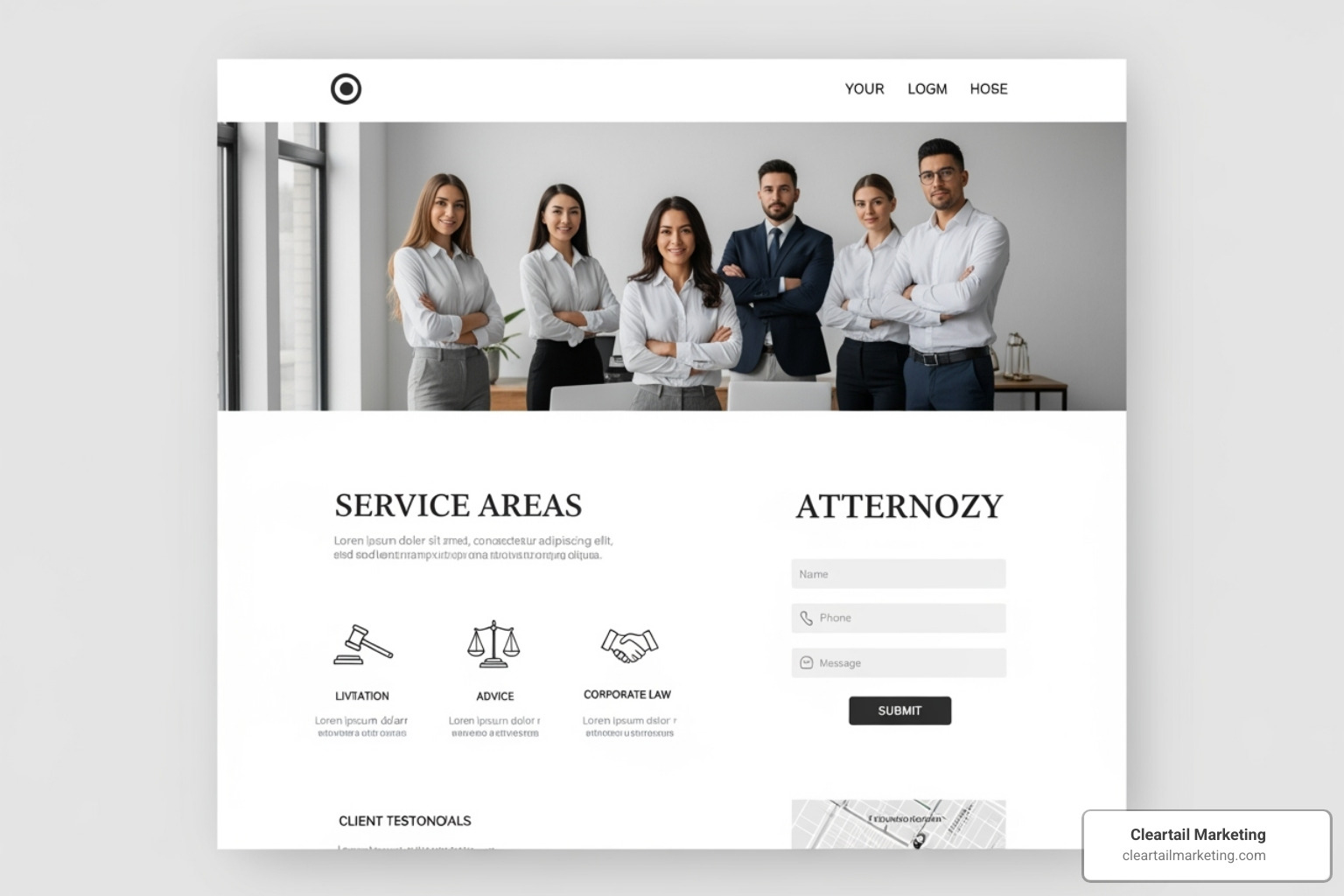
Social proof is powerful, as people look to others’ experiences when making decisions. In fact, 84 percent of consumers trust online reviews as much as a personal recommendation.
- Client testimonials are invaluable. Feature genuine testimonials with real names and photos. Video testimonials are even better, as they can lift conversions by up to 86 percent by adding a layer of authenticity.
- Case results demonstrate your ability to deliver outcomes (e.g., “$50 million recovered for accident victims”). Just make sure everything complies with your local bar association’s advertising rules.
- Awards and badges from respected organizations like Super Lawyers or Avvo add third-party credibility. They are external validation that you’re recognized by your peers.
- Attorney photos and bios humanize your firm. Professional photos and concise bios help clients see the real people who will be fighting for them.
Strategically weaving these trust signals throughout your attorney landing page design dismantles the doubts that prevent potential clients from taking action.
Crafting Compelling Copy and a Powerful Call to Action (CTA)
Your landing page copy should be an empathetic conversation focused on the client.
Shift from “we” language to “you” language. Instead of “We are a top-tier law firm,” try “You deserve justice.” This makes the visitor the hero of the story. Your value proposition should be crystal clear: what problem do you solve, and what unique benefit do you offer?
Keep your contact forms simple. Asking for a name, email, and phone number is usually enough. Too many fields reduce conversions. Always include a short privacy statement near the form, like “We respect your privacy,” to ease concerns.
Your Call to Action is the moment of truth. Use action-oriented text that tells people what they’re getting: “Get Your Free Case Review” or “Schedule a Consultation Now.” These are far better than generic words like “Submit.”
Make your CTA button stand out with contrasting button colors. It should be impossible to miss. Urgency elements can also encourage action. Phrases like “Call 24/7 for immediate assistance” can motivate someone on the fence, but always use them ethically.
Tailoring Your Landing Page for Different Practice Areas
A key lesson in attorney landing page design is that one size does not fit all. The emotional state of a personal injury client in crisis is completely different from that of someone calmly planning their estate. They need different experiences.
Macro vs. Micro Landing Page Strategies
The key is understanding the type of conversion you’re after.
Macro conversions are for immediate, urgent needs like Personal Injury and Criminal Defense. These prospects need a lawyer now. Your landing page must reflect this urgency with big phone numbers, clear “Call Now” buttons, and language promising immediate help. They want to talk to a person, not download an eBook.
Micro conversions work for planned legal services like Estate Planning or Family Law. These prospects are in research mode and aren’t ready to commit on day one. This is where gated content is effective. Offer a valuable guide or checklist in exchange for their email address. This allows you to nurture the relationship until they’re ready to hire you.
Customizing Your Attorney Landing Page Design for Key Practices
Let’s get specific about how this looks in practice.

-
Personal Injury: Lead with empathy. A headline like “Injured and overwhelmed? We fight so you can focus on healing” works well. The copy should balance compassion with strength, showcasing ethically presented case results (e.g., “$50 Million Recovered for Accident Victims”) to prove your track record. Firms like Omar Ochoa Law exemplify this with bold headlines and clear CTAs.
-
Criminal Defense: These pages require a tone of authority and discretion. The prospect is scared and needs a steady hand. Emphasize 24/7 availability and use confident, protective language like, “We defend your rights and your future.” Firms like Strategic Criminal Defence and Ryan Deck Law do this well, projecting strength and offering immediate contact options.
-
Family Law: This area requires a delicate balance of compassion and decisiveness. Use calming colors and reassuring copy that acknowledges the client’s difficult situation while guiding them through it. Focus on protecting their family’s future. Stanchieri Family Law and Levine Family Law Group excel at creating this supportive yet professional atmosphere.
-
Estate Planning: Shift your approach toward security and peace of mind. These clients are planners, not in crisis. Use a clean, uncluttered design and speak to long-term benefits. Offering educational content like a guide on “5 Steps to Safeguarding Your Family’s Future” is highly effective. Firms like ELG Estate Planning understand these clients want to be informed partners in the process.
The bottom line is that your attorney landing page design should feel like it was created specifically for the person who just clicked your ad.
Technical Foundations and Continuous Optimization
A great attorney landing page design is useless if it’s slow, broken on mobile, or untrackable. Success requires a solid technical foundation and a commitment to continuous improvement.
Technical Best Practices for Performance
If your page takes more than three seconds to load, 40 percent of visitors will leave. That’s wasted ad spend.
- Mobile-first optimization is mandatory, as a majority of landing page traffic comes from mobile devices. Your page must be designed for smartphones, with large, tap-friendly buttons, readable text, and simple forms.
- Page load speed is a silent conversion killer. We optimize every element—compressing images and minimizing code—to ensure your page loads almost instantly. Google also rewards fast pages with better ad placement and lower costs.
- Using a subdomain (e.g.,
offers.yourfirm.com) keeps your main site clean and allows for precise campaign tracking. - A true landing page has no distracting navigation. Eliminating menus and other links keeps visitors focused on the conversion goal.
Measuring Success and A/B Testing
You can’t improve what you don’t measure. The most important metric is your conversion rate—the percentage of visitors who complete your desired action. A well-targeted law firm landing page can convert at 8.33 percent or higher.
A/B testing transforms guesswork into science. We create two versions of a page with a single element changed (like the headline or CTA button color), split the traffic, and see which performs better. This simple practice can improve conversion rates significantly.
If you use Google Ads, your landing-page experience directly affects your Quality Score, which means a better page can lower your ad costs.
We implement call tracking and form submission tracking on every page. This lets us attribute leads directly to specific campaigns, giving you clear ROI data.
Legal and Ethical Considerations for your attorney landing page design
Legal marketing has strict ethical guidelines, and your landing pages must comply.
- Attorney advertising disclaimers are required and vary by jurisdiction. Always check your local bar association’s rules.
- When mentioning case results, you must include “no guarantee of results” language. Disclaimers like “Past results do not guarantee future outcomes” are essential.
- GDPR and CCPA compliance is not optional if you collect personal information. This means clear consent for data collection and transparent privacy policies.
- Every landing page should include a prominent privacy policy link, even if all other navigation is removed.
Frequently Asked Questions about Attorney Landing Pages
If you’re considering dedicated landing pages, you likely have some practical questions. Here are the most common concerns we hear from attorneys.
What are the most common mistakes law firms make on landing pages?
The same mistakes appear repeatedly. The most damaging include:
- Sending paid traffic to the homepage. It’s unfocused and overwhelms visitors who came for one specific thing.
- Cluttered design with too many links. Every link is an escape route away from your conversion goal, turning an expensive click into a bounce.
- Weak, generic headlines and CTAs. A headline like “Welcome to our Firm” is useless, and a CTA button that just says “Submit” is a missed opportunity to state your value.
- Not being mobile-friendly. When someone searches on their phone in a moment of need, a page that isn’t optimized for mobile is an immediate dead end.
- Forgetting to add trust signals. Without testimonials, case results, and attorney photos, you’re asking a potential client in a vulnerable position to trust a stranger.
How do I integrate a landing page into my marketing strategy?
Landing pages are the conversion engine for your digital marketing. They are the destination for all your campaigns.
- For PPC campaigns (Google Ads, social media), create a dedicated landing page for each ad group. This message matching improves your Quality Score and conversion rates.
- For email marketing, direct recipients to a specific landing page for the offer, rather than your homepage. The focused experience converts better.
- For social media campaigns, send users from a targeted ad to a landing page that speaks directly to that audience and offer.
- Use landing pages to promote lead magnets. Offer a valuable guide in exchange for an email address to build your list for future nurturing campaigns.
At Cleartail Marketing, we integrate your attorney landing page design with your PPC, email, and social strategies so every marketing dollar works harder.
What’s the difference between a landing page and a practice area page?
Many attorneys confuse these, but they serve very different purposes.
A practice area page is part of your main website. It has full navigation and is designed for informational and SEO purposes, targeting broad keywords. It encourages exploration and education for visitors who are still researching.
A landing page is a standalone conversion tool with no navigation. Every element guides the visitor toward a single action (e.g., call, submit a form). It’s designed for a specific campaign targeting users who have already decided they need help and are ready to act.
Your practice area pages bring in organic traffic, while your landing pages convert paid traffic. Both are essential, but they are not interchangeable.
Conclusion: Turn Clicks into Signed Cases
In today’s competitive legal market, a focused, optimized attorney landing page design isn’t a bonus—it’s the essential bridge between expensive ad clicks and signed clients.
You’re spending anywhere from $6 to $50 per click. Sending that traffic to a cluttered homepage is wasting money. A dedicated landing page that eliminates confusion, matches your ad’s promise, and builds trust will improve conversion rates, lower your cost per lead, and boost your ROI.
We’ve seen law firms cut acquisition costs in half and double or triple their conversion rates. It’s not luck; it’s about giving potential clients a clear, direct path to the solution they need, without overwhelming them with options.
At Cleartail Marketing, we understand the unique challenges of legal marketing. Since 2014, we’ve helped over 90 law firms create web designs and digital strategies that convert. Your expertise is in the courtroom and with your clients, not wrestling with website analytics. That’s where we come in.
We build landing pages that work while you focus on practicing law. We test, optimize, and refine until every dollar of your marketing budget is working as hard as you do.
Ready to stop watching your ad spend evaporate and start signing more qualified clients? Start building a website that works as hard as you do with Cleartail Marketing today. Let’s turn those clicks into cases.
