



WHY SOCIAL MEDIA CRISIS MANAGEMENT MATTERS MORE THAN EVER
Crisis management social is the practice of preparing for, identifying, and resolving brand-threatening issues on social media before they spiral out of control. In 2025, with over 5 billion people on social media, a single negative post can become a global firestorm in minutes. Effective management involves real-time monitoring, swift and transparent responses, coordinated team action, and post-crisis analysis.
The stakes are incredibly high. With 81% of consumers avoiding brands that don’t respond to complaints, silence isn’t an option. Yet 70% of businesses still lack a crisis communication plan. A crisis can erupt from a poorly worded tweet, a product failure, or even a deepfake video. The speed of social media means a local complaint at 9 AM can be national news by noon.
The good news? 72% of consumers will stick with a brand that addresses a crisis swiftly and sincerely. Companies that weather these storms aren’t lucky—they’re prepared. They have playbooks, they practice, and they respond with empathy.
This guide walks you through building that preparation, from identifying a true crisis to leveraging AI for faster response. You’ll learn from real-world examples and find strategies that separate resilient brands from those that crumble.
I’m Magee Clegg, founder and CEO of Cleartail Marketing. For over a decade, I’ve helped 90+ B2B companies implement crisis management social strategies that protect their reputation and maintain customer trust. The insights ahead will help you turn social media from a potential liability into a tool for building stronger customer relationships.
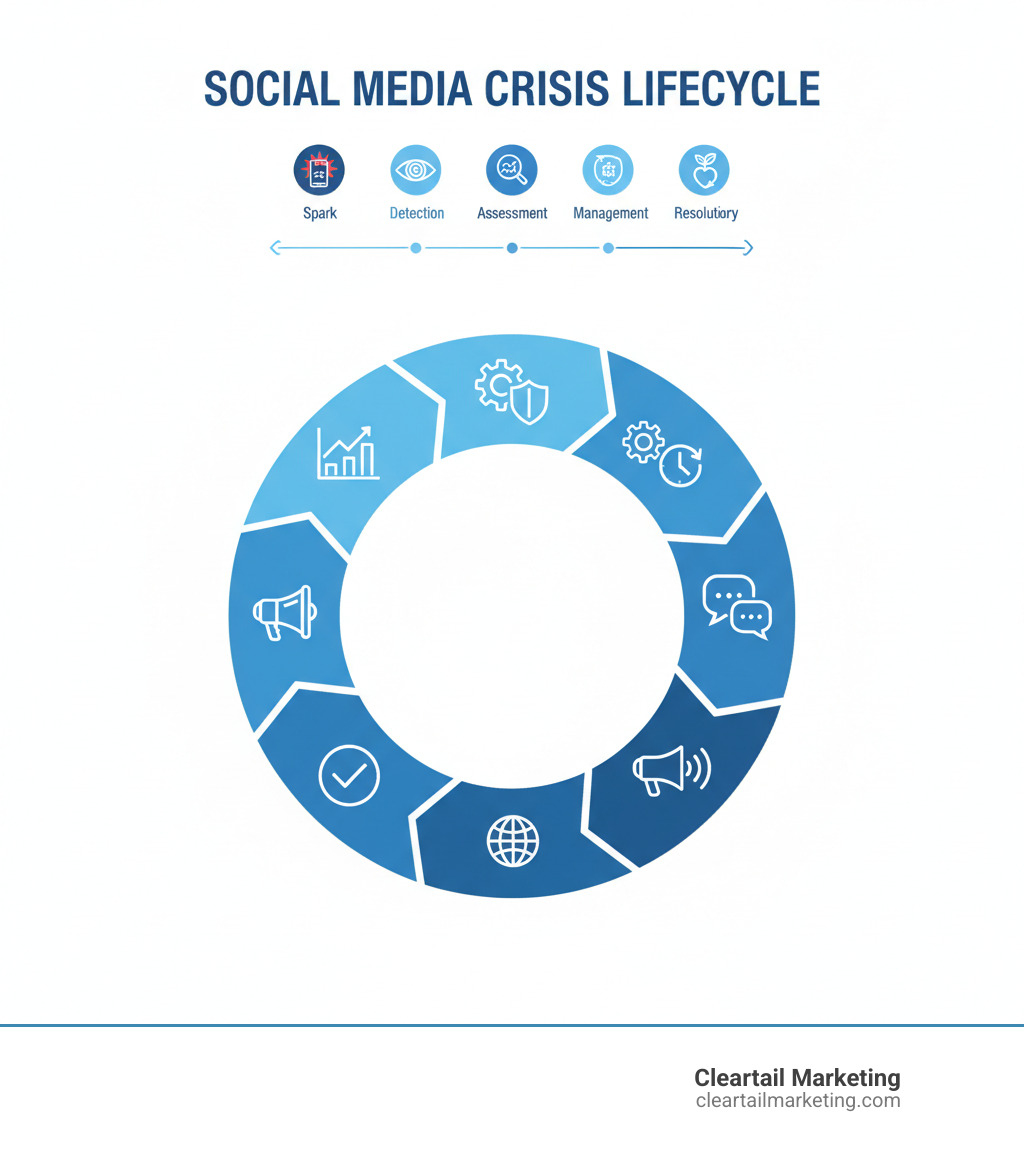
UNDERSTANDING THE MODERN THREAT: SOCIAL MEDIA CRISIS VS. CUSTOMER SERVICE HICCUP
Not every negative comment is a five-alarm fire. A key skill in crisis management social is distinguishing a customer service hiccup from a genuine crisis.
A customer service issue is typically an isolated complaint from one or a few customers about a bad experience. It needs a professional response but won’t sink your business.
A social media crisis, however, is when negative content spreads like wildfire. The key factors are viral spread, a significant reputational threat, and a tangible operational impact like falling sales or legal issues. When an issue reaches a massive audience in minutes and puts your brand’s image at risk, you’re in crisis territory.
The 2025 digital landscape has amplified these threats. Speed is everything, as a local complaint can become global news in hours. New challenges like AI-generated deepfakes can spark outrage with fabricated content. Meanwhile, consumer expectations have shifted; 81% of consumers will avoid brands that don’t respond publicly to complaints.
The sobering reality is that crisis frequency has skyrocketed, with 69% of brand executives having weathered at least one crisis in the last five years. Crises are now a regular part of business, requiring a cross-functional capability involving legal, operations, and executive leadership. For more information on protecting your brand’s image proactively, explore our guide on Online Reputation Management.
BUILDING YOUR DIGITAL SHIELD: KEY COMPONENTS OF A SOCIAL MEDIA CRISIS PLAN

The best time to prepare for a crisis is long before one hits, yet 70% of businesses don’t have a plan. A solid crisis plan is your digital shield. It starts with assembling a cross-functional crisis team including marketing, social media, support, PR, legal, and IT, with clearly defined roles. This team needs a command center (physical or virtual) for instant coordination and a trained spokesperson to communicate with empathy. Crucially, your legal and PR teams must be aligned beforehand to ensure transparent, legally sound communication. The Crisis Communication and Social Media Best Practice Guide offers excellent frameworks for team structure.
MASTER PROACTIVE DEFENSE WITH SOCIAL LISTENING
Social listening is your early warning radar. It goes beyond tracking brand tags to include real-time monitoring of your brand, products, and leadership across social media, news sites, and forums. By tracking sentiment (not just volume), you can catch negative shifts instantly. Monitoring keywords beyond your brand name and uncovering untagged mentions reveals hidden threats. Spike alerts for sudden surges in mentions or negative sentiment notify your team immediately, providing critical lead time. This proactive approach is central to effective crisis management social and a core part of our Social Media Management services.
DEVELOP YOUR CRISIS PLAYBOOK AND TIERS
Your crisis playbook is your battle plan for when adrenaline is high. Start by categorizing potential crises into tiers (e.g., Low, Medium, High) based on severity. For each tier, define clear escalation triggers, such as a spike in mentions or media pickup, so your team can act decisively. Prepare pre-approved messaging and holding statements for common scenarios. A good holding statement (“We’re aware, we’re investigating, and we’ll provide updates soon”) buys you time while showing you’re responsive. Your playbook should also outline step-by-step response protocols that have been reviewed by legal. The Situational Crisis Communication Theory (SCCT) provides frameworks for matching your response to the crisis type.
PREPARE YOUR TEAM FOR EFFECTIVE CRISIS MANAGEMENT SOCIAL RESPONSE
A plan is useless if your team can’t execute it. Crisis simulations and role-playing exercises are essential for testing your workflows and building confidence. Have your team practice responding to real-world scenarios, from drafting messages to delivering statements. This training ensures that when a real crisis hits, your team can think clearly and act effectively, not panic. For more comprehensive strategies on protecting your business when things go wrong, check out our guide on Business Reputation Crisis Management.
EXECUTING YOUR PLAN: BEST PRACTICES FOR CRISIS MANAGEMENT SOCIAL COMMUNICATION

When a crisis hits, execution is everything. Your response in crisis management social must be guided by speed, transparency, and empathy. Move fast, be honest, and remember the people affected. Maintain your authentic brand voice, avoid corporate jargon, and immediately pause all scheduled content to avoid looking tone-deaf. Finally, you must actively combat misinformation by correcting false narratives with facts. For more insights on maintaining your brand’s integrity, explore our guide on Building Brand Trust.
ACT WITH SPEED, TRANSPARENCY, AND EMPATHY
The first hour sets the tone. Acknowledge the issue immediately, even if you don’t have all the answers. A simple holding statement like, “We’re aware of the situation and are investigating. We’ll provide an update soon,” buys credibility and time.
When you communicate, share what you know and admit what you don’t. If you made a mistake, own it. Data shows 72% of consumers will stick with a brand that addresses a crisis swiftly and sincerely. Set clear expectations for updates to reduce public anxiety and humanize your response by showing genuine concern. Silence is not an option; it’s often interpreted as guilt or indifference, as seen when Tesla’s silence underscored the importance of communication during a lawsuit, damaging their reputation.
PAUSE SCHEDULED CONTENT AND CONTROL THE NARRATIVE
The moment a crisis is confirmed, halt all automated and scheduled posts across every platform. An upbeat marketing message during a crisis suggests your brand is out of touch. Review and postpone any planned email campaigns or ad launches that conflict with the current situation.
Create a dedicated crisis information hub—a webpage or pinned social media post—to serve as the single source of truth. This centralizes accurate information and prevents people from hunting across multiple channels. Use this hub and your social channels to actively correct false information. When you spot rumors, respond quickly with factual corrections and links to your official hub. This proactive approach helps you control the narrative.
LEARNING FROM THE BATTLEFIELD: REAL-WORLD EXAMPLES AND POST-CRISIS ANALYSIS
The most powerful teacher in crisis management social is experience. Studying how other brands have handled adversity provides invaluable lessons. After any crisis, a thorough post-mortem analysis is crucial for dissecting what happened, measuring effectiveness, and updating your playbook to build resilience. For comprehensive insights, explore our Reputation Management Case Studies Ultimate Guide.
CASE STUDIES IN CRISIS MANAGEMENT SOCIAL
Let’s examine three real-world examples of crisis response.
The Good (KFC’s “FCK” Campaign): When a logistics failure forced KFC UK to close stores due to a chicken shortage, they responded with accountability and humor. Their now-famous KFC’s “FCK” apology campaign was a full-page ad featuring a rearranged logo on an empty bucket. The transparent, self-aware response was celebrated, turning a potential disaster into a brand-strengthening moment.
The Bad (Bud Light & Dylan Mulvaney): After a Dylan Mulvaney partnership sparked backlash, Bud Light’s response was inconsistent, attempting to appease all sides. This satisfied no one, alienating both their traditional base and supporters of the partnership. The result was a significant drop in sales (around 15% in Q2 2023) and a lesson in the danger of inauthentic, non-committal crisis communication.
The Agile (e.l.f. Cosmetics on TikTok): When false claims about harmful ingredients went viral on TikTok, e.l.f. Cosmetics fought back on the same platform. They created short-form videos with factual corrections, partnered with trusted creators, and launched an Ingredient Safety and Transparency Policy. This agile, platform-specific approach successfully countered the misinformation and protected their credibility.
MEASURING YOUR RESPONSE AND REBUILDING TRUST
Once the storm calms, the work isn’t over. Measure your response effectiveness using metrics like sentiment shift, share of voice, and engagement rate. Conduct a post-crisis debrief with your team to honestly assess what went well and what didn’t. Seek feedback from customers and stakeholders to identify blind spots. Use these learnings to update your crisis plan, refining triggers, templates, and roles. This continuous improvement cycle transforms each crisis from a threat into a learning opportunity, building the resilience needed to emerge stronger next time.
THE FUTURE IS NOW: LEVERAGING AI AND AUTOMATION IN CRISIS RESPONSE
The landscape of crisis management social is being transformed by artificial intelligence and automation. AI isn’t replacing the human touch; it’s amplifying our ability to spot trouble early and act decisively. Think of AI as an always-on watchdog that accelerates detection, streamlines workflows, and provides data-driven insights. This allows your human experts to focus on empathetic, strategic communication. For more on how technology can improve your marketing, explore our resources on Marketing Automation.
AI-POWERED DETECTION AND ALERTS
AI serves as a digital early warning system, working 24/7 to flag anomalies. Key features include:
- Sentiment drop alerts: AI detects sudden negative shifts in conversation tone around your brand and sends an immediate alert.
- Viral spike detection: It identifies posts gaining unusual traction, helping you get ahead of issues before they trend.
- Identifying bot networks: AI can distinguish genuine public sentiment from orchestrated disinformation campaigns, like in the Jaguar crisis where fake profiles drove significant negative engagement.
- Uncovering untagged threats: It finds critical conversations about your brand even when you aren’t tagged, preventing you from being blindsided.
AI-ASSISTED RESPONSE AND ROUTING
Once a threat is detected, AI helps your team respond faster and more efficiently.
- Automated issue routing: AI categorizes issues and instantly routes them to the correct team (e.g., support, PR, legal), saving precious time.
- AI-generated response suggestions: These tools can draft context-aware replies that your team can quickly personalize, cutting response times by up to 40%.
- Tone analysis: AI provides real-time feedback on your drafted responses to ensure they strike the right empathetic and professional tone.

This combination of AI detection and assistance improves human expertise, freeing your team to focus on the nuanced communication that builds trust. That’s the future of crisis management social, and it’s already here.
FREQUENTLY ASKED QUESTIONS ABOUT SOCIAL MEDIA CRISIS MANAGEMENT
Here are answers to common questions about handling high-pressure social media situations.
HOW QUICKLY SHOULD A BRAND RESPOND TO A SOCIAL MEDIA CRISIS?
Minutes matter. Aim for an initial acknowledgment within the first hour. You don’t need all the answers, but a holding statement is crucial. A simple post like, “We’re aware of this issue and are looking into it now. We’ll share more information as soon as we have it,” shows you’re responsive and can prevent the situation from spiraling.
SHOULD WE DELETE NEGATIVE COMMENTS DURING A CRISIS?
Generally, no. Deleting legitimate criticism often backfires, making you look like you’re hiding something. It’s better to respond transparently. The exception is for comments containing hate speech, spam, personal threats, or private information. These should be removed according to your content moderation policy to maintain a safe community.
WHAT’S THE FIRST THING TO DO WHEN A CRISIS HITS?
There’s no time for panic. Follow these immediate steps:
- Activate your crisis plan. This provides clear direction when emotions are high.
- Pause all scheduled content. A tone-deaf promotional post can make everything worse.
- Gather your crisis team. Get everyone with a designated role together immediately.
- Assess and verify information. Understand what happened before you respond publicly. Speed is important, but accuracy is critical.
CONCLUSION
The digital landscape of 2025 moves fast, and in this environment, crisis management social isn’t just another item on our marketing checklist—it’s the foundation that protects everything we’ve built. When a single post can reach millions in minutes, and when 81% of consumers will walk away from brands that stay silent during problems, being prepared isn’t optional anymore.
The most important takeaway? Preparation transforms panic into action. When we have a crisis team that knows their roles, pre-approved messaging ready to deploy, and regular simulations that build confidence, we’re not scrambling when trouble hits. We’re executing a plan. That’s the difference between brands that weather storms and those that sink under pressure.
But even the best plan needs continuous improvement. After every crisis—whether it’s ours or one we observe in our industry—there’s an opportunity to learn, adapt, and strengthen our defenses. Measuring our response effectiveness, gathering stakeholder feedback, and updating our playbooks keeps us sharp and ready for whatever comes next.
At Cleartail Marketing, we’ve spent over a decade helping 90+ B2B companies build resilient digital presences. We’ve seen how effective crisis management social strategies protect reputations and turn potential disasters into opportunities to deepen customer trust. Whether you need help with search engine optimization, social media management, reputation management, or comprehensive digital strategy, we bring both the technical expertise and the human touch that makes the difference.
Your brand’s reputation is too valuable to leave to chance. Don’t wait until a crisis forces your hand. Start building your digital shield today—one that combines smart planning, powerful tools, and genuine human connection. Get your guide to social media optimization packages and let’s work together to create a strategy that protects what you’ve built and strengthens the relationships that matter most.
The future of your brand depends on the preparation you make today. Let’s make sure you’re ready.
