



Understanding the Real Cost of Shared Hosting
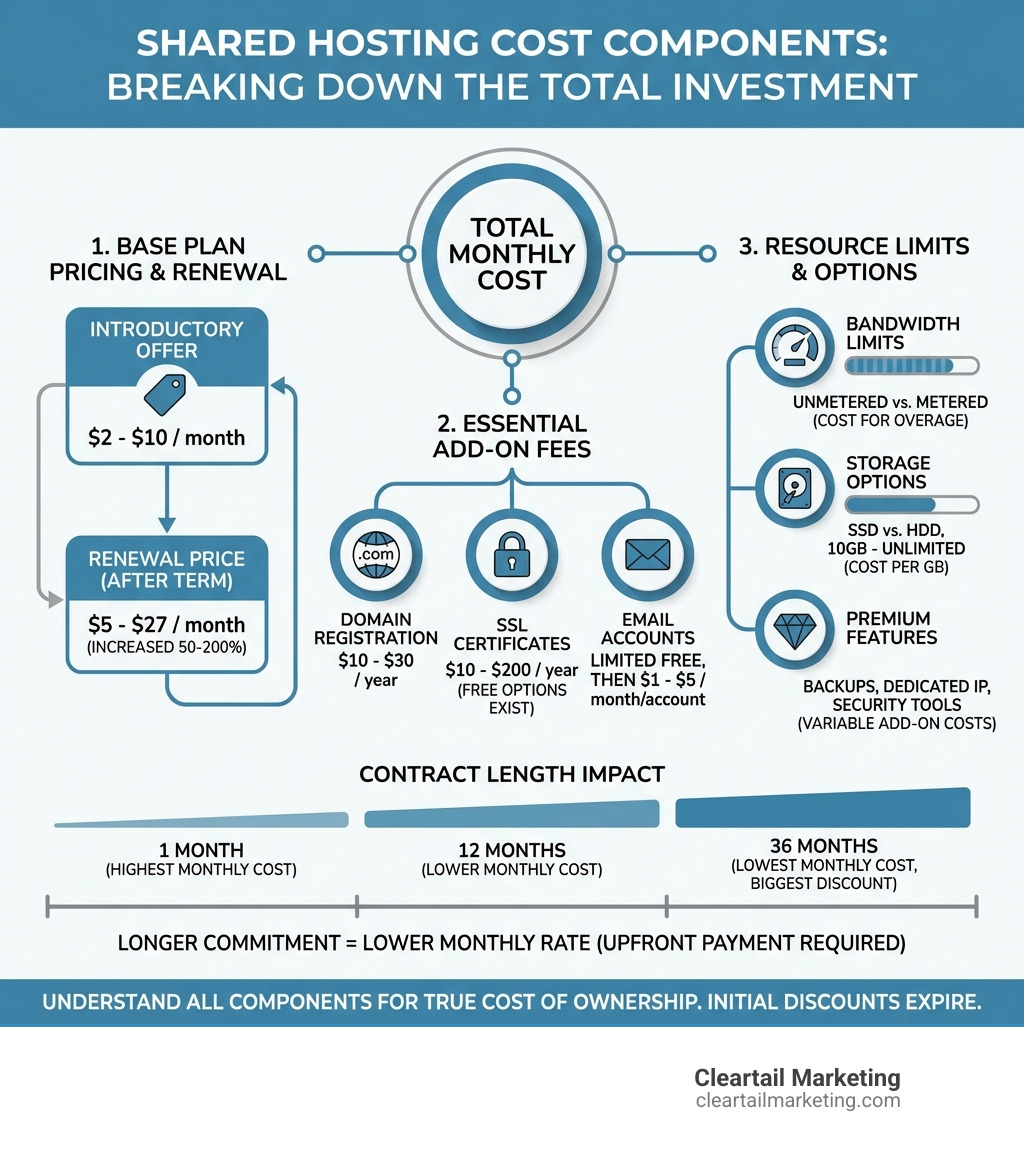
Shared hosting price typically ranges from $2 to $15 per month for introductory terms. However, renewal prices often increase by 50-200%, and additional expenses like domain registration ($10-$30/year) and SSL certificates can impact your total investment.
Quick Pricing Overview:
- Entry-Level Plans: $1.98-$4.99/month (introductory), renewing at $4.88-$9.88/month
- Mid-Tier Plans: $2.98-$6.99/month (introductory), renewing at $6.88-$14.99/month
- Premium Plans: $4.98-$9.99/month (introductory), renewing at $9.88-$26.99/month
- Average Monthly Cost: $2-$10/month for most small business needs
Website hosting is the foundation of your online presence. For small to medium-sized businesses, shared hosting offers the most affordable entry point. You rent space on a server housing multiple websites, sharing resources like bandwidth and processing power. This model keeps costs low but involves trade-offs in performance and control.
The hosting industry is known for pricing complexity. Providers advertise low promotional rates but often bury renewal costs in the fine print. Add-on services stack up quickly, and the cheapest plan may lack essential features.
I’m Magee Clegg, founder and CEO of Cleartail Marketing. We’ve helped over 90 B2B companies optimize digital marketing investments, including strategic decisions around shared hosting price and infrastructure. By increasing client traffic by over 14,000%, we’ve learned which hosting features drive ROI and which are unnecessary expenses.
What is Shared Hosting and How Does it Work?
Imagine shared hosting as leasing a plot of land within a larger property where several houses are built. You share resources like the main road and water supply with your neighbors. In technical terms, your website resides on a single physical server alongside many others, sharing CPU, RAM, and disk space.
When you sign up, the host leases you a portion of the server’s resources. To make your site findable, it needs a unique address via the Domain Name System (DNS). Once you purchase a plan, the host assigns a unique DNS, allowing global access to your files.
Shared hosting is popular for its affordability and ease of use, making it ideal for bloggers and small businesses. It is a managed solution, meaning the provider handles server maintenance and security updates, allowing you to focus on growth. To see how it compares to other options, view our Website Hosting Comparison Guide.
Decoding the Shared Hosting Price: Typical Cost Ranges
Introductory shared hosting price rates are designed to be eye-catching, typically ranging from $2 to $15 per month. Examples include DreamHost starting at $1.98/month, SiteGround at $2.95/month, and Bluehost at $3.99/month. These rates are excellent for launching a new site.
However, the true cost lies in the renewal rates. Industry standards involve significant increases once the initial term ends. A plan starting at $1.98/month might renew at $4.88/month, while premium tiers can jump from $9.99 to $26.99. We’ve seen renewal prices increase by over 200%.
| Plan Type | Introductory Price (per month) | Renewal Price (per month) |
|---|---|---|
| Basic Shared | $1.98 – $3.99 | $4.88 – $9.99 |
| Mid-Tier Shared | $2.98 – $6.99 | $6.88 – $14.99 |
| Premium Shared | $4.98 – $9.99 | $9.88 – $26.99 |
Note: Figures are based on industry averages. For Cleartail Marketing’s specific recommendations, contact us directly.
Key Factors and Features to Consider
The shared hosting price reflects the features included, and those features directly impact speed, reliability, and security. Because you are sharing a server with other sites, the quality of the underlying platform matters more than most people expect. When comparing plans, focus on the items below before you focus on the lowest advertised rate.
- Storage (SSD vs. HDD): SSDs are significantly faster than HDDs, especially for WordPress and database-driven sites. Look for at least 10-20 GB of SSD space for a typical small business site (more if you host lots of images, PDFs, or videos).
- Bandwidth Limits: Bandwidth is the data transferred to visitors. Many hosts advertise “unmetered” bandwidth, but it is still governed by fair-use policies. For most small sites, “unmetered” is fine; for high-traffic or media-heavy sites, ask about real-world thresholds.
- Uptime Guarantees: Look for 99.9% or higher to help ensure your site remains accessible.
- Control Panels: Tools like cPanel (or similar dashboards) simplify file management, databases, DNS, and email setup.
- Security: Essential features include SSL certificates, malware scanning, web application firewalls (WAF), and account isolation to reduce risk from other sites on the same server.
- Customer Support: 24/7 live chat (plus ticketing) is invaluable when email breaks or a plugin update causes errors.
- Backups: Automated backups are crucial for disaster recovery. If backups are offered, confirm frequency (daily vs. weekly), retention period, and restore costs.
We guide clients toward Reliable Hosting Providers that prioritize these features.
Factors That Influence Your Shared Hosting Price
- Contract Length: Longer commitments usually yield higher discounts. A 36-month term often cuts the monthly rate by 40% or more, but you are trading flexibility for price.
- Introductory vs. Renewal Pricing: Always check the “regular rate” that applies after the first term and what term length is required to earn the promotional rate.
- Feature Bundles: Higher tiers may include more resources and premium tools (staging, improved security, premium DNS, or performance layers). For WordPress users, our WordPress Hosting Low Cost Complete Guide provides more detail.
- Account Limits: Some low-cost plans restrict the number of websites, databases, or email accounts you can create. If you plan to run multiple sites or landing pages, those limits can push you into a higher tier.
- Performance Guardrails: Hosts may cap CPU usage, concurrent processes, or entry processes. These technical limits are a common reason a cheap plan slows down once traffic grows, even if bandwidth is “unmetered.”
Geographic Location and Performance
Data center location affects latency. Choosing a server near your target audience can improve page load times by up to 40%, which is a significant factor for SEO. Many providers offer a choice of data center locations.
Monitoring site speed helps you understand how geography impacts user experience. Most hosting dashboards and tools like Google PageSpeed Insights can help you interpret performance metrics and identify areas for improvement.
For global audiences, a Content Delivery Network (CDN) is essential to cache content worldwide. For a vendor-neutral explanation of how CDNs work, see Content delivery network.
A practical approach for most small businesses is to pick a data center closest to your primary customer base (for Cleartail Marketing clients, often the United States or Canada), then add a CDN if you serve multiple regions or run media-heavy pages.
Finally, performance is not only about the host. Image compression, caching, and efficient themes/plugins can reduce server load and help you stay on a lower shared plan longer without sacrificing user experience.
Hidden Costs and Essential Add-ons
The advertised shared hosting price rarely covers everything. Common add-ons include:
- Domain Registration: While often free for the first year, renewal fees range from $10-$30/year.
- Domain Privacy: This shields your contact info from the public WHOIS database, costing $5-$15/year.
- Site Backups: Robust, daily backup solutions often cost an additional $2-$5/month.
- Professional Email: Some plans limit mailboxes; advanced email features may require a separate subscription.
- Themes and Plugins: Premium WordPress themes average $60, while specialized plugins can range from $5 to $400.
Understanding these is key to calculating the true Cost of Website Hosting.
Domain Registration and SSL Certificates
SSL certificates encrypt data and are mandatory for SEO and security. Most reputable hosts include a free Domain Validated (DV) SSL. However, e-commerce sites may need Organization Validated (OV) or Extended Validation (EV) certificates, which can cost $50 to $500 per year. Learn more in our guide on High Security Hosting.
Managed vs. Unmanaged Shared Hosting Price
Shared hosting is almost always “managed,” meaning the provider handles server maintenance, security patches, and OS updates. This is ideal for teams without deep technical resources. Unmanaged hosting, common for VPS or dedicated servers, requires you to handle all server-side tasks. For more on this, see our WordPress Hosting Cost – Complete Guide.
Shared Hosting vs. Upgrading to Advanced Hosting Solutions
As your site grows, you may outgrow shared resources. Here is how hosting types compare:
- Shared Hosting: $2-$15/month. Best for beginners and low-traffic sites. Shared resources can lead to the “noisy neighbor” effect.
- VPS Hosting: $10-$100/month. Offers dedicated resources and better performance for growing stores and medium-traffic sites.
- Cloud Hosting: $10-$200/month. Highly scalable and reliable, using a network of servers. Ideal for fluctuating traffic.
- Dedicated Hosting: $80-$500+/month. An entire physical server for your site, offering maximum control and security.
Consider upgrading when you experience performance bottlenecks, consistent high traffic, or need custom software configurations. Upgrading provides dedicated resources and improved security. For a deeper dive, check our Website Hosting Costs – Complete Guide.
Frequently Asked Questions about Shared Hosting Prices
Can I host my website for free?
Free plans exist on platforms like Wix, but they have heavy limitations: restricted resources, subdomains (yoursite.wix.com), forced ads, and limited support options. For professional businesses, the trade-offs in brand image and SEO usually outweigh the savings. Even a basic paid shared hosting price provides a better foundation, including the ability to use your own domain and configure core settings.
Why do renewal prices increase so much?
Introductory offers are “loss leaders” used to attract customers. The renewal price reflects the actual operational costs, including 24/7 support, security, and data center maintenance. Providers also know that migrating a site can be a hassle (DNS changes, email migrations, plugin compatibility, and downtime risk), which influences retention pricing.
To avoid surprises, treat renewal as part of the buying decision: check the regular rate, confirm whether taxes or fees apply, and note whether certain features are promotional (for example, discounted security add-ons that later revert to full price).
How can I save money on shared hosting?
- Opt for Longer Contracts (Carefully): Lock in low rates for 24-36 months if you are confident you will keep the site and the provider meets your needs.
- Use Bundled Deals: Look for plans including a free domain (first year) and SSL.
- Optimize Performance: Compressed images, caching, and clean code reduce resource usage and can delay the need to upgrade.
- Avoid Unnecessary Add-ons: Skip optional SEO, “site builder,” or backup tools if you already have alternatives or do not need them yet.
- Compare Providers: Leverage introductory offers from reputable hosts, but compare renewal pricing and support quality, not just the headline rate.
- Choose the Right Plan: Start with a basic plan and upgrade only when necessary.
- Audit Email Needs: If you need advanced deliverability, archiving, or admin controls, you may be better off budgeting separately for professional email rather than overpaying for a higher hosting tier just to get more mailboxes.
The goal is not simply the lowest monthly price, but the lowest total cost for a stable, secure site over time.
Conclusion
Understanding shared hosting price involves looking past promotional rates to the long-term renewal costs and essential add-ons. Shared hosting remains the best entry point for small businesses, offering a managed, affordable solution that lets you focus on your audience.
At Cleartail Marketing, we help businesses secure reliable, scalable foundations for their digital presence. By leveraging longer contract terms and avoiding unnecessary extras, you can optimize your budget effectively. A well-chosen plan is a vital investment in your digital future. For more insights, explore our Website Hosting Cost Complete Guide.
