


UNDERSTANDING GOOGLE COST PER ACTION: THE KEY TO PROFITABLE ADVERTISING
GOOGLE COST PER ACTION (CPA) IS A CRITICAL METRIC SHOWING HOW MUCH YOU SPEND TO GET A CUSTOMER TO COMPLETE A DESIRED ACTION, LIKE A PURCHASE OR FORM SUBMISSION. IN SIMPLE TERMS, IT’S YOUR TOTAL AD COST DIVIDED BY THE NUMBER OF ACTIONS.
Cost Per Action (CPA) = Total Marketing Cost ÷ Number of Actions
Understanding CPA is essential because it tells you if your advertising is profitable. A $50 CPA is great for a $500 sale but disastrous for a $30 product. While you only pay for results, many businesses struggle to keep their CPA low enough to be profitable.
This is where optimization is key. Factors like your Quality Score can dramatically lower your CPA—a one-point improvement can reduce CPA by about 16%. Your ad copy, landing pages, and bidding strategy also play crucial roles.
I’m Magee Clegg, founder of Cleartail Marketing. Since 2014, I’ve helped over 90 B2B companies reduce their google cost per action and scale results. In this guide, I’ll break down everything you need to know about CPA, from basic calculations to advanced optimization strategies that can transform your advertising profitability.
What is Cost Per Action (CPA) and How Is It Calculated?
At its core, Cost Per Action (CPA) is a fundamental digital advertising metric that measures campaign efficiency by focusing on tangible results. As Google defines it, CPA is the total cost spent to receive a required action from your customer. This shifts the focus from spending on ads to investing in specific outcomes that drive your business forward. At Cleartail Marketing, CPA is a key indicator of campaign health in our Pay Per Click Advertising strategies.
The CPA Formula Explained
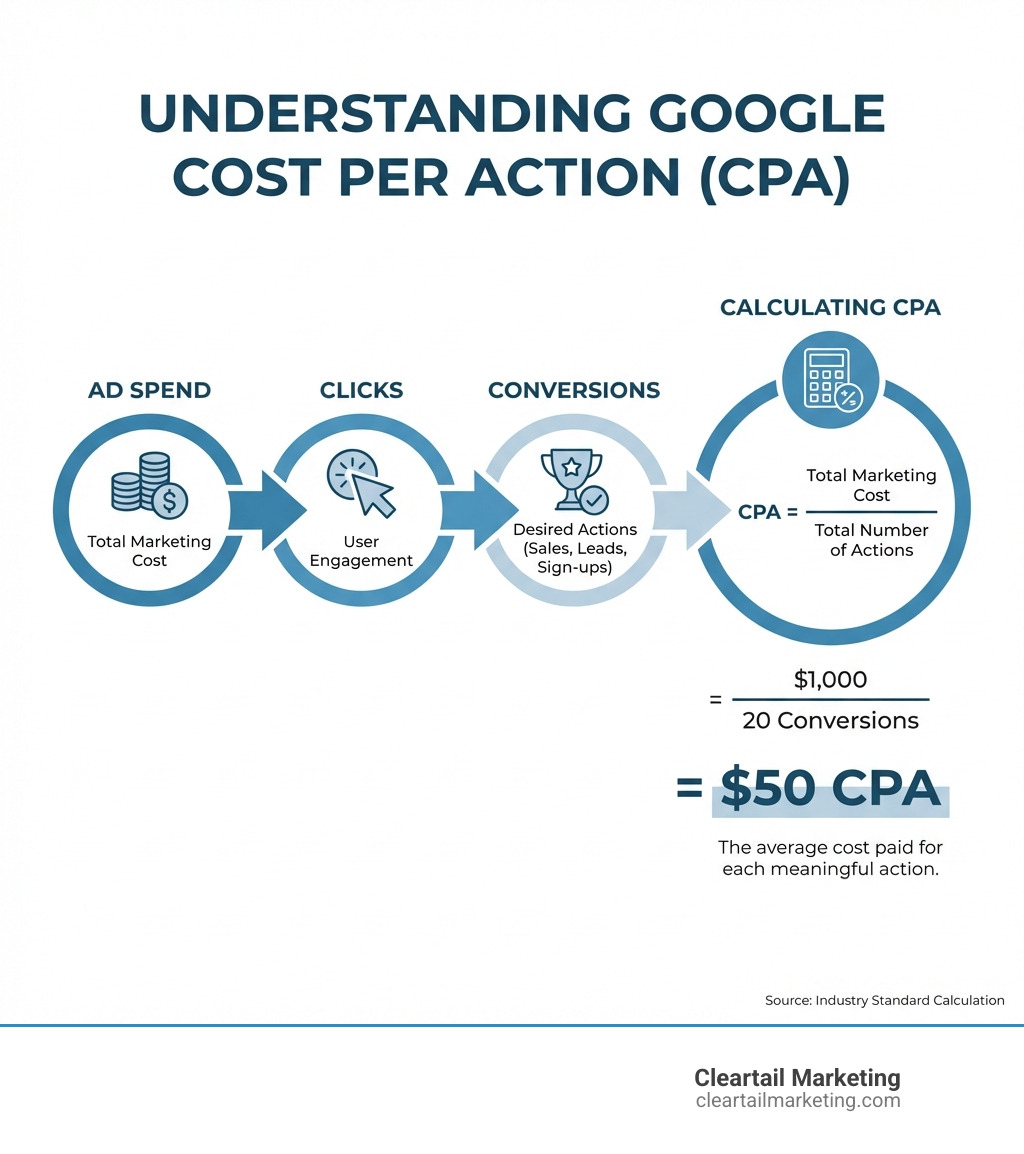
The calculation for google cost per action is wonderfully straightforward: divide your total marketing cost by the number of actions (conversions).
CPA = MC / A
Where:
- CPA is your Cost Per Action
- MC is your total Marketing Cost (or total ad spend)
- A is the number of Actions (or conversions)

For example, if you spent $1,000 on a campaign that resulted in 20 purchases, your CPA would be $50 ($1,000 / 20). This means it cost you $50 to acquire one customer through that campaign.
Common “Actions” in CPA
The “action” in CPA is versatile and depends on your business goals. Common actions we track for clients include:
- Sales or Purchases
- Lead Form Submissions
- Newsletter Sign-ups
- App Downloads
- Phone Calls
- Content Downloads (e.g., whitepapers, e-books)
- Registrations for events or webinars
The Critical Role of Conversion Tracking
Without accurate conversion tracking, your CPA calculations are just guesswork. It’s an absolutely essential component for understanding your true ROI. Conversion tracking allows you to see what happens after a customer clicks your ad.
Setting up tracking in Google Ads involves placing a code snippet (“tag”) on your website that fires when a desired action occurs. You can also import goals from Google Analytics for a more holistic view. Accurate tracking ensures the “A” in your CPA formula is reliable, which is paramount for making informed decisions. At Cleartail Marketing, robust conversion tracking is a non-negotiable first step in all our Google Ads Management services.
CPA vs. Other Key Metrics: CPC, CPL, and CAC
In digital marketing, it’s crucial to understand how CPA relates to other metrics like CPC, CPL, and CAC. Each offers a different lens through which to view campaign performance at various stages of the customer journey, from initial engagement (CPC) to final customer acquisition (CAC). While driving traffic is important, we ultimately prioritize cost-effective actions that lead to profit. For a deeper dive into click-based metrics, check out our guide on Cost Per Click And Pay Per Click.
Here’s a quick comparison:
| Metric | Definition | What it Measures | When to Use It | Example |
|---|---|---|---|---|
| CPC | Cost Per Click | Cost to get a user to click your ad | Driving traffic, brand awareness, initial engagement | $0.50 per click |
| CPL | Cost Per Lead | Cost to acquire a prospect’s contact info (e.g., email, phone) | Lead generation for sales teams, building marketing lists | $20 per lead |
| CPA | Cost Per Action | Cost to get a user to complete a desired action (e.g., purchase, signup) | Measuring direct campaign profitability, optimizing for conversions | $50 per purchase |
| CAC | Customer Acquisition Cost | Total cost to acquire a new paying customer (across all sales & marketing) | Holistic business health, long-term strategic planning | $150 per new customer |
Cost Per Action (CPA) vs. Cost Per Click (CPC)
The key difference is what you’re paying for. Cost Per Click (CPC) is the price of traffic—you pay each time someone clicks your ad. With CPA, you’re paying for results—a completed action with direct business value. A low CPC is good, but it doesn’t guarantee profitability if those clicks don’t convert. CPA focuses on the ultimate goal, not just the initial click. Learn more in our article What Is A CPC?.
Cost Per Action (CPA) vs. Cost Per Lead (CPL)
This distinction is vital for businesses with longer sales cycles. Cost Per Lead (CPL) measures the cost to acquire a prospect’s contact information. CPA, in this context, often refers to the cost of turning that prospect into a paying customer. CPL measures the efficiency of your lead generation, while CPA tells you the ultimate cost to close a deal. A low CPL is only valuable if those leads convert at a profitable CPA.
Cost Per Action (CPA) vs. Customer Acquisition Cost (CAC)
While related, these are not the same. CPA is a tactical, campaign-level metric (e.g., the cost per sale from a specific Google Ads campaign). CAC (Customer Acquisition Cost) is a strategic, business-level metric that includes all sales and marketing costs (ad spend, salaries, software, etc.) divided by the number of new customers. CPA helps optimize individual campaigns, while CAC provides a broader view of your business’s growth sustainability.
Understanding and Benchmarking Your Google Cost Per Action
Knowing your google cost per action is paramount for profitability. A “good” CPA isn’t a universal number; it’s tied to your business economics, including profit margins and Customer Lifetime Value (LTV). If a customer brings in $500 in revenue over their lifetime, you can afford a higher CPA than if they only bring in $50. A healthy business often aims for an LTV:CPA ratio of 3:1 or higher to ensure sustainable growth and a strong Return on Investment (ROI).
Average Google Cost Per Action by Industry
While your ideal CPA is unique, industry benchmarks provide valuable context. They help you understand what’s typical and identify areas for improvement. Across all industries, the average CPA for Search Ads is around $45.27, while for Display Ads, it’s approximately $65.80. However, these figures vary dramatically by industry.
Highly competitive industries like legal or finance often have much higher CPAs. Always use your own business model and profit margins as the primary guide for evaluating your CPA.
How Quality Score Directly Impacts Your Google CPA
If there’s a secret sauce to lowering your google cost per action, it’s your Quality Score. This metric reflects the relevance and usefulness of your ads, and it directly influences your costs. It’s based on:
- Expected Click-Through Rate (CTR)
- Ad Relevance
- Landing Page Experience
The relationship is profound: for each point your Quality Score is above the average of 5, your CPA can drop by about 16%. A higher Quality Score is like getting a discount from Google, leading to lower CPCs and a lower overall CPA. This is why our PPC Advertising Management efforts constantly focus on improving these components for our clients.
Mastering the Target CPA Bidding Strategy
Target CPA bidding is a powerful automated strategy in Google Ads that uses machine learning to optimize for conversions. According to Google’s official documentation, you tell Google your desired average CPA, and its algorithms work to get as many conversions as possible at or below that target. The system uses historical data and real-time signals (like device, location, and time of day) to find the optimal bid for each auction. Using automated strategies like Target CPA is a key part of modern PPC Campaign Marketing, allowing us to optimize at a scale manual bidding can’t match.
When to Use Target CPA Bidding
Target CPA is powerful but not for every situation. It works best when:
- You have accurate conversion tracking. This is non-negotiable.
- You have sufficient conversion history. Many advertisers see better performance with at least 15-30 conversions in the last 30 days.
- Your campaigns are stable with a consistent conversion rate.
It’s not ideal if you sell products with widely different values (Target ROAS can be a better option in those cases) or if your campaign is brand new with no conversion data.
Best Practices for Setting and Managing Target CPA
- Set Realistic Goals: Base your target on historical performance. Start near your current average CPA and adjust gradually.
- Respect the Learning Phase: The algorithm needs about seven days to learn. Avoid making major changes during this time, as it can reset the process.
- Use Portfolio Strategies: Group campaigns to apply a single Target CPA and gain more control with optional bid limits, a strategy we use in our Pay Per Click Advertising Management Services.
- Monitor “Average Target CPA”: This metric shows the actual traffic-weighted average CPA your strategy optimized for, which is a more accurate reflection of performance.
Pros and Cons of Target CPA
Pros:
- Time-Saving: Automates bid management, freeing you up for strategy.
- Auction-Time Optimization: Uses real-time signals for precise bidding.
- Maximizes Conversions: Aims to get the most conversions at your target cost.
Cons:
- Less Manual Control: You relinquish direct control over individual bids.
- Requires Data: Needs significant conversion history to work well.
- Can Reduce Traffic: An overly aggressive (low) target can starve your campaign of impressions and clicks.
- Ignores Conversion Value: Optimizes for the number of conversions, not their monetary value.
Proven Strategies to Lower Your Google Ads CPA
Lowering your google cost per action is an ongoing process of optimization that requires constant testing and refinement. The goal is to improve efficiency and maximize your ad spend, ensuring every dollar works harder to drive profitable actions. This dedication to optimization is central to our PPC Advertising Management philosophy.
7 Actionable Ways to Reduce Your CPA
Here are seven proven strategies we implement to lower Google Ads CPA:
- Improve Quality Score: Focus on making your ads and landing pages highly relevant to your keywords. This leads to lower CPCs and directly impacts your CPA.
- Optimize Landing Pages for Conversions: A fast, mobile-friendly landing page with a clear call-to-action (CTA) will convert more visitors, lowering your CPA. Our Landing Page Optimization services focus on exactly this.
- Refine Keyword Targeting & Use Negative Keywords: Review your search terms report to add irrelevant queries as negative keywords. Focus your budget on high-intent keywords that convert.
- A/B Test Ad Copy and Creative: Test different headlines and descriptions to find what resonates with your audience, leading to higher click-through and conversion rates.
- Improve Audience Targeting: Use Google’s audience options (in-market, custom intent, remarketing) to show ads to people who are more likely to convert.
- Leverage Ads Retargeting Campaigns: Show ads to people who have already visited your site. These “warm” audiences often have a much lower CPA.
- Adjust Bids and Budgets Based on Performance: Shift your budget from underperforming campaigns to your top performers to ensure your ad spend is allocated efficiently.
Frequently Asked Questions about Google Cost Per Action
We often get questions from clients about optimizing their google cost per action. Here are some of the most common ones:
What is a good CPA for Google Ads?
There is no single magic number. A “good” CPA is one that is profitable and sustainable for your business. It depends entirely on your profit margins and Customer Lifetime Value (LTV). A healthy goal is to have an LTV at least three times your CPA (LTV:CPA ratio of 3:1). While industry benchmarks exist (e.g., an average of $45.27 for Search Ads), your own business economics are the most important guide.
How long does the Target CPA learning phase last?
The learning phase typically lasts about seven days. During this time, Google’s algorithm gathers data to optimize its bidding. It’s normal to see performance fluctuate. It is crucial to avoid making significant campaign changes during this period, as this can reset the learning process.
Can I use Target CPA for a brand new campaign?
We do not recommend using Target CPA for a brand new campaign. The strategy relies on historical conversion data to work effectively. A new campaign has no data, so the algorithm will struggle. It’s better to start with Manual CPC or Maximize Clicks to gather at least 15–30 conversions over 30 days before switching to Target CPA. This provides the data foundation needed for the strategy to succeed.
Conclusion
Understanding and optimizing your google cost per action is not just about saving money; it’s about making your advertising truly effective and profitable. CPA is a direct measure of your marketing efficiency, telling you how much you’re truly paying for the results that matter most to your business.
From accurately calculating CPA and setting up robust conversion tracking to leveraging the power of Quality Score and mastering the Target CPA bidding strategy, every step you take towards optimization contributes to a healthier bottom line. It’s a continuous journey of testing, refining, and adapting to ensure your ad spend generates the best possible return.
At Cleartail Marketing, we pride ourselves on helping businesses like yours steer the complexities of Google Ads, focusing on strategies that reduce CPA and maximize profitability. We believe that with the right expertise and a data-driven approach, your Google Ads campaigns can deliver exceptional results.
Ready to take control of your Google Ads costs and drive more profitable actions? Learn more about how much Google Ads should cost or reach out to us today to see how our team can help you achieve your advertising goals.
