



Why Your Online Reputation Determines Your Business Success
Reputation management tips are essential for any business owner who wants to control their brand’s digital narrative. In today’s hyper-connected world, your online reputation is the first impression potential customers have of your business, formed in less than a second.
Quick Reputation Management Tips:
- Monitor regularly – Set up Google Alerts for your brand name
- Respond to all reviews – Both positive and negative within 24-48 hours
- Encourage positive reviews – Ask satisfied customers (70% will review when asked)
- Optimize your Google Business Profile – Complete all sections and post weekly
- Create positive content – Use SEO to push down negative results
- Train your team – Ensure consistent, professional responses
- Have a crisis plan – Prepare for reputation emergencies
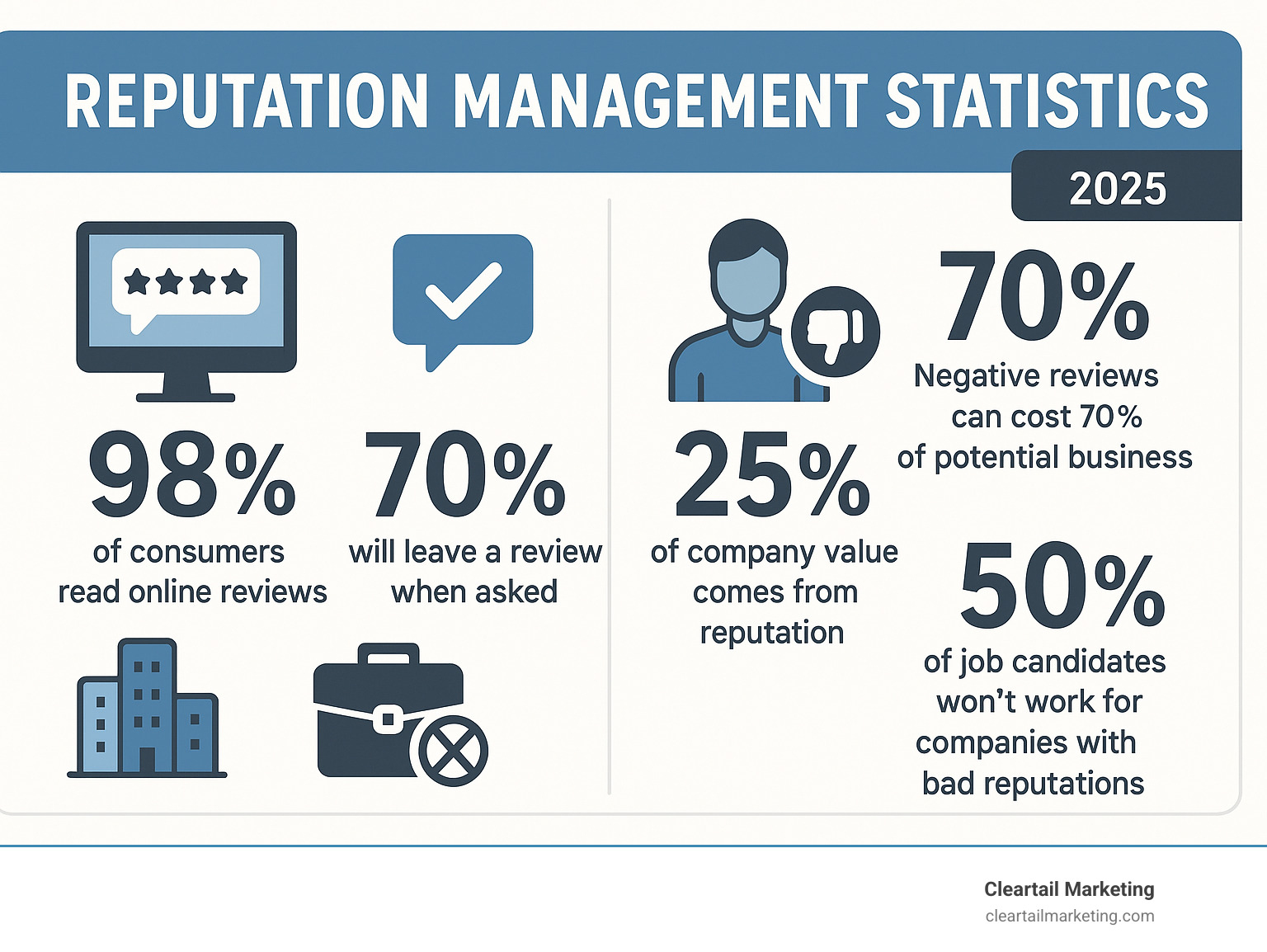
The stakes are high: 98% of consumers read online reviews before visiting a business, and four negative search results can cost you almost 70% of potential customers. Furthermore, 25% of your company’s market value comes directly from your reputation.
The good news is that reputation management is more than damage control. When done right, it’s a growth engine that increases customer trust, conversion rates, and competitive positioning.
The challenge for most business owners is that reputation management feels overwhelming. Monitoring review sites, crafting responses, and creating content can feel like navigating digital noise.
I’m Magee Clegg, founder of Cleartail Marketing. Over the past decade, I’ve helped 90+ businesses implement effective reputation management tips that drive real results, like generating 170 five-star reviews in two weeks for one client. My experience shows that success combines proactive relationship-building with smart reactive strategies.
Reputation management tips further reading:
Proactive Strategies: Building a Foundation of Trust
The smartest reputation management tips focus on building trust before you need it. Think of it as maintaining your health—it’s easier to stay in shape than to recover from illness. Investing in proactive strategies creates a protective shield around your brand that can weather any storm.

How to Encourage Positive Reviews and Testimonials
Here’s a secret: most happy customers want to help you succeed, they just don’t know how. A simple review request system for a local restaurant client took them from 12 to over 180 reviews in three months. The key was making it effortless for customers.
The most powerful strategy is simple: just ask. Search Engine Land reports that 70% of customers will leave a review when asked, yet most businesses don’t. Use a friendly in-person ask, a follow-up email, or a QR code on your receipt; timing and sincerity are key.
But asking is only half the battle. You need to make it incredibly easy for customers to leave reviews. Provide direct links to your preferred platforms, whether that’s Google Business Profile, Yelp, Facebook, or industry-specific sites like TripAdvisor or Healthgrades.
Once you start receiving positive feedback, showcase it everywhere. Feature testimonials on your website, share them on social media, and include them in marketing materials. This creates a powerful cycle—when potential customers see others praising your business, they’re more likely to become customers.
Customers who consistently rave about your business become your brand advocates. Nurture these relationships with exclusive perks, early access to new products, or personal thank-you notes. These loyal fans will become your most authentic marketing team.
Our Customer Feedback Management Service helps businesses streamline this entire process, making review generation feel natural rather than pushy.
Leveraging Social Media and Content
Social media is where your brand’s personality shines. It’s not about posting pictures, but building genuine relationships. Successful businesses understand that social media is a conversation, not a billboard.
Consistent brand voice across all platforms builds trust and recognition. Whether you’re on LinkedIn, Instagram, or Facebook, your tone and style should feel unmistakably yours. This consistency helps customers feel like they know your business.
Engaging with followers is non-negotiable. Respond quickly and authentically to comments and questions. Since 73% of users will choose a competitor if a brand fails to respond, active engagement is crucial for building customer loyalty.
User-generated content is pure gold for reputation building. Encourage customers to share photos or stories featuring your products. Create branded hashtags and feature customer content on your own channels. This authentic content carries more weight than traditional advertising.
Thought leadership through valuable content positions your business as an expert. Share insights, tips, and industry news that genuinely helps your audience. When you consistently provide value, people see your business as trustworthy.
SEO-optimized blog posts drive organic traffic while helping control your brand’s narrative in search results. By creating helpful, relevant content, you’re building authority and pushing positive information higher in search rankings.
Our Online Reputation Social Media services help businesses build an authentic, engaging online presence that attracts positive attention.
The Role of Employees and Company Culture
Your employees are your reputation’s secret weapon. As the daily representatives of your brand, their genuine happiness and engagement show in every customer interaction.
Employee satisfaction directly impacts customer experience. Happy employees provide better service and naturally speak positively about your company. This positive energy is contagious and influences customer perception.
Internal feedback systems help you address issues before they become public. Employee surveys, suggestion boxes, and open-door policies create a culture where problems get solved internally rather than aired on review sites.
Your employer branding affects more than just hiring. Glassdoor research shows 50% of candidates won’t work for a company with a bad reputation, even for more money. When potential employees see negative reviews about your workplace, it raises red flags for customers too.
Employee advocacy programs turn your team into authentic brand ambassadors. When employees share company news or positive workplace experiences on their personal social media, it carries incredible credibility.
Effective reputation management tips recognize that great reputations start from within. Investing in your company culture and treating employees well creates positive energy that radiates to every customer.
Our Corporate Reputation Management approach always begins with strengthening internal culture, because authentic positive reputations can’t be faked.
Reactive Strategies: Managing Feedback and Crises
No matter how perfect your proactive strategy, negative feedback is inevitable. You can’t control it, but you can prepare for it. The real test of your brand is how you handle challenges when they arrive.
The good news? These moments can strengthen your reputation when you respond thoughtfully. I’ve seen businesses turn their harshest critics into loyal advocates simply by showing they care enough to make things right.

Essential Reputation Management Tips for Responding to Negative Reviews
Surprisingly, negative reviews can boost your credibility. Customers are skeptical of perfect five-star ratings. A few well-handled negative reviews show you’re real and committed to improvement.
The challenge is that consumers are 21% more likely to leave a review after a negative experience than a positive one. This means we need to be extra prepared.
Speed matters more than perfection. While 53.3% of customers expect responses within seven days, nearly 75% expect social media responses within 24 hours. Your quick response shows you’re paying attention.
When crafting your response, acknowledge their experience without getting defensive. Even if you disagree, validate their feelings. A simple “I’m sorry you had this experience” goes much further than explaining why they’re wrong.
Offer concrete solutions whenever possible. Don’t just apologize—tell them what you’re doing about it. This shows accountability and gives other potential customers confidence that you’ll take care of them.
For complex issues, take the conversation offline. Provide your phone number or email and invite them to discuss the matter privately. This prevents a public back-and-forth while showing you’re serious about resolving their concern.
Remember these essential reputation management tips for review responses: be professional and personal, respond to all reviews, acknowledge specific points, and never share private customer information. Don’t ignore negative feedback—it’s like hanging up on a customer with a problem.
Our How to Manage Your Online Reputation guide walks you through exactly how to craft these responses.
Handling Positive Feedback and Press
Positive reviews deserve just as much attention as negative ones, yet many businesses treat them as afterthoughts. This is a missed opportunity to strengthen relationships.
Thank every customer who takes time to write a positive review. It takes effort to leave feedback, and acknowledging that effort encourages more of the same. A genuine “Thank you for taking the time to share this!” shows appreciation.
When responding to positive reviews, reinforce what led to their great experience. If they praised your fast delivery, mention how your team works hard to get orders out quickly. This helps potential customers understand what to expect.
Share positive press coverage across all your channels. When a local newspaper or industry blog features your business, amplify that coverage. It validates your brand and extends your reach.
Building relationships with journalists and bloggers pays dividends. Engage authentically with media professionals by providing helpful information and being a reliable source. This investment often leads to more positive coverage.
This proactive approach to positive reinforcement forms the foundation of effective Positive Reputation Management.
Preparing for a PR Crisis
Hoping to avoid a PR crisis isn’t a strategy. Crises like product recalls, viral employee posts, or service mishaps can strike any business at any time.
The companies that weather these storms best aren’t those that avoid problems—they’re the ones who prepare before problems arise.
Develop your crisis communication plan when thinking is clear. This plan should outline potential scenarios, identify communication channels, and establish who approves messaging before it goes public.
Designate a spokesperson before you need one. This person becomes the official voice of your company during challenging times, ensuring consistent messaging.
Pre-draft template messages for various crisis scenarios. While you’ll need to customize details, having a framework saves precious time when emotions are high.
During a crisis, intensify your social media monitoring. Misinformation spreads fast, so you need to identify and address false narratives quickly.
After the crisis passes, conduct a thorough post-crisis analysis. What worked? What could you improve? These insights help you refine your approach for the future.
Our Business Reputation Crisis Management services can help you build this crucial foundation. If you’re already facing challenges, our Business Reputation Repair Services can help.
Advanced Reputation Management Tips: SEO, Monitoring, and Measurement
Beyond proactive and reactive basics, advanced reputation management tips leverage technology and data. This transforms reputation management from a necessity into a strategic advantage that drives business growth.

The Connection Between Reputation and SEO
Many business owners are surprised to learn that online reputation and search engine rankings are deeply connected. Google wants to show users the most trustworthy businesses, so companies with stellar reputations tend to rank higher.
Review signals have become a crucial ranking factor for local businesses. According to Moz, review signals are among the top local search factors Google considers. The quantity, quality, and freshness of your reviews help determine where you appear in results. Products with three- or four-star ratings generate three times more sales than those with one-star ratings.
Your Google Business Profile optimization plays a massive role here. This isn’t just about filling out your business information. It’s about actively managing your profile: responding to reviews, posting updates, adding photos, and keeping information current. Our Google My Business Reputation Management guide walks you through optimizing every element.
When negative content appears high in search results, suppressing negative search results becomes essential. We use strategic content creation and SEO to push down unfavorable content by creating a wealth of positive, high-quality content that ranks higher.
The key is creating positive content consistently. Regular blog posts, press releases, and customer success stories help establish your authority and ensure positive information dominates your search results. When someone googles your business, you want them to find glowing reviews and helpful articles.
Tools and Metrics for Monitoring Your Reputation
You can’t improve what you don’t measure. Effective reputation management tips rely on the right tools and metrics, many of which are free or reasonably priced.
Google Alerts is one of the most valuable free tools. Set up alerts for your business name, key executives, and industry terms. You’ll get email notifications whenever these terms appear online, giving you an early warning system.
For more comprehensive monitoring, social listening platforms like Sprout Social, Mention, or Hootsuite track mentions across social media, forums, and blogs in real-time. These tools provide sentiment analysis, helping you understand how people feel about your brand.
Review management platforms such as Yext, Podium, or Birdeye centralize reviews from multiple platforms into one dashboard, so you can monitor and respond from one place.
The metrics that matter most include sentiment analysis—the overall tone of online conversations about your brand. Your Net Promoter Score (NPS) measures customer loyalty. Share of voice compares your brand’s mentions relative to competitors.
Don’t forget to track your response rate and response time to reviews. Quick, consistent responses show you’re engaged. Finally, measure how your reputation efforts impact your conversion rates—a better reputation should translate to more sales.
Learning from Competitors and Industry Trends
Don’t operate in a vacuum. Valuable reputation management tips come from studying what others in your industry are doing—both right and wrong.
Analyzing competitor reviews reveals goldmines of insight. What are customers praising about your competitors? What complaints keep appearing? These patterns show you where to focus your improvement efforts and how to differentiate your business.
Benchmarking your reputation against industry leaders and competitors helps set realistic goals. Compare your sentiment scores, review volume, and response times to identify specific areas for improvement.
Industry best practices vary significantly. What works for restaurants might not work for financial services. Companies in specialized fields like Reputation Management for Insurance or Reputation Management for Financial Advisors need custom approaches.
Staying ahead of emerging trends can give you a competitive edge. New social media platforms and review sites appear regularly. Being an early adopter often means less competition and more engaged audiences.
At Cleartail Marketing, we help businesses implement these advanced strategies through our comprehensive Online Reputation Management Services. The combination of smart monitoring, strategic SEO, and competitive intelligence creates a system that doesn’t just protect your brand—it actively drives growth.
Frequently Asked Questions about Online Reputation Management
After working with 90+ businesses over the past decade, I’ve heard these questions countless times. Let me share the honest answers that will help you make informed decisions about your brand’s digital future.
How long does it take to repair a bad online reputation?
There’s no magic number for reputation repair. The timeline depends on the severity of the damage and the consistency of your efforts.
Timeframe depends on several key factors. A handful of negative reviews can often show improvement within 3-6 months with dedicated effort. A viral social media disaster or widespread negative press can take 12-18 months or longer to fully recover from.
The severity of damage matters tremendously. I’ve seen businesses bounce back from isolated incidents quickly, while others dealing with systemic issues or legal troubles face much longer roads to recovery.
Consistency of effort is everything. Sporadic attempts won’t yield results. Businesses that commit to daily monitoring, regular positive content creation, and prompt responses see meaningful progress much faster.
Remember: proactive strategies build lasting change, while reactive ones just stop the bleeding. Containing immediate damage is quick, but building genuine trust takes sustained effort over months.
The silver lining? Most businesses see positive momentum within the first quarter of consistent effort. For comprehensive guidance, explore our Clean Up Online Reputation resources.
Can I remove a negative review?
This is a common question. While the first instinct is to remove a scathing review, the answer is usually no—and that’s often for the best.
Platform policies protect review authenticity. Google, Yelp, and other major review sites have strict policies against businesses removing reviews simply because they are negative. Their value depends on authentic, unfiltered feedback.
However, there are exceptions where removal is possible. You can flag inappropriate content that violates platform guidelines, such as hate speech, personal attacks, spam, or fake content. I’ve successfully helped clients get truly abusive or fraudulent reviews removed by documenting policy violations.
Legal options exist for defamation, but they’re expensive and time-consuming. It’s often more cost-effective to focus on generating positive reviews that overshadow the negative ones.
My honest advice: stop trying to remove negative reviews and start focusing on generating positive ones. When you have 50 five-star reviews, one angry rant becomes background noise. Plus, responding professionally often impresses potential customers more than a perfect score.
How much does reputation management cost?
Reputation management costs vary widely, much like car prices, depending on your specific needs.
Cost factors vary dramatically. Basic monitoring tools and DIY approaches might run $50-200 monthly, while comprehensive agency services can range from $1,000 to $10,000+ per month for enterprise-level or crisis situations.
The scope of services drives pricing. Simple review monitoring costs less than full-scale crisis management, SEO, content creation, and social media management. Maintaining a strong reputation requires less investment than recovering from a major crisis.
In-house versus agency costs differ significantly. An internal team may lack the specialized tools and crisis experience that agencies provide. Most businesses find that agencies deliver better results more efficiently.
I encourage clients to think about ROI considerations rather than just upfront costs. A strong online reputation directly impacts conversion rates, customer acquisition, and pricing power. We’ve seen clients increase revenue by 20-30% through effective reputation management, making it a high-return investment.
For detailed pricing breakdowns, check out our guide on How Much Does Reputation Management Cost?.
Reputation management is an investment in your business’s future, not just an expense. The cost of inaction is almost always higher than the cost of taking action.
Take Control of Your Brand’s Digital Narrative
Your online reputation is your business’s digital heartbeat. Every review, mention, and search result shapes customer perception before they even visit your site. The reputation management tips we’ve explored are practical tools that can transform your business.
Consider that 98% of consumers read online reviews, and a few negative results can cost you 70% of potential customers. But we’ve also seen how businesses that actively manage their reputation see increased trust, higher conversion rates, and stronger competitive positioning.
The beauty of effective reputation management is its dual nature. Proactive strategies like encouraging positive reviews and building authentic social media relationships create a strong foundation of trust. Meanwhile, reactive approaches—responding thoughtfully to feedback and having crisis plans ready—protect that foundation.
This isn’t a one-time fix. Reputation management tips work best as part of your daily business rhythm. This means consistently delivering excellent customer experiences, engaging your community, and addressing concerns with empathy.
Advanced strategies—leveraging SEO to control your search narrative, using monitoring tools, and learning from competitors—turn reputation management from a defensive necessity into a competitive advantage.
At Cleartail Marketing, we’ve guided over 90 businesses through this journey. We’ve seen how the right approach doesn’t just protect your brand—it becomes a powerful engine for growth and customer loyalty.
Your brand’s digital story is being written every day. The question is: will you be the author, or just a character in someone else’s narrative?
For a comprehensive strategy custom specifically to your business needs and industry, explore our Reputation Management services. Let’s work together to ensure your online reputation becomes your strongest business asset.
