


Why CPC Per Click Is the Metric Every Ad Budget Depends On
CPC per click — short for cost per click — is the amount you pay each time someone clicks on your ad. It’s the core pricing model behind most paid digital advertising.
Here’s a quick breakdown:
| Term | What It Means |
|---|---|
| CPC | Cost Per Click — you pay only when someone clicks your ad |
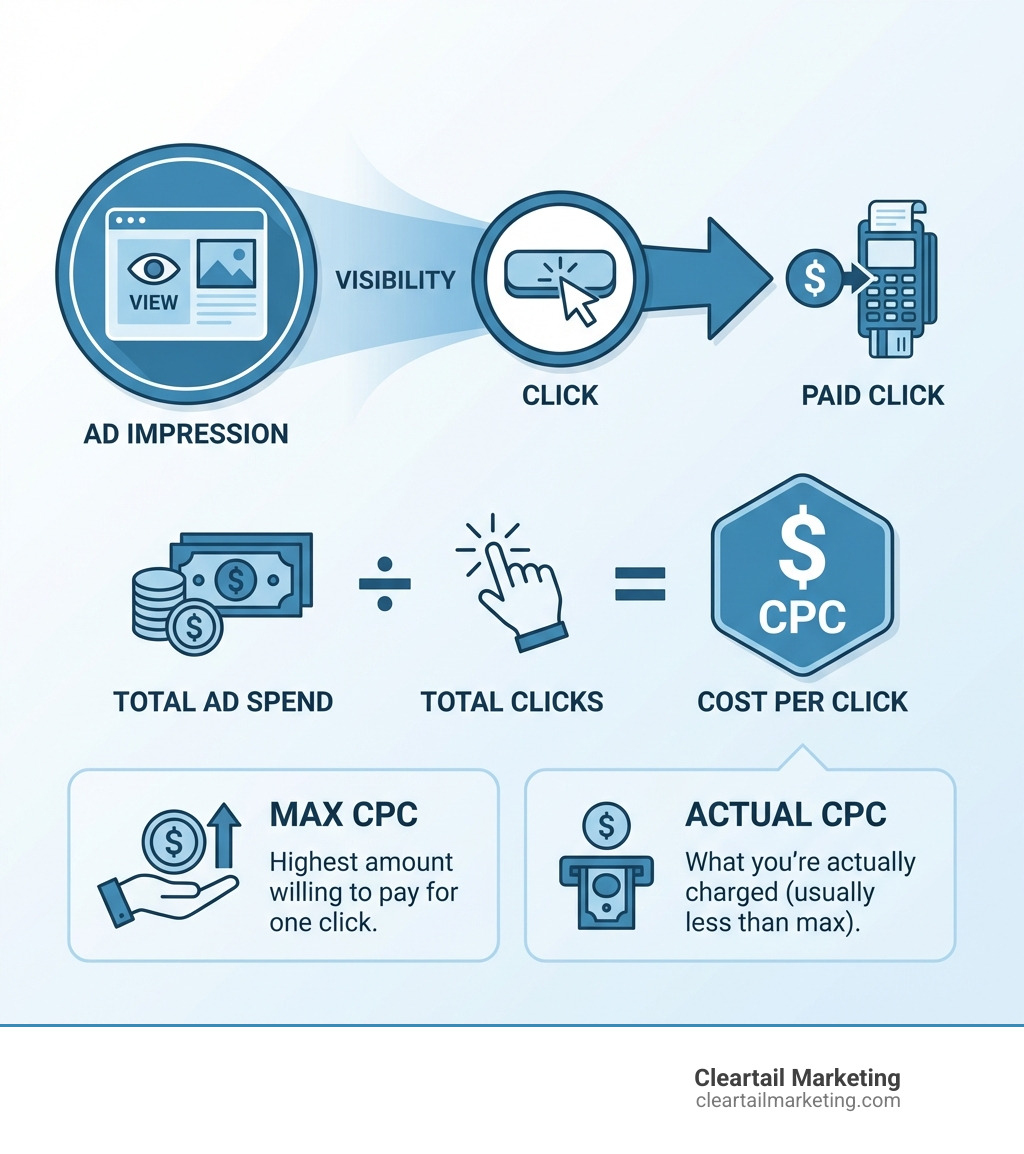
| Max CPC | The highest amount you’re willing to pay for one click |
| Actual CPC | What you’re actually charged — usually less than your max |
| Formula | Total Ad Spend ÷ Total Clicks = CPC |
Example: If you spend $500 and get 250 clicks, your CPC is $2.00.
CPC is also called pay-per-click (PPC). You don’t pay for people who simply see your ad — only for those who click it. That makes it one of the most budget-friendly and measurable models in digital advertising.
And the results can be significant. Research suggests businesses earn around $8 for every $1 spent on PPC — but only when campaigns are managed well.
I’m Magee Clegg, founder and CEO of Cleartail Marketing, and since 2014 I’ve helped B2B companies drive real growth through cost-effective strategies — including managing CPC per click campaigns that have delivered up to 5,000% ROI for our clients. In this guide, I’ll walk you through everything you need to know to make every click count.
Cpc per click terms simplified:
What is CPC Per Click and How Does It Work?
At its heart, cpc per click is a performance-based advertising model. Unlike traditional billboards or TV ads where you pay for the possibility of being seen, CPC ensures you only open your wallet when a user takes a specific action: clicking your ad.
This model is the backbone of Search Engine Marketing (SEM). When you search for “best CRM software” on Google, the results at the top labeled “Sponsored” are there because advertisers are bidding for that space. However, Google doesn’t charge them just for showing up. They only get a bill when you, the searcher, decide that their ad looks relevant enough to click on.
Understanding what is a CPC is essential for any business looking to drive direct response traffic. It works through a sophisticated auction system. Every time a search is performed, an auction happens in milliseconds. Advertisers bid on specific keywords, and the platform (like Google or Bing) decides which ads to show based on the bid amount and the quality of the ad.
For mobile app advertisers, tools like the Adjust Help Center are vital for tracking these clicks. Because you are paying for every single interaction, you need to know exactly which clicks are leading to app installs or in-app purchases. This attribution ensures that your cpc per click spend isn’t just generating traffic, but high-quality users.
Calculating Your Costs: The CPC Formula and Real-World Examples
Calculating your cpc per click is straightforward, but the implications for your bottom line are deep. The math is simple:
Total Cost / Total Clicks = Average CPC
Let’s look at some real-world scenarios to see how this plays out across different budgets:
- The Small Business Test: You spend $100 on a Facebook campaign and receive 2,000 clicks. Your average CPC is a tiny $0.05.
- The High-Growth Startup: You spend $1,750 on Reddit Ads and receive 7,000 clicks. Your CPC is $0.25.
- The Competitive Niche: You spend $600 on Google Search ads but only receive 100 clicks. Your CPC is $6.00.
While a $6.00 CPC might seem high compared to $0.05, it all comes down to the revenue tie-in. If those 100 clicks result in two sales worth $5,000 each, that $600 investment is a massive win. Understanding the average cost of pay per click advertising helps you set realistic expectations for your industry.
Industry Benchmarks: Legal vs. Real Estate
Your industry has a massive impact on what you’ll pay. According to data from LOCALiQ, the average CPC for search advertising across all industries in 2024 was $4.66. However, the gap between sectors is wide.
| Industry | Average CPC (Search) |
|---|---|
| Attorneys & Legal Services | $8.94 |
| Dental Services | $6.69 |
| Home Trade Services | $6.55 |
| Real Estate | $2.10 |
| Arts & Entertainment | $1.55 |
The reason for these discrepancies is the “value of a lead.” A law firm might earn tens of thousands of dollars from a single client, so they are willing to bid much higher than a local theater selling $20 tickets. For a deeper dive into these mechanics, check out our guide on cost per click and pay per click.
The Mechanics of Bidding: Max CPC vs. Actual CPC
One of the most common points of confusion for new advertisers is the difference between what they bid and what they pay. In Google Ads, you set a Max CPC — the absolute ceiling of what you’re willing to pay for a single click.
However, thanks to the way the ad auction works, your actual cost per click is almost always lower than your maximum bid. Think of it like eBay: if you bid $10 for an item but the next highest bidder only bids $5, you only pay enough to beat them (plus a small increment).
Understanding Your Actual CPC Per Click
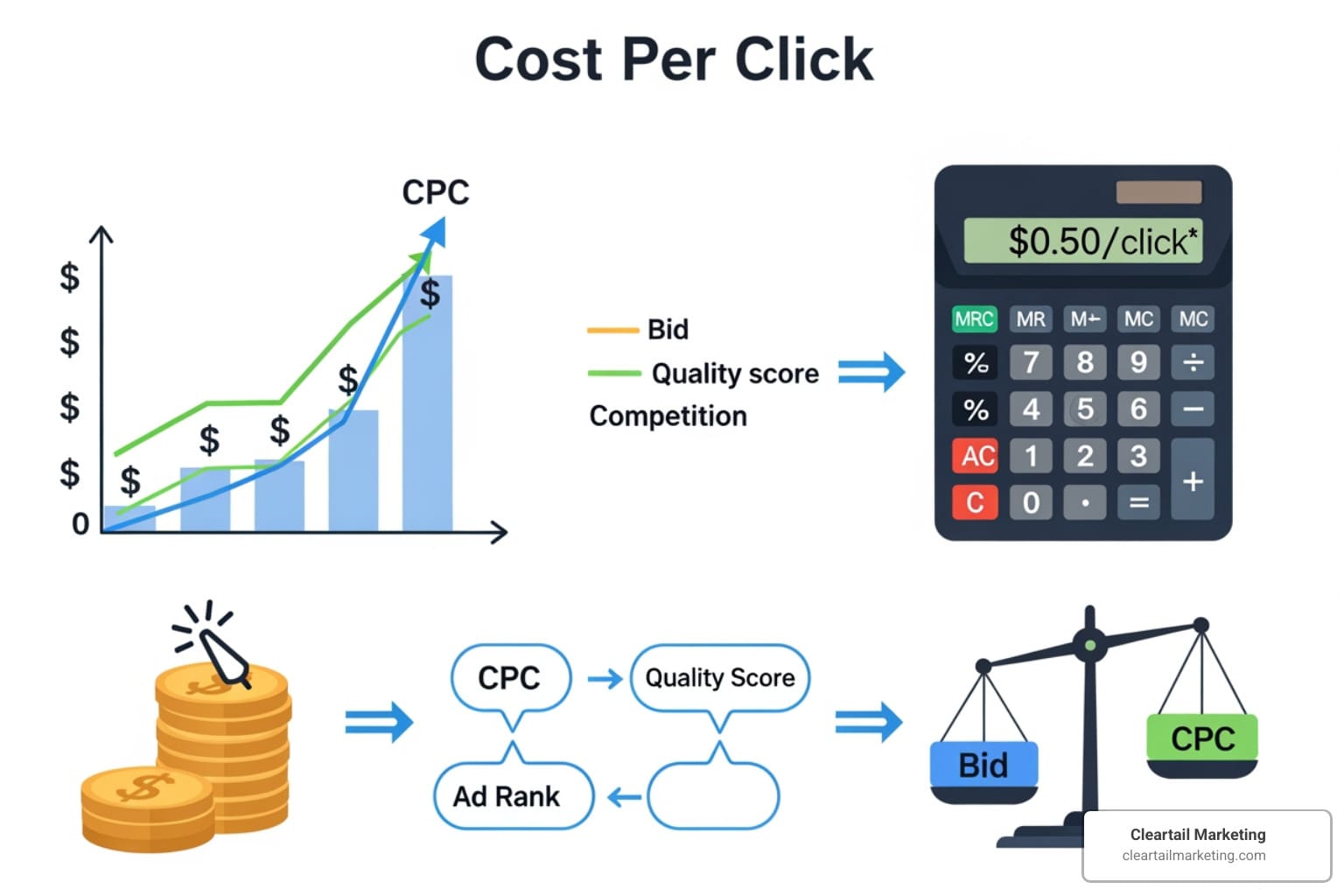
In the digital ad auction, your actual cpc per click is determined by the Ad Rank of the person below you, divided by your Quality Score, plus one cent. This means you aren’t just paying for your own bid; you’re paying to stay just ahead of your closest competitor.
If you are using manual CPC bidding, you have total control over these caps. However, if you enable features like Enhanced CPC or bid adjustments (for location or device), your actual cost might occasionally exceed your Max CPC to help you capture a high-value conversion. To understand the nuances of your bill, read our breakdown of Google Ads CPC: how much you really pay per click.
How Quality Score Impacts CPC Per Click
If there is one “secret sauce” to lowering your costs, it’s the Quality Score. Google and other platforms want to show relevant ads because it keeps users coming back. To encourage this, they reward high-quality ads with a “discount” on their cpc per click.
Quality Score is based on:
- Ad Relevance: Does your ad match the searcher’s intent?
- Landing Page Experience: Is your site fast, mobile-friendly, and relevant?
- Expected CTR: How likely are people to click your ad based on past performance?
A high Quality Score can mean you pay less than a competitor who has a higher bid but a lower-quality ad. This is the fundamental CPC meaning in modern marketing: it’s not just about who has the most money, but who provides the best experience.
Platform Benchmarks and Industry Standards
Where you choose to advertise is just as important as what you bid. Each platform has its own “vibe” and its own cost structure. Here is how the average cpc per click looks across the major players in 2024:
- Google Search: $2.69 – $5.26 (Highly intent-driven)
- YouTube: $2.32 (Great for visual storytelling)
- Facebook: $1.72 (Excellent for demographic targeting)
- TikTok: $1.00 (The go-to for younger audiences)
- LinkedIn: $5.58 (The premium for B2B decision-makers)
Interestingly, platforms like Reddit have recently revolutionized their models. During beta testing, Reddit CPC bidding reduced costs by up to 50% compared to their traditional impression-based (CPM) model. This makes it a highly attractive option for brands looking for community-led engagement without the high price tag of LinkedIn.
When evaluating how much is pay per click advertising, these are just averages. Your specific cpc per click will fluctuate based on your targeting, your timing (holiday seasons are always more expensive!), and your creative quality.
Proven Strategies to Lower Your Advertising Costs
We often tell our clients at Cleartail Marketing that you don’t always need a bigger budget; sometimes you just need a better strategy. If your pay per click charges are eating into your margins, here are the levers you can pull to lower your cpc per click:
- Improve Your Quality Score: As mentioned, this is the fastest way to get a discount from Google. Focus on making your landing pages lightning-fast and highly relevant to your keywords.
- Use Negative Keywords: This is a game-changer. By telling Google not to show your ad for certain terms (e.g., if you sell “luxury watches,” add “cheap” or “free” as negative keywords), you stop wasting money on clicks that will never convert.
- Target Long-Tail Keywords: Instead of bidding on “shoes” (which is expensive and broad), bid on “men’s waterproof trail running shoes size 11.” The volume is lower, but the cpc per click is usually cheaper and the intent is much higher.
- Geographic and Device Adjustments: If your data shows that people on iPhones in New York convert at twice the rate of people on Androids in Florida, adjust your bids! You can bid more for the high-performers and less for the low-performers.
- A/B Testing: Never settle for your first ad draft. Test two different headlines. The one with the higher click-through rate (CTR) will eventually lead to a lower ads cost per click because the platform sees it as more relevant.
Frequently Asked Questions about CPC
What is the difference between CPC and CPM?
This is the most common fork in the road for advertisers. CPC (Cost Per Click) means you pay for engagement. It is best for conversion goals, like sales or sign-ups. CPM (Cost Per Mille) means you pay for 1,000 impressions (views), regardless of whether anyone clicks.
As noted in Reddit’s advertising models, CPM is fantastic for brand awareness—getting your name out there—while CPC is for when you want people to do something. We usually recommend CPC for businesses that need to see a direct return on every dollar spent.
What is a “good” cost per click?
A “good” cpc per click is any amount that allows you to remain profitable. If you pay $10 per click but your average customer spends $1,000, that’s a great CPC. If you pay $0.50 per click but no one ever buys anything, that’s a bad CPC. Always look at your conversion rate and customer lifetime value (CLV) rather than just the raw cost of the click.
When should I use manual vs. automated CPC bidding?
- Manual Bidding: Use this when you are just starting or have a very tight budget. it gives you 100% control over your pay per click charges.
- Automated Bidding: Use this once your campaign has some data (usually 30+ conversions a month). Google’s machine learning can adjust bids in real-time based on thousands of signals (like time of day or user browser) that a human could never track manually.
Conclusion
Mastering cpc per click is the difference between an advertising campaign that feels like a “black hole” for money and one that acts as a predictable revenue engine. By understanding the relationship between your Max CPC, your Quality Score, and your actual costs, you can outsmart competitors who are simply trying to outspend you.
At Cleartail Marketing, we specialize in this kind of strategic bidding. We don’t just aim for more clicks; we aim for the right clicks that lead to real business growth in the U.S. and Canada. Whether you are struggling with high costs or just starting your first campaign, our team is dedicated to building the relationships and results your business deserves.
Ready to stop guessing and start growing? Connect with a premier PPC Ad Agency today, and let’s make your next click the one that counts.
